Event · 2500 BCE – 64 BCE · Bronze Age Collapse
Phoenicia
- Also known as
- An Fhéiníc
- Bangsa Fenisia
- Canaan
- Fenici
- Fenici
- Fenici
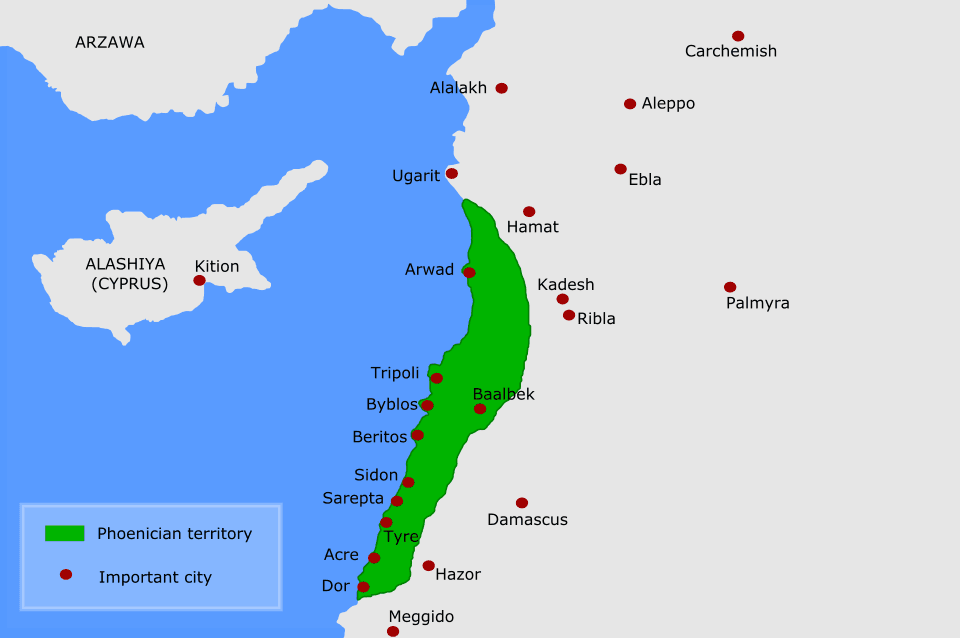
Before the Greeks named them, the people of the eastern Mediterranean coast called themselves Canaanites.
Along the narrow strip of Levantine coast where the pine-clad flanks of the Lebanon Mountains drop precipitously into the eastern Mediterranean, there was once a land of carpenters. To the pharaohs of the New Kingdom, who sent their agents north to negotiate for the tall, straight trunks of native cedarwood, these coastal dwellers were the Fenekhu. To the Greeks, who eventually arrived to trade for timber and the prized, deep-crimson dye produced there, they became the Phoinikes—the "red men," perhaps named for their sun-bronzed skins, or for the blood-red murex shells that littered their rocky beaches. Yet the people who actually built the harbors of Byblos, Sidon, and Tyre never used these names to describe themselves as a collective nation. If you had stopped a merchant on the stone quays of Berytus or Arwad in the ninth century BCE and asked him his nationality, he would not have said he was a Phoenician. He would have told you he was a Sidonian, or a Tyrian, or simply a Canaanite. They were a society of fiercely independent city-states, bound not by a shared crown or a unified border, but by a common tongue, a matching material culture, and a sudden, brilliant realization that the sea was not a barrier, but a highway.
This maritime civilization emerged directly from the Bronze Age Canaanites, maintaining a remarkable continuity of life even as the great empires around them crumbled. Sometime between 1200 and 1150 BCE, a mysterious cataclysm known to history as the Late Bronze Age collapse swept across the eastern Mediterranean. The Hittite Empire vanished; Egypt retreated into its borders; cities from Greece to the southern Levant were reduced to ash. Yet the coastal towns clustered between the Eleutherus River and Mount Carmel survived the crisis with their political independence intact. In the power vacuum that followed, these cities experienced a dramatic renaissance. With the old imperial trade monopolies shattered, the mariners of Tyre and Sidon stepped into the void. They re-established the long-distance trade routes that once connected Mesopotamia and Egypt, weaving together the fractured pieces of the ancient world. They built ships of cedar with sturdy fir planking, mastered the art of navigating by the stars, and turned the Mediterranean into a Phoenician lake.
The geography of their homeland dictated this maritime destiny. Phoenicia was a beautiful but punishingly narrow ribbon of fertile alluvium, rarely more than a few miles wide, pinned against the sea by the towering mountain passes of Galilee and Lebanon. To expand, the Phoenicians could not march inland; they had to launch outward. They preferred to build their cities on rocky offshore islands or easily defended promontories—sites like Tyre, Sidon, and Aradus, which were secure from landward attack and possessed natural bays that faced north to shelter their galleys from the prevailing winds. From these secure bases, their merchant fleets pushed westward. By the tenth century BCE, during the legendary reign of Hiram I of Tyre, Phoenician ships had established a vast mercantile network. They sailed to Cyprus, Sardinia, Sicily, Malta, and the Balearic Islands, leaving behind ports, warehouses, and markets. They went as far as the Atlantic coast of the Iberian Peninsula, bringing back silver, tin, and iron. Modern analysis of "hacksilver" found in the Levant reveals lead isotope ratios matching ores from Spain and Sardinia, physical proof of a trade network that stretched thousands of miles.
Wherever these merchants went, they carried more than just amphorae of wine, cedar logs, and purple-dyed textiles. Their most enduring legacy was an intellectual one: a highly efficient, twenty-two-letter phonetic script derived from the older Proto-Sinaitic writing system. Unlike the complex cuneiform of Mesopotamia or the hieroglyphs of Egypt, which required years of specialized scribal training, this early alphabet was simple, flexible, and perfectly suited to the rapid-fire bookkeeping of international merchants. It was an innovation born of commercial necessity, but it transformed human literacy. Adopted by the Greeks, this Phoenician script became the direct ancestor of the Latin and Cyrillic alphabets, while also shaping the development of Syriac and Arabic writing systems. Through this modest tool of trade, the thoughts, laws, and poetry of the Western world would eventually find their written form.
Despite their immense wealth and cultural reach, the Phoenician city-states were never a single empire. They were political rivals, governed by local kings and powerful oligarchies of merchant families who competed fiercely for dominance. For centuries, Sidon was the preeminent power, so much so that both the writers of the Hebrew Bible and the poet Homer used "Sidonians" as a general term for all Phoenicians. Later, Tyre rose to supreme prominence, establishing its own wealthy daughter-cities, most notably Carthage on the North African coast, which would eventually grow into an empire of its own. But this lack of political unity left the Phoenician homeland vulnerable. By the eighth century BCE, the shadow of great land empires began to fall over the Levant once more. The Neo-Assyrians, followed by the Babylonians and the Achaemenid Persians, successfully reduced the Phoenician cities to tributary states. Though these foreign masters highly valued the Phoenician fleets—often using them as the backbone of their imperial navies—the absolute autonomy of the old city-states was gone.
The independence of Phoenicia finally dissolved into the wider Mediterranean world during the conquests of Alexander the Great and the subsequent Hellenistic era, culminating in 64 BCE when the region was formally annexed as a Roman province. Because they wrote primarily on perishable papyrus and parchment, almost nothing of their native literature, histories, or philosophy survived the damp coastal climate or the fires of ancient conquests. For centuries, they were a "lost" civilization, known only through the biased accounts of their rivals—the Greeks, the Romans, and the Hebrews—who often portrayed them merely as cunning merchants or hostile neighbors. It was only in the seventeenth and eighteenth centuries, with the discovery of long-ignored stone inscriptions, and the subsequent archaeological excavations of the twentieth century, that the true dimensions of their world were recovered. What emerged was the portrait of a people who, without armies of conquest, reshaped the ancient world through the quiet, persistent work of trade, leaving an indelible mark on the languages we speak and the routes we still travel.
Connected to
- containsUgarit6k BCE
+ 4 further connections to entries not yet ingested