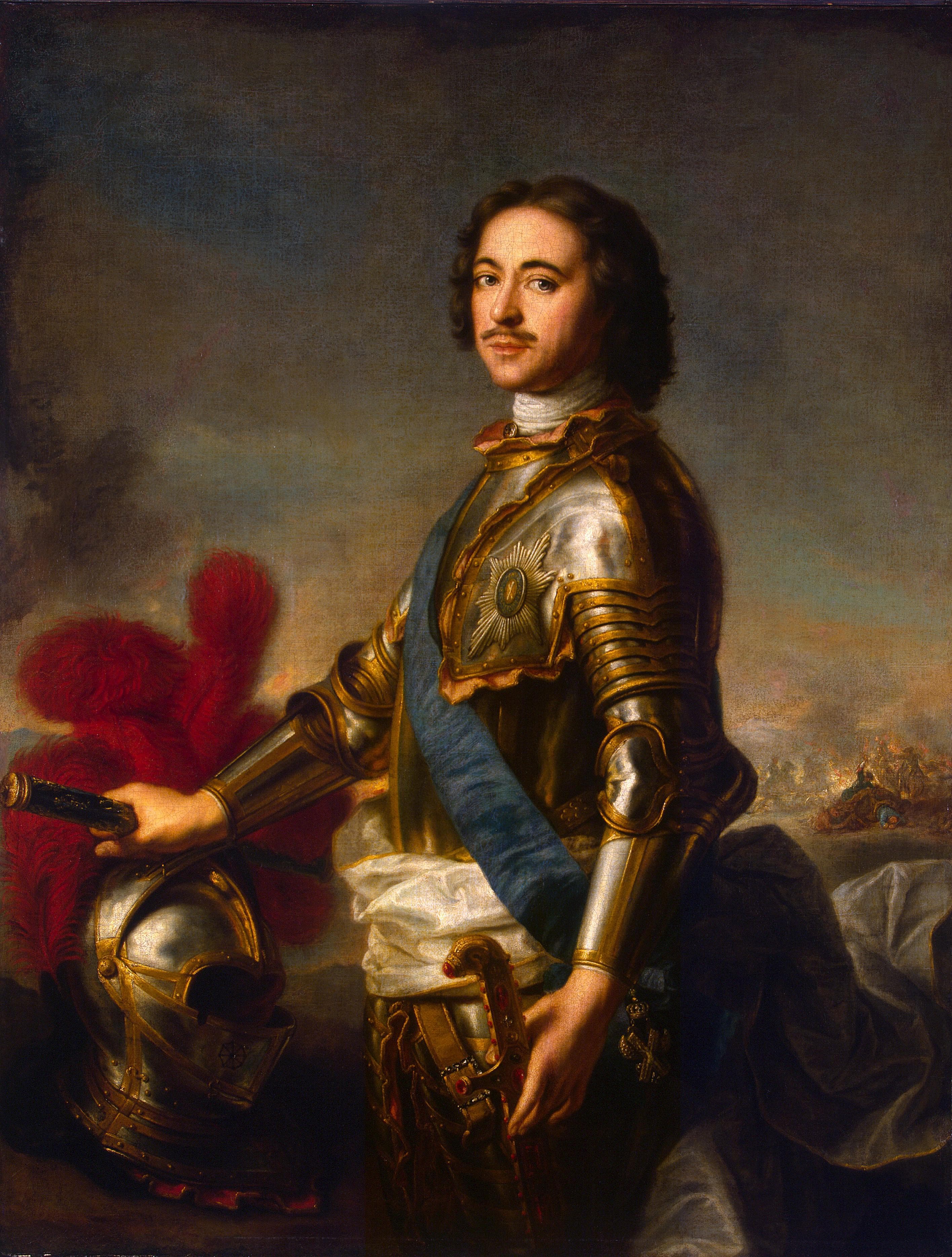
The transformation of Russia from an isolated, medieval tsardom into a formidable global empire was largely the work of one restless, towering autocrat.
In the spring of 1682, a ten-year-old boy stood on a wooden balcony in the Moscow Kremlin and watched his world tear itself apart. This was Peter, the younger son of the late Tsar Alexis. Following the sudden death of Peter’s childless half-brother, Feodor III, a vicious succession crisis erupted between two rival boyar clans: the Miloslavskys, representing the old, blind, and weak-minded Prince Ivan, and the Naryshkins, representing the young, robust Peter. Urged on by Peter’s ambitious half-sister Sophia, the streltsy—Russia’s elite, ultra-traditionalist military corps—revolted. Armed with halberds and muskets, they stormed the palace, dragging Peter’s mentors, friends, and maternal uncles from the state apartments to be butchered on the spears of the mob below. When the blood dried, a bizarre compromise was struck. Peter and his disabled half-brother Ivan V were crowned joint tsars, seated side-by-side on a dual throne with a hole cut into the back of the velvet drapery so their regent, Sophia, could whisper state decisions to them from behind. The violence of those weeks left Peter with lifelong facial tics, a physical shudder when confronted by crowds, and an enduring, visceral hatred for the old, suffocating Muscovite order that had nearly devoured him.
Exiled with his mother to the country estate of Preobrazhenskoye while Sophia ruled the capital, the young tsar was left to his own devices. He avoided the court ritualists and instead sought out those who worked with their hands. He spent his youth in mock military maneuvers, organizing his playmates into highly disciplined "toy" regiments, and setting off elaborate firework displays. At sixteen, he discovered an abandoned English sailboat in a shed, had it restored, and learned to sail on local lakes. Lacking the mathematical skills to use a newly acquired sextant, he wandered into Moscow’s German Quarter—the foreign enclave where Western mercenaries, craftsmen, and merchants lived. There, among Dutch shipwrights and Scottish soldiers, Peter found his true education. He learned arithmetic, geometry, fortification, and Dutch. He befriended bibliophiles, carpenters, and engineers, realizing that the key to power lay not in the incense-laden ceremonies of the Kremlin, but in the pragmatic, scientific world of Western Europe.
By 1689, Peter’s mock regiments had grown into a formidable force of real soldiers, and Sophia’s hold on power was slipping after two disastrous military campaigns against the Crimean Khanate. Warned of a plot against his life, Peter fled in the dead of night to the fortified monastery of Troitse-Sergiyeva Lavra, where his loyal troops and supporters rallied to him. Sophia was overthrown and forced into a convent. When Peter’s mother died in 1694, and his brother Ivan passed away in 1696, the giant youth—who had grown to an astonishing height of six feet eight inches—stood alone as the autocrat of Russia.
12 links to entries not yet ingested in the Library.
Peter viewed his realm not with traditional piety, but with a cold, modernizing impatience. He saw the Russian people as stubborn children who had to be dragged, screaming and kicking, into the scientific age. To Peter, the state was an instrument of absolute transformation, and violence was a perfectly legitimate tool to achieve its ends. Believing that a ruler must lead by personal example, he enlisted in his own military from the lowest ranks, working his way up from a humble bombardier in 1695 to a captain, and eventually an admiral. He was a monarch who believed in the nobility of sweat and calloused hands, famously declaring that he was forced to hold a sword in one hand and a quill in the other.
His first major geopolitical test was the search for open water. Landlocked and isolated, Russia’s only maritime outlet was the frozen port of Arkhangelsk on the White Sea. The Baltic Sea was a Swedish lake, while the Black Sea was controlled by the Ottoman Empire. Peter turned south, aiming for the Ottoman fortress of Azov near the mouth of the Don River. His first campaign in 1695 ended in a humiliating failure; he lacked the naval power to blockade the fortress from the sea. Undeterred, Peter returned to Moscow, established a massive shipyard in Voronezh, and built a fleet of thirty ships in a matter of months. In July 1696, the new Russian navy returned and captured Azov.
Yet Peter knew that a single fortress on an inland sea was not enough to challenge the great empires of the world. He needed Western technology, Western alliances, and Western expertise. In March 1697, he took the unprecedented step of traveling to Western Europe as part of an eighteen-month diplomatic mission known as the "Grand Embassy." No Russian tsar had left the country in over a century, and Peter insisted on traveling "incognito" under the alias of Pyotr Mikhaylov. The disguise fooled no one—a six-foot-eight giant with a twitching face and a massive entourage was hard to miss—but it allowed Peter to bypass tedious court etiquette and work directly in the shipyards of the Dutch East India Company and the Royal Navy docks in England. He absorbed everything: shipbuilding, medicine, anatomy, and watchmaking. He purchased books, contracted foreign experts, and built a massive collection of scientific instruments, minerals, and anatomical anomalies for his personal cabinet of curiosities, determined to debunk his subjects' superstitious fears of monsters and malformed creatures.
When Peter returned to Russia, he immediately set about dismantling the old Muscovite world. He began a cultural revolution from the top down. He ordered his boyars to cut off their traditional long beards, physically shearing them himself in court, and commanded the nobility to adopt Western dress. He reformed the Russian orthography, designing a new, streamlined civil script himself, and introduced the country’s first newspaper, the Sankt-Peterburgskie Vedomosti. He discarded the traditional Byzantine calendar, decreeing that the year 1700 would begin on the first of January, in alignment with the Julian calendar of Europe. Later, he would replace the old boyar administration with a Governing Senate and administrative departments called Collegiums, and restructure the entire Russian nobility through the Table of Ranks, which based social status on merit and state service rather than birth.
Peter’s grandest and most brutal monument to this new Russia was founded in 1703 on the swampy delta of the Neva River, land newly seized from the Swedes during the Great Northern War. Here, on the edge of the Baltic, he built Saint Petersburg. Designed by imported Italian, French, and German architects, the city was built on water and mud, constructed by the forced labor of tens of thousands of peasants who died of disease and exhaustion. It was a city of stone, classical facades, and straight avenues—the antithesis of medieval, wooden Moscow. In 1712, Peter officially moved the capital there, declaring it his "window to the West." It was the physical manifestation of his reign: rational, Western, ruthlessly imposed, and built on the bodies of his subjects.
By the time of his death in 1725, Peter had transformed a secluded, landlocked tsardom into the Russian Empire, officially recognized as such after his victory over Sweden. He had founded a navy, built a world-class army, established the Russian Academy of Sciences, and forced a medieval society to look toward the future. Yet this modernization was achieved through the absolute power of the autocrat. Peter’s well-ordered police state survived him, leaving Russia with a dual legacy: a brilliant, Europeanized elite living in a modern empire, built upon a foundation of absolute autocracy and the crushing subjugation of its people.