A few nights before giving birth, Agariste dreamed she had delivered a lion—an omen of greatness that foreshadowed the formidable figure her son would become.
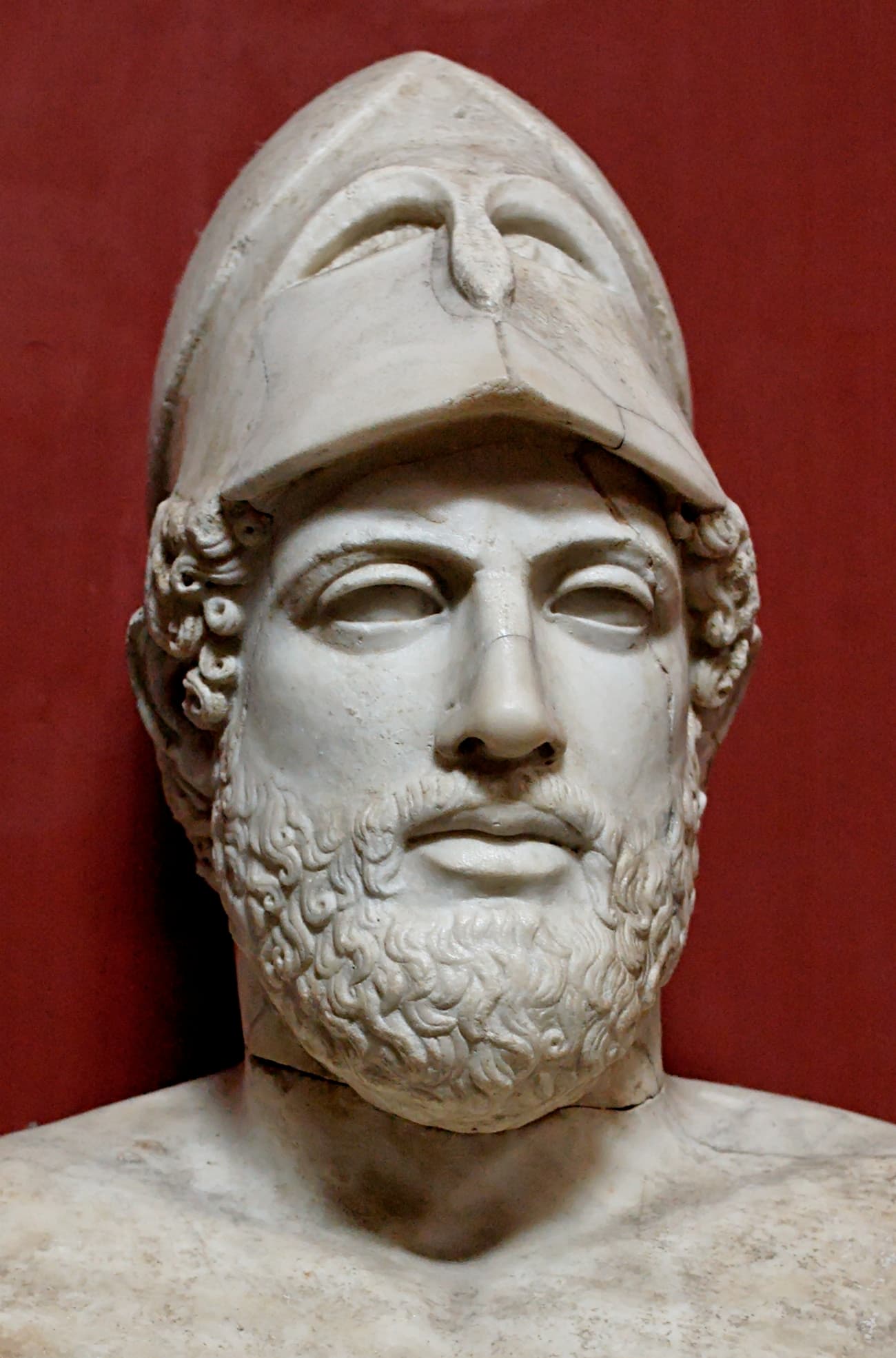
Before he was a statesman, before he was a general, and long before his name became synonymous with the golden afternoon of Athenian power, Pericles was a target for the comic playwrights of the Agora. They called him "Squill-head," mocking a skull so curiously elongated that he refused to be depicted in public without his bronze general’s helmet. He was an aloof, introverted young aristocrat of the Acamantis clan, born into a house of immense wealth and volatile pedigree. His father, Xanthippus, had commanded the Greek fleet that annihilated the remnants of Xerxes’ navy at Mycale; his mother, Agariste, belonged to the brilliant, cursed house of the Alcmaeonids—a dynasty that had given Athens its democratic reformers and its most controversial oligarchs. Legend held that a few nights before his birth, Agariste dreamed she had given birth to a lion. Yet the young lion did not roar. He withdrew. He spent his early years avoiding banquets, cultivating an austere frugality, and studying under the most radical minds of the fifth century BCE. He learned dialectic from Zeno of Elea and music from Damon, but it was the natural philosopher Anaxagoras who truly formed him. Anaxagoras taught him a skepticism of divine phenomena, a rigorous intellectual discipline, and, above all, an unshakeable, unnatural composure. In a city governed by the passions of the Assembly, Pericles learned the political value of absolute emotional calm.
He stepped into the arena not as a demagogue, but as a patron of the arts and a quiet strategist. In the spring of 472 BCE, a young Pericles financed the production of Aeschylus’s tragedy The Persians at the Greater Dionysia, a lavish civic duty that served as a public declaration of his immense wealth and his political alignment. The play was a nostalgic celebration of the victory at Salamis, a subtle piece of political theater designed to bolster the populist faction of Themistocles against the conservative aristocrat Cimon. By 463 BCE, Pericles was secure enough to act as the prosecutor when Cimon was put on trial for neglecting Athenian interests in Macedon. Though Cimon was acquitted, the conservative supremacy was fracturing. The decisive blow came in 461 BCE under the leadership of Ephialtes, Pericles’ political mentor, who stripped the ancient aristocratic council of the Areopagus of its historic powers. When Cimon was ostracized shortly thereafter on charges of betraying Athens to Sparta, and Ephialtes was mysteriously assassinated by an assassin’s dagger, the path was cleared. Pericles, still in his thirties, assumed the unofficial leadership of the democratic party. For the next three decades, he would rule Athens not through tyrannical decree, but through the sheer force of his rhetoric and his annual election to the board of ten generals.
12 links to entries not yet ingested in the Library.
Under his stewardship, Athenian democracy grew radical, wealthy, and unapologetically imperialist. Pericles recognized that the backbone of Athenian military dominance was its navy, and the navy was manned not by wealthy hoplites, but by the thetes—the landless lower classes. To bind these citizens to the state, Pericles introduced a series of revolutionary reforms that transformed the civic life of the city. He established public wages from the treasury for citizens serving as jurymen in the Heliaia and eventually expanded state pay to soldiers, sailors, and minor magistrates. He created the theoricon, a state fund that paid the admission fees for poor citizens to attend the theater, ensuring that the great civic dramas of Sophocles and Euripides were not luxury goods but democratic rites. To his conservative critics, this was shameless populism that bribed the electorate with their own tax dollars and initiated a moral degeneration of the citizenry. Yet, in a paradox typical of his calculated nationalism, Pericles paired these inclusive measures with a highly exclusionary citizenship law in 451 BCE, which restricted Athenian franchise strictly to those who could prove Athenian parentage on both sides. He was building an exclusive club of rulers, funded by the tribute of others.
For the wealth that financed this democratic experiment did not come from Attica alone. Pericles systematically transformed the Delian League—a voluntary maritime coalition formed to defend Greece against Persia—into an Athenian empire. He moved the league’s treasury from the sacred island of Delos to the Athenian Acropolis, arguing that as long as Athens defended the Aegean from the Persians, she was not accountable to her allies for how their tribute was spent. To secure Athenian hegemony, he pioneered the use of cleruchies—military colonies established on confiscated allied territory. Poor Athenian citizens were shipped to strategic outposts like the Thracian Chersonese, Naxos, and Euboea, where they received parcels of land, effectively converting the city’s needy proletariat into property-owning imperial garrisons. When the island of Samos revolted against Athenian dominance in 440 BCE, Pericles personally led the fleet that blockaded and eventually crushed the secessionists. To the wider Greek world, the city that championed liberty at home was fast becoming a tyrant state abroad.
This imperial tribute found its ultimate monument on the high rock of the Acropolis. With the hostilities against Persia effectively closed—either through exhaustion or the disputed Peace of Callias—Pericles proposed a grand Pan-Hellenic congress to discuss the rebuilding of temples destroyed during the Persian invasions. When Sparta blocked the initiative, Pericles went ahead anyway, using the accumulated tribute of the Delian League to launch the most ambitious construction project of the ancient world. Under the artistic direction of his close friend, the sculptor Phidias, the rocky plateau of Athens was transformed. The Parthenon rose in white Pentelic marble, a monument of unmatched geometric sophistication; the colossal bronze statue of Athena Promachos stood guard over the harbor; the Propylaea formed a monumental gateway to the heavens. The project was more than an act of piety or aesthetic pride; it was a massive Keynesian public works program that gave employment to thousands of stonecutters, carpenters, metalworkers, and sailors, binding the economic survival of the working-class citizen directly to the physical glory of the empire.
Yet the golden age was inherently unstable, built upon the resentment of tributary allies and the growing paranoia of Sparta. By the late 430s BCE, the delicate balance of power in the Greek world was collapsing. Pericles’ aggressive foreign policy—including a strategic alliance with the naval power of Corcyra and the economic strangulation of Megara—pushed the Peloponnesian League, led by Sparta, toward open warfare. As the storm gathered, Pericles’ domestic enemies, unable to unseat him directly, struck at his intimate circle. Phidias was prosecuted for embezzling gold intended for the statue of Athena; the philosopher Anaxagoras was forced to flee Athens under charges of impiety; and Aspasia, the brilliant, highly educated Milesian courtesan who was Pericles' lifelong partner and intellectual equal, was prosecuted for her dependency.
When war finally broke out in 431 BCE, Pericles devised a strategy of cold, mathematical calculation that ran entirely counter to the traditional Greek ethos of honor. Knowing that the Spartan hoplites were unbeatable on land, he convinced the population of Attica to abandon their farms, ancestral tombs, and countryside homes, and retreat behind the Long Walls that connected Athens to its port at the Piraeus. Let the Spartans ravage the crops, he argued; Athens would import its food by sea, strike at the Peloponnesian coast with its navy, and win a war of attrition by refusing to fight a pitched battle.
It was a strategy of terrifying rationality, but it did not account for the biology of crowded spaces. In 430 BCE, a devastating plague entered the congested city through the Piraeus, sweeping through the refugees packed into the dusty spaces between the Long Walls. It decimated the population, stripped the citizens of their moral resolve, and shattered their faith in Pericles’ leadership. In his final months, having watched his sister and his two legitimate sons perish from the disease, the statesman himself succumbed to the infection in 429 BCE. Thucydides, who lived through those years, mourned his passing as the end of Athenian restraint. Pericles had been able to control the mob because he did not owe his power to them; those who followed him, lacking his stature, would flatter the passions of the Assembly, leading the city into disastrous foreign adventures and eventual defeat. He left behind a city of marble, a radicalized constitution, and a legacy that would forever debate whether he was the midwife of the West's greatest democratic experiment or the architect of its first ruinous empire.