Person · 1925 CE – 1961 CE
Patrice Lumumba
- Also known as
- Isaie Tasumbu
- Isaïe Tasumbu
- Isaïe Tasumbu Tawosa
- Isaïe Tasumbu Tawosa
- Isaïe Tasumbu Tawosa
- Isaïe Tasumbu Tawosa
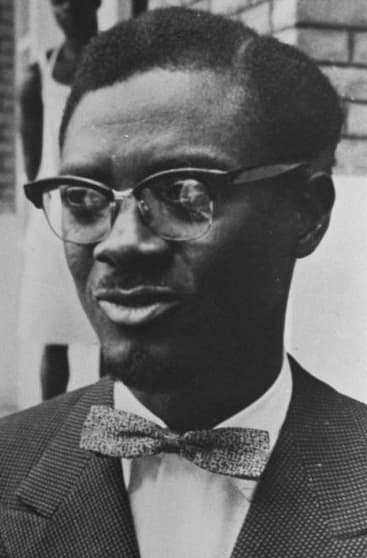
Before he was known as the architect of Congolese independence, the boy born Isaïe Tasumbu Tawosa was called Élias Okit'Asombo by his Tetela family in the Belgian Congo—a name translating to "heir of the cursed." It was a dark, prophetic moniker for a child who would grow up to…
On June 30, 1960, during the formal ceremonies marking the birth of the Republic of the Congo, King Baudouin of Belgium delivered a speech of paternalistic self-congratulation. He praised the "genius" of his ancestor, Leopold II, and framed independence not as a liberation won by the Congolese, but as the final, benevolent act of a civilizing mission. The schedule called for a polite response from the newly installed president, Joseph Kasa-Vubu. Instead, a thirty-four-year-old tall, slender man in a dark suit and spectacles stepped uninvited to the rostrum. Patrice Lumumba, the newly minted prime minister, delivered an unprogrammed tour de force that shattered the colonial theater. He spoke directly to the Congolese people, reminding them of the "humiliating bondage forced upon us by strength," the racial mockery, the expropriation of their lands, and the "iron rule" of a regime that had massacred their compatriots. It was a moment of electrifying truth for the colonized and a declaration of war for the colonizers. Lumumba had earned his mandate through the ballot box, but with this single speech, he signed his own death warrant in the cold calculations of Brussels and Washington.
Lumumba’s rise to the apex of Congolese politics was rapid, propelled by a singular intellect and an oratorical power that defied the strict ethnic divisions of his vast homeland. Born Isaïe Tasumbu Tawosa in 1925 in the village of Onalua, within the Katakokombe region of Kasai province, he was a member of the Tetela ethnic group. His original surname, derived from the Tetela words for "heir of the cursed" or "bewitched people who will die quickly," carried a tragic prescience. Raised Catholic but educated at both Protestant and Catholic mission schools, he was a precocious and challenging student who openly corrected his teachers. Outside the narrow curricula designed by colonial administrators to produce compliant clerks, the young Lumumba devoured the European Enlightenment. He read Jean-Jacques Rousseau and Voltaire, immersed himself in Victor Hugo and Molière, and wrote anti-imperialist poetry. He navigated the colonial system as a traveling beer salesman in Léopoldville and a postal clerk in Stanleyville, but his mind belonged to the burgeoning global movement of African liberation.
By the late 1950s, the Belgian Congo was an economic powerhouse of mineral wealth but a political vacuum. Unlike other regional leaders who built their power bases on ethnic loyalty, Lumumba sought a truly national vision. In 1958, he co-founded the Mouvement National Congolais (MNC) on a platform of immediate independence, state-led economic development, ethnic integration, and strict neutrality in the Cold War. His charisma was magnetic. At the All-African Peoples’ Conference in Accra later that year, he befriended Ghana’s Kwame Nkrumah, solidifying his commitment to pan-Africanism. The Belgian authorities watched him with growing alarm. When an anti-colonial riot broke out in Stanleyville in late 1959, Lumumba was arrested, convicted of incitement, and sentenced to six months in prison. Yet, his movement had become unstoppable. The MNC dominated the local elections while their leader sat in a cell. Realizing they could not chart the country’s future without him, the Belgian government released Lumumba directly from prison to attend the Brussels Round Table Conference in January 1960, where the date for independence was abruptly set for June.
Connected to
12 links to entries not yet ingested in the Library.