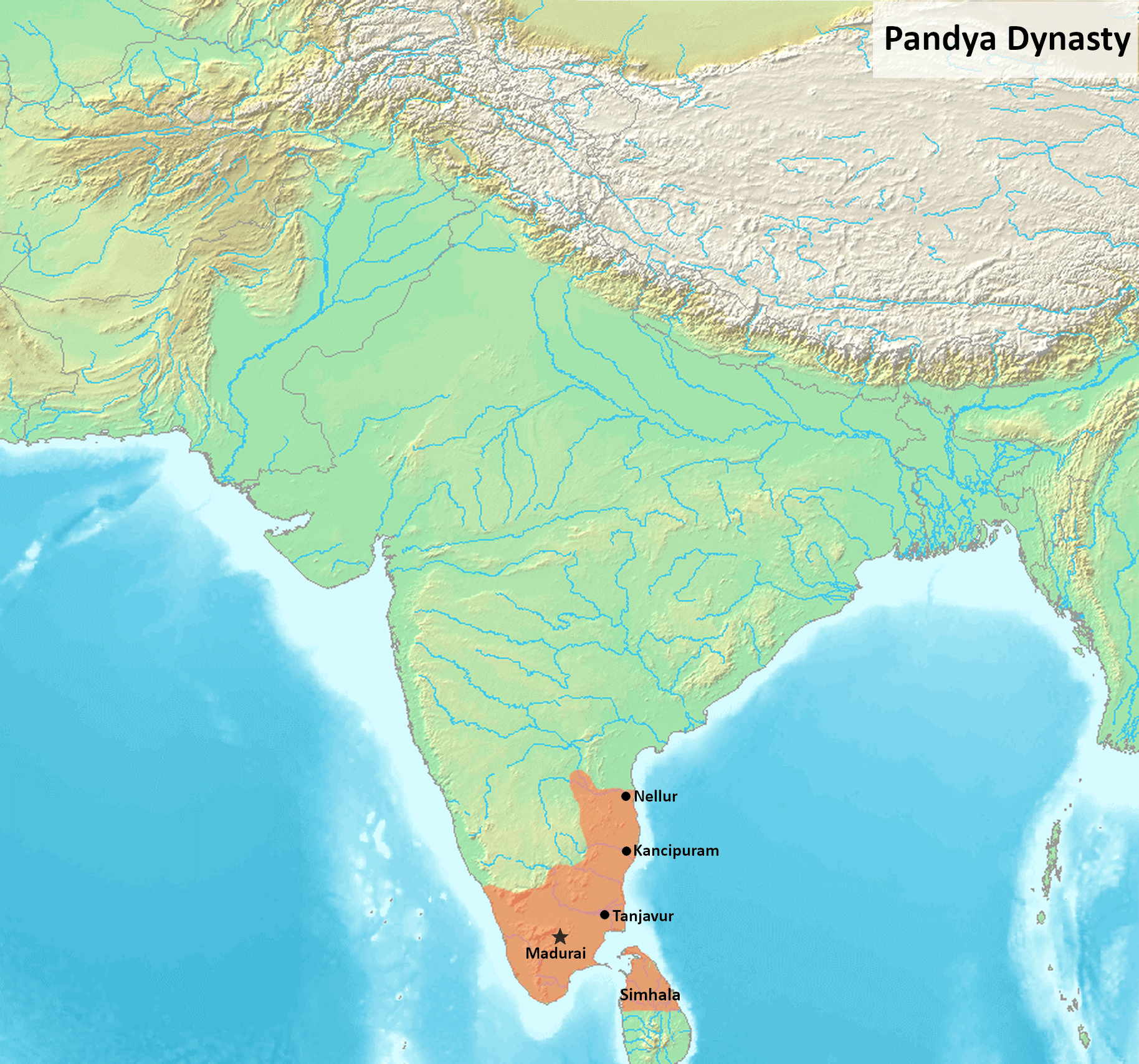
Few ruling houses in global history have matched the sheer longevity of the Pandya dynasty, which steered the fortunes of the southern Tamil region from at least the fourth century BCE until well into the seventeenth century CE.
To the ancient Greek merchants and Maurya emperors of the fourth and third centuries BCE, the southern tip of the Indian subcontinent was not a wild frontier, but a wealthy, sophisticated ocean-facing power known as the Pandya kingdom. When Megasthenes, the Greek ambassador to the court of Chandragupta Maurya, compiled his observations of India, he recorded a striking legend of a southern queen named "Pandaia." He described her as a daughter of Heracles, ruling over a realm of 365 villages, each tasked with meeting the royal palace’s needs on a single, rotating day of the year. This memory of a powerful southern matriarch echoed across the Indian Ocean for centuries, finding parallel expression in Ceylonese folklore through the figure of Alli Rani—an Amazonian queen who ruled the western and northern coasts of Sri Lanka with an army of women and a court where men served merely as domestic hands. Whether historical queens or mythological composites of the great Pandya goddesses Meenakshi and Kannagi, these stories pointed to a civilization that defined itself by the sea, its ancient lineage, and its immense wealth.
The Pandyas of Madurai were one of the mu-ventar—the "three crowned rulers" of the Tamil region, alongside the Cholas and the Cheras. They governed a territory known as Pandya Nadu from the inland cultural capital of Madurai and the bustling southern port of Korkai. While the etymology of their name remains a subject of debate—some scholars trace it to the Sanskrit Pandu (white or pale) in reference to the legendary Pandavas of the Mahabharata, and others to the ancient Tamil pandu, meaning "old country"—there was no doubt about their antiquity. In his rock edicts, the third-century BCE Maurya Emperor Ashoka listed the Pandyas as a sovereign, friendly neighbor lying beyond his borders, alongside the Greek kingdoms of the Mediterranean and the island of Sri Lanka. To Ashoka, they were partners in dharma, receiving his emissaries and establishing his "double system of medical aid" for both humans and animals.
This was a civilization built upon the treasures of the deep. In the first century BCE, the Kalinga king Kharavela claimed in his Hathigumpha inscription to have broken a 132-year-old confederacy of Tamil countries and plundered a vast hoard of pearls from the Pandyas. Archaeological excavations at Korkai and other coastal sites have vindicated these ancient claims of maritime wealth, yielding Roman coins, distinct pottery, and port installations that bear witness to a lucrative, long-distance trade. The Pandyas stamped their authority on this commerce with silver punch-marked coins bearing their dynastic emblem: a fish. According to Tamil origin myths, the three brothers who founded the Tamil kingdoms originally ruled in common at the port of Korkai before the Chera and Chola brothers departed to establish their own lands in the west and north, leaving the Pandya brother to guard the ancestral home.
+ 4 further connections to entries not yet ingested
For over two thousand years, the fortunes of the Pandyas ebbed and flowed like the tides of the Indian Ocean, in a cycle of imperial dominance, sudden collapse, and spectacular revival. The early historic period of the Pandyas, celebrated in the vibrant poems of the Sangam academies of Madurai, flourished until it faded into obscurity around the third century CE under the rise of the Kalabhra dynasty. By the late sixth century, however, a ruler named Kadungon restored the Pandya line, initiating a period of fierce regional rivalry. For three centuries, the Pandyas of Madurai, the Pallavas of Kanchi, and the Chalukyas or Rashtrakutas of the Deccan engaged in a relentless struggle for hegemony. The Pandyas launched repeated invasions into the fertile Kaveri estuary of the Cholas, campaigned through the ancient Chera lands of central Kerala, and crossed the Gulf of Mannar to attack Sri Lanka.
This era of competition took a disastrous turn in the ninth century with the dramatic rise of the Cholas of Thanjavur. Reduced to vassals and stripped of their lands, the Pandyas were forced into a defensive alliance with their traditional rivals, the Sinhalese of Sri Lanka and the Cheras. For nearly four centuries, the Pandyas bided their time under the shadow of the Chola Empire, waiting for a crack in the imperial edifice.
That opportunity finally arrived in the thirteenth century, ushering in the second and most magnificent golden age of the dynasty. Under the "Later Pandyas," particularly the formidable monarchs Maravarman I and Jatavarman Sundara Pandya I, the dynasty surged back to imperial dominance. Though Maravarman’s initial northern expansions into Chola territory were checked by the Hoysala kings of the Mysore Plateau, his successors proved unstoppable. Around 1251 CE, Jatavarman Sundara Pandya I launched a series of sweeping campaigns that extended Pandya rule as far north as Nellore in the Telugu country, subjugated southern Kerala, and conquered northern Sri Lanka. Kanchi became a secondary northern capital of the empire. The Hoysalas were driven back to their highland plateau, and their king, Somesvara, was slain in battle.
By 1279 CE, Maravarman Kulasekhara I shattered a desperate alliance between the Hoysalas and the dying Chola Empire. He invaded Sri Lanka, defeated its defenders, and carried off the ultimate prize of Buddhist sovereignty: the venerable Tooth Relic of the Buddha, bringing it back to Madurai as a symbol of uncontested southern hegemony. During this golden age, the Pandyas practiced a unique system of co-regency where power was shared among several royal princes, though one supreme monarch retained ultimate primacy.
This vast wealth and political complexity were mirrored in the cultural life of Pandya Nadu. The dynasty’s early rulers had originally followed Jainism—a heritage preserved in the ancient Tamil-Brahmi inscriptions of Mangulam, which record royal gifts of rock-cut beds to Jain ascetics. However, the sixth-century revival under Kadungon coincided with the dramatic rise of the Hindu Bhakti movement. The Pandyas became passionate patrons of the Shaivite Nayanar and Vaishnavite Alvar saints, transforming their territory into a land of monumental stone temples, most notably the towering, labyrinthine Meenakshi Temple in Madurai. The medieval kings claimed descent from the Chandravamsha—the prestigious Lunar Race of mythological kings—and prided themselves on their patronage of the legendary Tamil Sangams, the literary academies where poets and scholars gathered under royal auspices. Several Pandya kings were accomplished poets themselves, contributing verses to the canonical Akananuru and Purananuru anthologies.
Yet, the very mechanism of shared royal power that facilitated their expansion became the instrument of their downfall. In the early fourteenth century, a bitter internal crisis over succession between rival Pandya claimants coincided with the southern campaigns of the Delhi Sultanate. The army of Alauddin Khalji, led by the general Malik Kafur, invaded the south in 1310–11 CE, plundering Madurai and throwing the kingdom into chaos. In the decades of instability that followed, the Pandyas suffered successive losses: southern Kerala broke away in 1312, northern Sri Lanka was lost by 1323, and the establishment of the independent Madurai Sultanate in 1334 permanently severed the dynasty from its ancient capital.
Though their grand empire was shattered, the Pandyas did not vanish. They retreated southward, continuing to rule in diminished, localized capacities from regions like Tenkasi until the mid-seventeenth century, finally fading from the historical record around 1650 CE. They left behind a memory of one of the longest-lived dynasties in global history. They had survived the rise and fall of the Mauryas, the Romans, the Pallavas, and the Cholas, leaving an indelible imprint on the cultural geography of southern India through the living Tamil language, the soaring gopurams of Madurai, and the ancient trade routes that once linked the pearl-rich Gulf of Mannar to the wider world.