Event · 275 CE – 897 CE · Indian Ocean Trade
Pallava dynasty
- Also known as
- Dinasti Pallava
- Dinasti Pallawa
- Dinastia Pallava
- Dinastija Pallava
- Dinastía Pallava
- dynastie Pallava
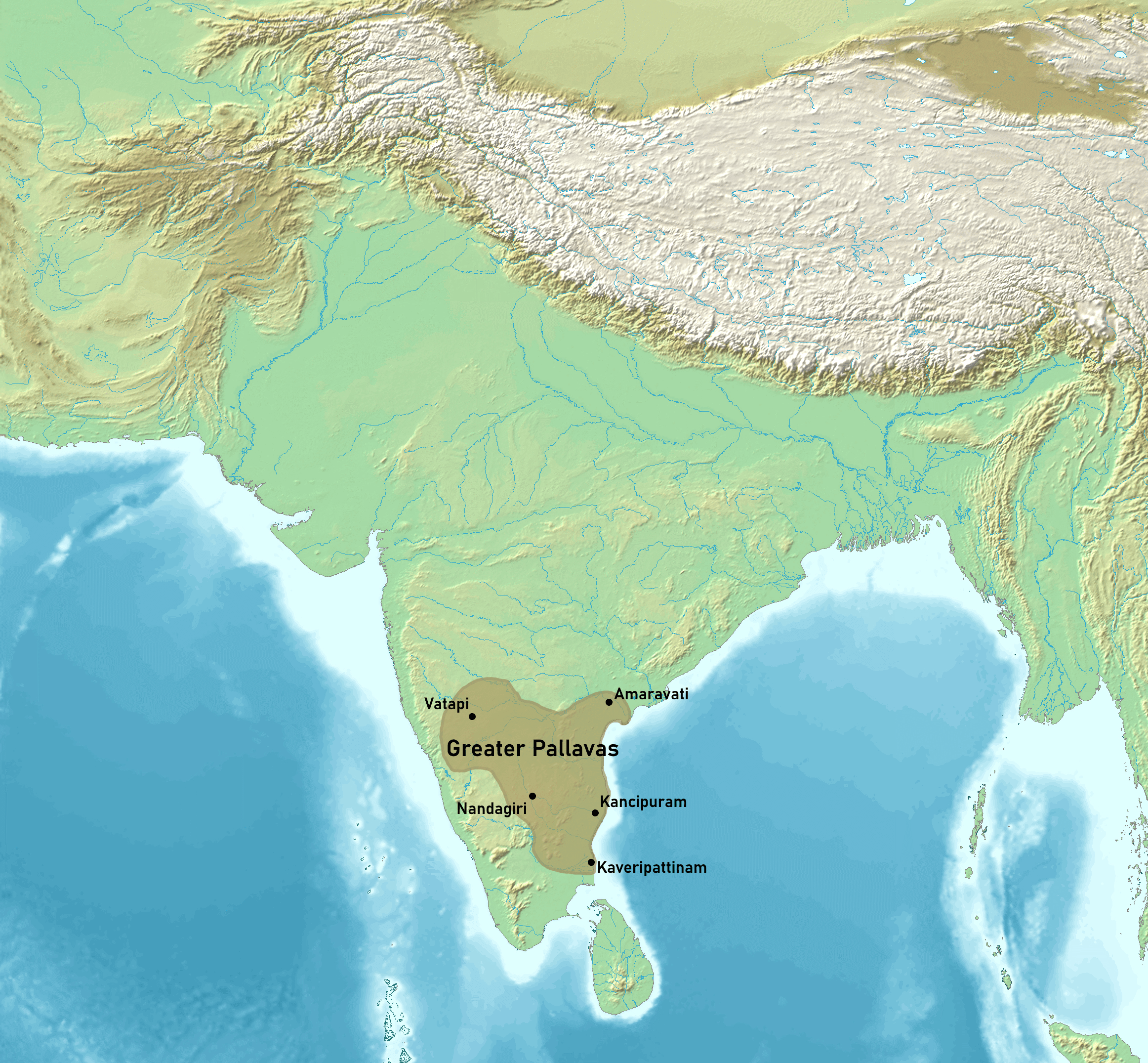
The rise of the Pallava dynasty began in the shadow of a fallen empire, emerging from the collapse of the Satavahanas whom they had once served as subordinates.
In the early fourth century CE, three copper-plate grants were issued from the city of Kanchipuram. Found centuries later scattered across the plains of modern Andhra Pradesh, these plates—commissioned by the Pallava ruler Sivaskandavarman—were written not in the local vernaculars, but in Prakrit, the administrative language of the great northern empires. Half a century prior, another inscription by a ruler named Simhavarman I was carved into the stone of the western Guntur district, bearing no royal titles at all. These early documents reveal a dynasty in its infancy, operating in the long shadow of the collapsed Satavahana Empire. Yet within a few centuries, this enigmatic family would transform Tondaimandalam—the frontier region bridging the Telugu-speaking north and the Tamil-speaking south—into the cultural crucible of southern India.
The origins of the Pallavas remain one of the great battlegrounds of South Asian historiography. Their very name invites linguistic detective work: in Sanskrit, pallava means a tender branch or creeper, while in Tamil, it can denote an arrow or spruce. Some historians argue they were originally northern intruders, perhaps former Satavahana feudatories who migrated southward to carve out a kingdom around Kanchipuram as their former masters declined. Others suggest a native Tamil origin, pointing to the Sangam literature which sings of the Thirayar ("sea-people") and the Thondaiyar clans of the northeastern Tamil country. According to one legendary lineage, the dynasty was founded by Prince Ilandiraiyan, born of a union between a Chola king and a princess of the subterranean Naga realm. Other records claim an even grander epic heritage, tracing their lineage back to Ashwatthama, the legendary warrior of the Mahabharata. There are even those who point to their earliest coins, stamped with a maned lion and inscribed in Kannada, or those who link them to the Kurumbas, a pastoralist community. Whatever their lineage, by the sixth century, the Pallavas had successfully synthesised these disparate northern and southern elements, establishing a distinct, highly sophisticated political identity.
This synthesis found its perfect expression in Kanchipuram, a capital that soon became one of the greatest intellectual and religious sanctuaries of the subcontinent. When the Chinese pilgrim Xuanzang journeyed through the Deccan in the seventh century, he found a thriving, cosmopolitan metropolis and wrote glowingly of the benign Pallava administration, noting the region's deep piety and educational vigor. To secure this capital, however, the Pallavas had to fight a relentless, multi-front war that lasted for six hundred years. To their north lay the Chalukyas of Vatapi, their permanent rivals for Deccan supremacy; to the south lay the ancient Tamil powers, the Cholas and the Pandyas; to the west, the Kadambas. The city of Kanchipuram itself was a frequent prize in this geopolitical chess game. The Pallava king Kumaravishnu I wrestled it from the Cholas in the fourth century, only for the dynasty to lose it again to Chola counter-attacks, and later to the devastating invasions of the Kalabhras, who swept through the Tamil country in the early sixth century. It was Simhavhishnu, ascending the throne in the latter half of the sixth century, who finally broke the Kalabhra grip, claiming the title "lion of the earth" and securing Kanchipuram as an unassailable bastion of Pallava power for the next three hundred years.
Connected to
- religionHinduism
+ 4 further connections to entries not yet ingested