Place · Mesoamerican Civilizations
Palenque
- Also known as
- B'aakal
- B'aakal
- Cidade Pré-Hispânica e Parque Nacional de Palenque
- Palau del Governador
- Palenke
- Palenke
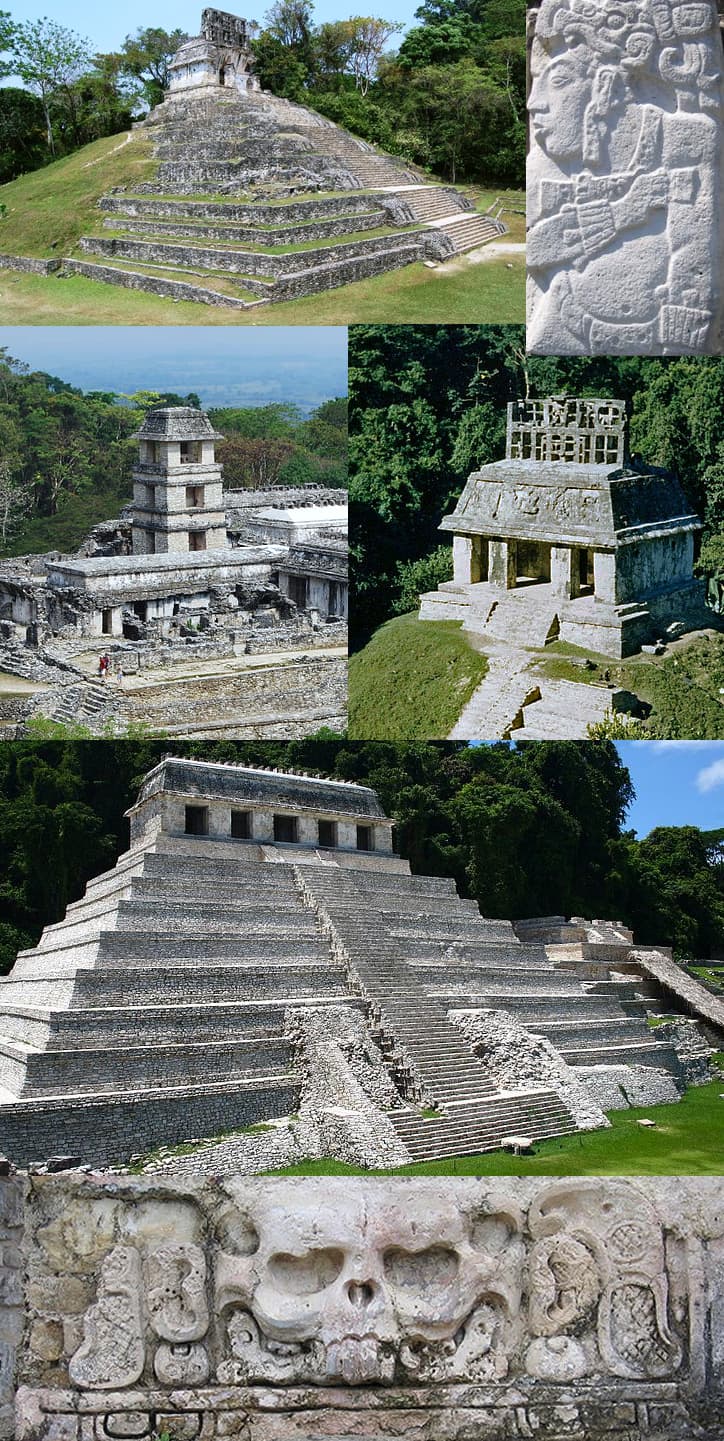
Deep in the humid forests of Chiapas, where cedar, mahogany, and sapodilla trees reclaimed a once-thriving civilization, lies the Maya city-state anciently known as Lakamha, or "big waters." Active from approximately 226 BCE to 799 CE, this medium-sized center yielded an…
Deep in the rainforests of modern Chiapas, where the foothills of the Maya highlands descend toward the floodplains of the Usumacinta River, a constant, heavy mist clings to the canopy of mahogany, cedar, and sapodilla trees. It is an environment of intense humidity and torrential rains—averaging over eighty-five inches a year—where the line between the natural world and human architecture has spent centuries blurring. Here lies the ancient Maya city-state of Lakamha, meaning "big waters," known today by the Spanish name of Palenque. Unlike the arid, windswept plains of the Yucatán Peninsula where cities like Chichen Itza lay exposed to the sky, Palenque was swallowed whole by the jungle after its collapse in the eighth century. It became a place of shadows and damp stone, where the green earth reclaimed monuments of staggering sophistication, leaving only a fraction of its estimated thousand structures visible to the modern world, while the rest remain buried beneath the forest floor.
The site is modest in physical scale compared to giants like Tikal or Copán, yet Palenque represents a pinnacle of Classic Maya artistic achievement. Because the local limestone was hard and uneven, the city’s builders adapted by developing a masterful command of stucco modeling and plaster, utilizing these materials to coat their buildings, smooth their walls, and create some of the most fluid, expressive bas-reliefs in Mesoamerica. They worked entirely with stone tools, constructing parallel walls that supported steep, pointed corbelled vaults and towering, perforated roof combs that gave their temples a light, almost latticed appearance. Through these plastered and richly painted surfaces, the artists of Palenque carved and molded a dense historical and mythological record. In the mid-twentieth century, it was the decipherment of these very hieroglyphic tablets—specifically by pioneering scholars like Heinrich Berlin, Linda Schele, Peter Mathews, and Tatiana Proskouriakoff—that unlocked the dynastic history of the Maya, transforming what was once viewed as an anonymous, peaceful empire of time-obsessed priests into a highly dramatic, historically documented landscape of warring kings, political alliances, and sudden reversals of fortune.
Palenque’s documented history begins in the fifth century, but the city we see today was born out of a profound crisis. In 599 and again in 611, the powerful rival city-state of Calakmul invaded and sacked Palenque. The second defeat was catastrophic. The king of Calakmul entered the city in person, leaving Palenque in a state of political paralysis and deep existential dread. The glyphic panels at the Temple of the Inscriptions recount a dark era where essential calendar rituals were abandoned, recording the despairing phrase, "Lost is the divine lady, lost is the king." In the wake of this collapse, the dynastic line fractured. A princess named Sak Kʼukʼ assumed power in 612, ruling for three years in a society where female leadership was rare and often presented with masculine attributes to legitimize their authority. She eventually abdicated in 615, passing the crown to her twelve-year-old son, Kʼinich Janaabʼ Pakal—the ruler who would become known as Pakal the Great.
Connected to
- birthplace of · place of death ofK'inich Janaab' Pakal603 CE
+ 3 further connections to entries not yet ingested