Event · 1400 CE – 1905 CE · West African Empires
Oyo Empire
- Also known as
- Carstvo Oyo
- Carstvo Oyo
- Empayar Oyo
- Ilẹ̀ Ọba Ọ̀yọ́
- Ilẹ̀ ọbalúayé Ọ̀yọ́
- Ilẹ̀-Ọba Ọ̀yọ́
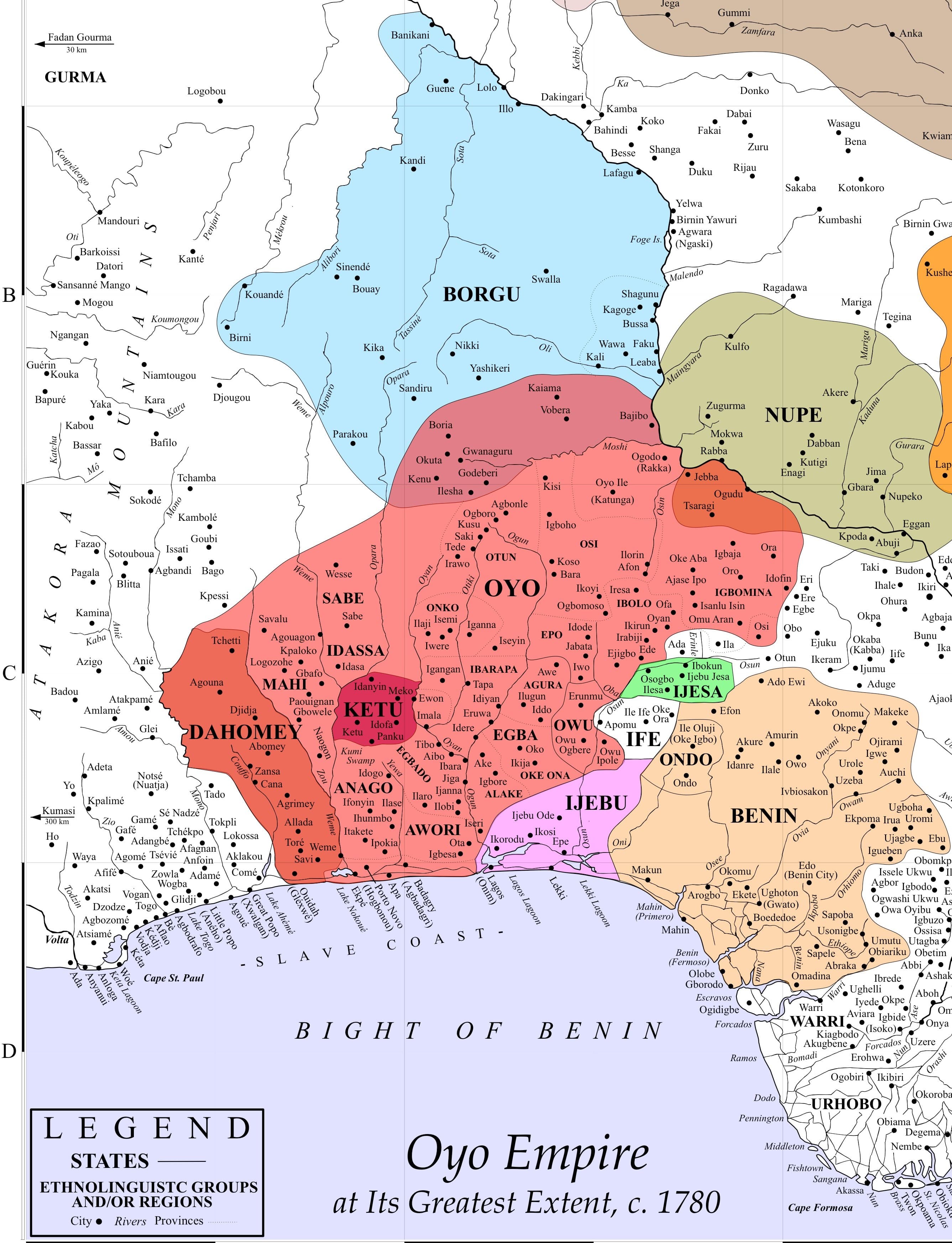
Where the serpent sank into the earth, a state arose that would reshape the West African landscape.
To follow the path of a giant, one must sometimes follow a serpent. According to the foundational lore of the Yoruba people, the prince Ọranmiyan, a son of the sacred cradle-city of Ile-Ife, set out with his warriors on a campaign to punish their northern neighbors. When a dispute split his army, leaving him with a force too small to conquer, he sought counsel from a chief along the southern shore of the Niger River. The chief presented him with a great snake, a magic charm fastened to its throat, and told the prince to follow the reptile until it stopped in one place for seven days and disappeared into the earth. For seven days the serpent rested at a site known as Ajaka, then sank into the ground. There, Ọranmiyan founded the city of Oyo-Ile and took the title of Alaafin—literally, the owner of the palace. He left his treasures in Ife, yielding its crown to another, and built a state destined to become the largest and most politically important empire in West Africa.
This legendary origin, though wrapped in myth, points to the historical geography that shaped the Oyo Empire from its inception around the fourteenth century. Positioned in the savanna lands of what is now western Nigeria and Benin, Oyo occupied a ecological bridge between the dense southern forests of Yorubaland and the vast northern plains of the Niger. This strategic location allowed Oyo to master the Trans-Saharan trade networks, importing horses from the north and exchanging textiles, ironwork, and eventually goods from the Atlantic coast. But this open, fertile savanna was a double-edged sword. While it permitted agricultural abundance and rapid population growth, it left the early kingdom vulnerable to the equestrian states of the north. Around 1535, disaster struck. The Nupe, led by the ruler Tsoede, swept down from the Niger, sacked Oyo-Ile, and forced the ruling dynasty into an eighty-year exile in neighboring Borgu.
The decades spent in exile transformed Oyo from a regional chiefdom into a military machine. Observing the tactics of their Nupe conquerors, whom they called the Tapa, the exiled Yoruba leadership realized that survival in the open plains demanded speed and shock power. Under the Alaafin Ofinran and his successors, they rebuilt their state around a formidable, heavily armored cavalry. When they finally returned to reclaim and repopulate Oyo-Ile, they did so with an army that could strike over immense distances. Operating from a temporary capital at Oyo-Igboho, the Alaafin Orompoto launched devastating campaigns to neutralize the Nupe threat forever. By the early seventeenth century, the Oyo cavalry was legendary. It was an army designed for the flat plains, capable of sweeping down upon infantry with terrifying velocity. When the empire attempted to expand toward the mountainous, forested terrain of Benin to the southeast, the geography of Ekiti halted the horses, forcing Oyo to grant autonomy to those borders. But to the west and south, across the rolling hills and plains, the cavalry was unstoppable.
By the late seventeenth century, Oyo’s expansion brought it into direct conflict with the rising powers of the coast, most notably the Kingdom of Dahomey. In 1728, Oyo forces launched a massive invasion of Dahomey. The conflict was a clash of military philosophies: Oyo relied on the ancient shock of charging horses, while Dahomey possessed no cavalry but was well-equipped with European firearms. During their early encounters, the crackle of Dahomean gunfire panicked the Oyo horses, while Dahomean trenches and fortifications neutralized the cavalry's mobility. Yet, after four days of grueling combat and the arrival of timely reinforcements, Oyo’s sheer discipline and superior numbers prevailed. It took eleven separate invasions over two decades, but by 1748, Dahomey was thoroughly subjugated and forced to pay an annual tribute. Oyo’s borders now reached the Atlantic, integrating the empire into the lucrative coastal trade, including the Atlantic slave trade, and making it the undisputed arbiter of West African politics. At its height in the eighteenth century, the empire spanned over 150,000 square kilometers, maintaining order through a sophisticated administrative apparatus that balanced local autonomy with imperial authority, while remaining remarkably free of the Islamic influences that dominated the savannah states to its north.
Yet, the very mechanism that allowed Oyo to govern its vast territories contained the seeds of its undoing. At the heart of the empire was a delicate, tense constitutional balance between the Alaafin and his council of state, the Oyo Mesi, led by the Prime Minister, or Basorun. This balance shattered in 1754 with the rise of a ruthless Prime Minister named Gaha. Desiring absolute control, Gaha initiated a twenty-year reign of terror, orchestrating palace coups and forcing four successive Alaafins to commit ritual suicide by presenting them with the symbolic parrot's eggs—a sign that their spiritual authority had departed. During one bloody stretch in 1754, two kings were forced to end their lives within months of taking the throne; Alaafin Labisi ruled for a mere seventeen days. Though the fifth king he served, Alaafin Abiodun, finally executed Gaha in 1774, the structural integrity of the empire had been fatally compromised. The central authority of the palace was fractured, and the provinces had watched the capital devour itself.
The final collapse was precipitated by a series of military failures and spiritual transgressions. Alaafin Abiodun’s late-eighteenth-century campaigns against Borgu and Nupe ended in disaster, costing the empire dozens of its finest generals. When Abiodun was murdered by his own son, Awole, the moral authority of the throne decayed further. In 1793, Awole ordered Afonja, the commander of the imperial war camp at Ilorin, to attack the town of Iwere-Ile—the birthplace of Awole's own mother. Afonja, bound by a sacred oath that forbade any commander from attacking this paternal home, refused. Two years later, Awole ordered an attack on the market town of Apomu, which belonged to the spiritual cradle of Ile-Ife. Because all Alaafins swore a sacred oath never to raise weapons against Ife, the spiritual home of the Yoruba, this order was viewed as a sacrilege. Afonja sacked the town to fulfill the literal command, but upon his return, he marched his army directly onto the capital of Oyo-Ile—violating the ultimate taboo—and demanded Awole’s abdication. Awole committed ritual suicide, leaving behind a fractured realm.
The death of Awole triggered a twenty-year interregnum, a chaotic scramble for the throne where rival military commanders and regional chiefs ignored the vacant palace and carved out their own domains. In 1817, Afonja formally seceded Ilorin from the empire, calling upon the assistance of Shehu Alimi, a Fulani leader who commanded the loyalty of Oyo’s growing Muslim population. It was a Faustian bargain. Within six years, Afonja was killed by his own Muslim allies, and by 1823, the strategic city of Ilorin was absorbed into the Sokoto Caliphate, turning its guns against the remnants of the empire it had once defended.
Though a rump Oyo state would persist in various forms for several decades, shifting its capital southward, the great savanna empire that had ruled from Oyo-Ile was gone. The horsemen who had once commanded the plains were undone by internal division, constitutional collapse, and the shifting tides of religious and military power. When the British colonial apparatus finally brought a formal end to the polity in 1905, they were dismantling an empire that had already fractured into memory. Yet, the legacy of Oyo remained deeply etched into the fabric of West Africa. Through its centuries of dominance, it unified a vast linguistic and cultural region, leaving behind administrative traditions, the celebrated peace of the Bere festivals, and a complex Yoruba identity that survived not only the fall of the Alaafin's palace but also the brutal middle passage to the Americas.
Connected to
6 links to entries not yet ingested in the Library.