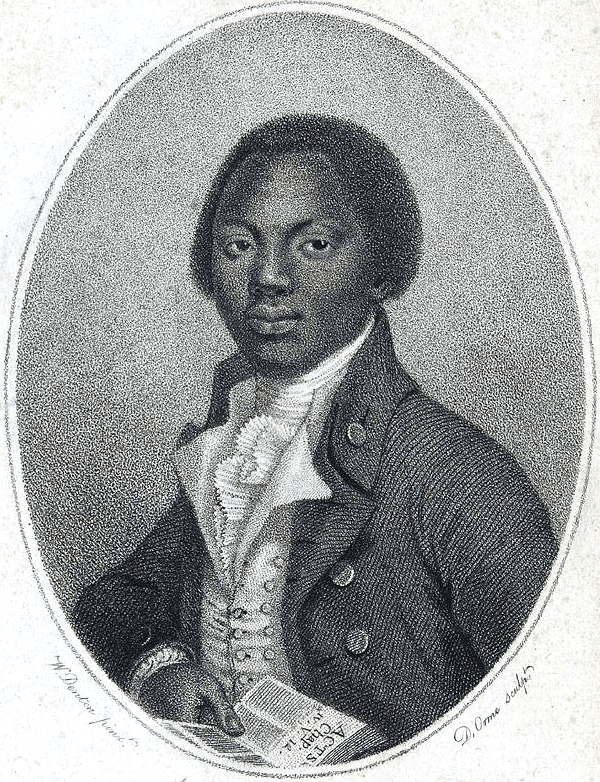
To strip a child of his name is to attempt to erase his past, and by the time he was purchased by a Royal Navy lieutenant, the boy from West Africa had already been called Michael and Jacob.
In December 1762, on the docks of Gravesend, a young black sailor named Gustavus Vassa was forced aboard the Charming Sally. He had spent the previous seven years serving a lieutenant in the Royal Navy, hauling gunpowder onto the smoke-choked decks of British warships during the Seven Years’ War, learning to read and write in London, and embracing the rituals of the Church of England. He believed himself a free man, or at least on the cusp of it, having been promised his liberty by his master. Instead, he was sold to a captain bound for the Caribbean. The young man protested, citing his years of service and his baptism at St Margaret’s, Westminster. His objections were met with the blunt reality of the eighteenth-century Atlantic world: his body was property, and his identity was whatever his owner chose to write on a bill of sale.
Names, and the power to strip or claim them, defined the life of the man who would eventually introduce himself to the world as Olaudah Equiano. Born around 1745, he would spend the vast majority of his fifty-two years known to his contemporaries, his employers, and the state as Gustavus Vassa—a name bestowed upon him by his navy captor after the sixteenth-century Swedish king who initiated the Protestant Reformation. On board his first slave ship, he had been called Michael; his first master in Virginia called him Jacob. When the boy refused the name Gustavus Vassa and insisted on being called Jacob, his obstinacy was met with "many a cuff" until he submitted. He would carry this imposed Swedish name through parish registries, navy musters, and marriage records, only reclaiming his African name in 1789 on the title page of his autobiography, The Interesting Narrative of the Life of Olaudah Equiano, or Gustavus Vassa, the African.
The journey of Equiano, from the Igbo village of Essaka in what is now southern Nigeria to the drawing rooms of London’s reformist elite, remains one of the most remarkable odysseys of the eighteenth century. According to his memoir, he was the youngest of six surviving sons of a slave-owning local leader. At about eleven years old, while the adults of his village were working in the fields, Equiano and his sister were kidnapped by slave traders. Torn from his sister after a brief, desperate reunion during their captivity, Equiano was carried toward the West African coast. Six months after his abduction, he saw the ocean for the first time and was carried aboard a European slave ship packed with 244 other captives, bound for the brutal sugarcane plantations of Barbados.
This foundational narrative of African birth has not been without controversy. In 2005, literary scholar Vincent Carretta unearthed a 1759 baptismal record from London listing Equiano’s birthplace as Carolina, alongside a 1773 Royal Navy ship’s muster that similarly identified his origins as South Carolina. While some historians argue these records suggest Equiano may have been born in the American colonies and reconstructed an African childhood from the testimonies of others to bolster the abolitionist cause, many scholars dispute this conclusion, maintaining that the overwhelming weight of internal and contextual evidence supports Equiano’s own account of his West African origin. What is beyond dispute is that his youth was shaped by the shifting, perilous currents of the transatlantic slave trade.
12 links to entries not yet ingested in the Library.
Sold from Barbados to Virginia, and then to Navy Lieutenant Michael Henry Pascal, Equiano’s life took a turn that separated his experience from that of the vast majority of enslaved Africans. Rather than facing the grueling, short life of field labor under the tropical sun, Equiano became a personal servant and an able seaman. He witnessed the siege of Louisbourg in 1758, the naval battle of Lagos in 1759, and the capture of Belle Île in 1761. In London, Pascal’s family took an interest in the boy, sending him to school to refine his literacy. Yet, the promise of security was an illusion. When Pascal sold him in 1762, Equiano found himself returned to the Caribbean, purchased by Robert King, an American Quaker merchant from Philadelphia.
King recognized Equiano’s intelligence and business acumen, employing him in his stores and shipping routes across the Caribbean and Georgia. He taught Equiano to write more fluently and allowed him to engage in petty trading on his own account. Selling fruit, glass tumblers, and minor wares, Equiano slowly amassed the forty pounds—equivalent to several thousand pounds today—needed to purchase his freedom, a sum he paid to King in 1766. Yet, as Equiano quickly discovered, freedom in the British colonies was a fragile legal fiction for a black man. While loading a ship in Georgia, he was nearly kidnapped back into slavery. Recognizing that his safety could never be guaranteed in the Americas, he returned to England around 1768.
For the next decade, Equiano lived the life of a free, cosmopolitan mariner. In 1773, he served as a crew member on the HMS Racehorse during a Royal Navy scientific expedition toward the North Pole, working alongside Dr. Charles Irving, an inventor who had designed a method for distilling seawater. Two years later, Irving recruited Equiano for a poorly fated venture on the Mosquito Coast of Central America, where Equiano’s African background was ironically utilized to help select and manage enslaved laborers on a sugar plantation. Though this venture failed, Equiano’s travels broadened his world, bringing him into contact with diverse cultures, including George, the son of the "Musquito king."
By the late 1770s, Equiano had settled permanently in London, a city harboring a growing community of free black residents. He found himself increasingly drawn to the burgeoning abolitionist movement, which was gaining momentum through the efforts of religious reformers and legal activists. Equiano’s deeply felt Christian faith, influenced by the evangelical preaching of George Whitefield, became the moral compass of his activism. Yet, his faith was repeatedly tested by the horrors of the trade he had escaped. In 1774, he watched helplessly as his friend John Annis, a free black cook, was kidnapped in London by his former master, William Kirkpatrick. Despite Equiano’s frantic efforts to secure his release with the aid of the activist Granville Sharp, Annis was dragged to Saint Kitts, tortured, and worked to death on a plantation. The tragedy highlighted the limits of English common law, which, despite the landmark Somersett Case of 1772, struggled to protect black people from the predatory reach of West Indian planters.
Determined to strike at the heart of the trade, Equiano became a key conduit of information for the white reformers who dominated the political landscape. In 1783, he was the first to alert Granville Sharp to the Zong massacre—an atrocity in which the captain of a slave ship had ordered 133 sick slaves thrown overboard to claim insurance payouts. The legal battles that followed transformed the Zong into a symbol of the unspeakable cruelty of the slave trade, galvanizing the British public. Equiano joined the Sons of Africa, a group of politically active black men in London, and began lecturing across the British Isles.
In 1789, Equiano published The Interesting Narrative. Supported by philanthropic abolitionists and aristocratic patrons, the book was a literary and political triumph. At a time when pro-slavery advocates argued that Africans lacked the intellectual and spiritual capacity for high civilization, Equiano’s elegant prose, vivid descriptions, and complex psychological insight offered an undeniable refutation of racial hierarchy. The book became an immediate bestseller, going through nine editions in his lifetime and being translated into German, Dutch, and Russian. Equiano traveled tirelessly to promote it, embarking on extensive lecture tours of England, Scotland, and Ireland, where he spent eight months between 1792 and 1793.
The proceeds from his book granted Equiano a rare degree of financial independence, allowing him to live on his own terms. He married an Englishwoman, Susannah Cullen, in 1792, and settled in Cambridgeshire, where they raised two daughters. When he died on March 31, 1797, the formal abolition of the British slave trade was still a decade away, but the intellectual and moral foundations of the traffic had been permanently eroded. Equiano’s memoir did not merely expose the physical brutality of the Middle Passage; it forced an empire to look into a mirror and reckon with the human cost of its global wealth. Through his words, the anonymous millions who had been reduced to cargo found a voice, ensuring that the struggle for abolition would be remembered not as a charitable gift from white reformers, but as a campaign forged and directed by those who had survived the fire themselves.