Person · 1582 CE – 1663 CE · Age of Sail and Empire
Nzinga of Ndongo and Matamba
- Also known as
- Ana de Sousa
- Ana de Sousa
- Ana de Sousa
- Ana de Sousa
- Ana de Sousa
- Ana de Sousa
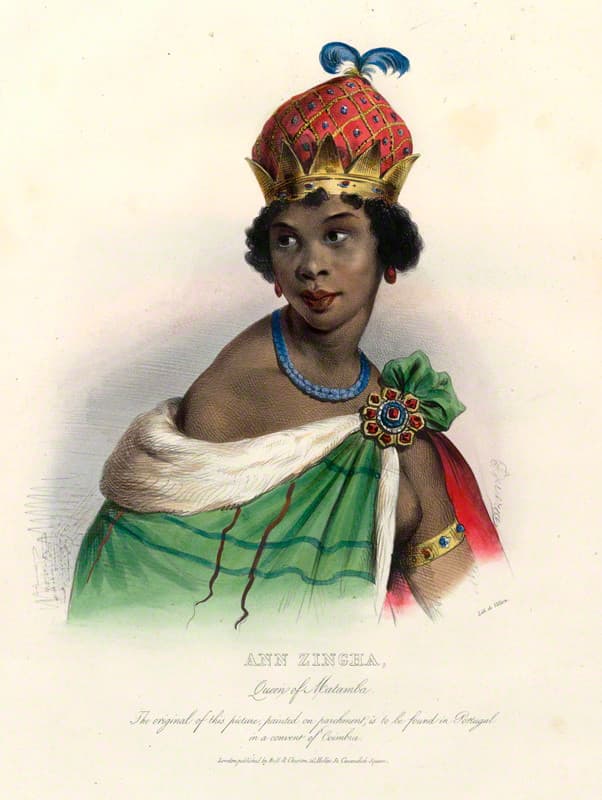
Legend has it that she was born with her umbilical cord twisted around her neck—a sign to the Mbundu people of central West Africa that the newborn girl would grow to possess spiritual gifts, pride, and immense power. Nzingha Ana de Sousa Mbande, born around 1583 into the royal family of the Ndongo kingdom, spent her childhood favored by her father, who allowed her to receive military and political training. It was an education that would soon face the ultimate trial. As the Portuguese Empire encroached upon South West Africa to fuel the rapidly growing transatlantic slave trade, Nzingha emerged first as a brilliant ambassador, and later, following her brother’s death in 1624, as the ruler of Ndongo.
When the Portuguese declared war in 1626, Nzingha’s forces were depleted, forcing her into exile. Yet she possessed a remarkable talent for shifting alliances. She secured a marriage to an Imbangala warlord to rebuild her army, conquered the neighboring Kingdom of Matamba, and later forged a treaty with the Dutch West India Company after they seized Luanda. Fighting alongside the Dutch, she reclaimed vast territories of Ndongo and defeated the Portuguese in multiple battles, though the fortress of Massangano remained out of reach. When the Dutch departed and the Portuguese recaptured Luanda in 1648, Nzingha refused to yield, continuing her campaign until she negotiated a peace treaty in 1656. By the time of her death in 1663, she had spent decades defending her people's sovereignty. Today, she stands as a towering symbol of resistance, remembered across Angola and the wider Atlantic world for her extraordinary political wisdom, military brilliance, and defiance of colonial conquest.
Connected to
- religionChristianity33 CE
- born in · citizen ofKingdom of Ndongo
+ 7 further connections to entries not yet ingested