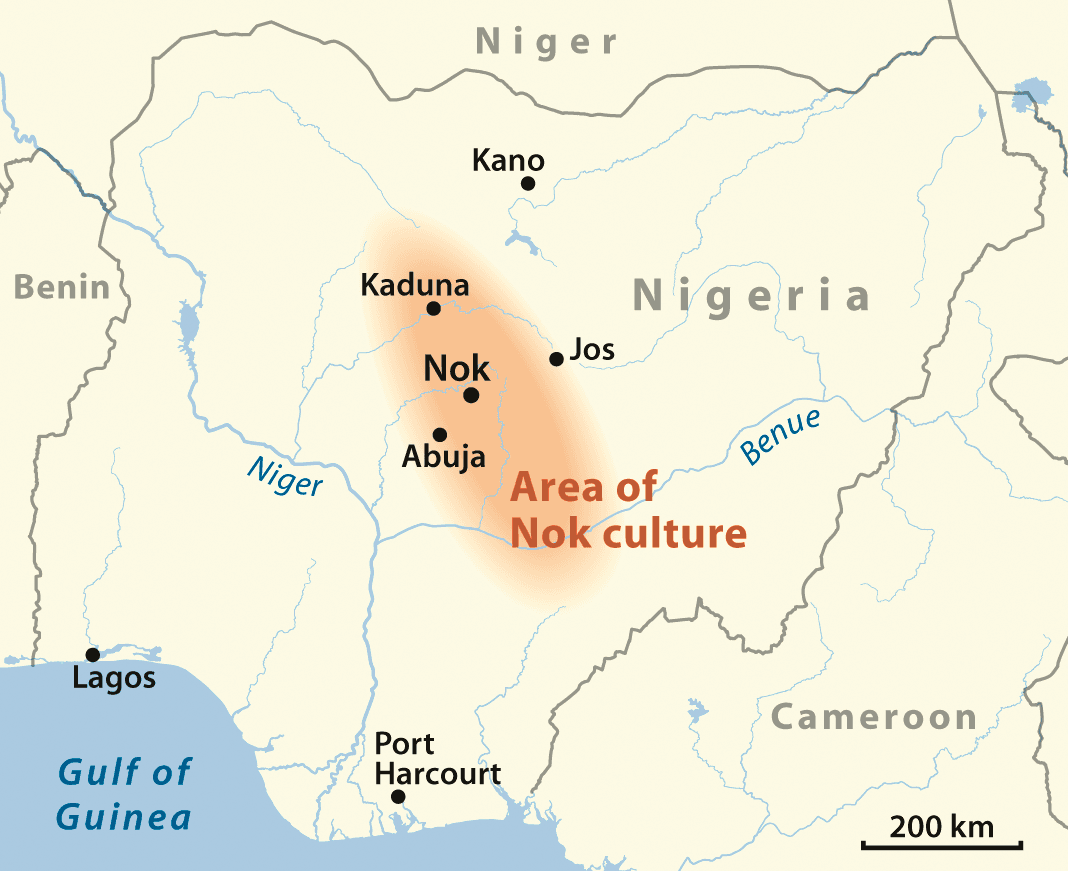
From their mountaintop settlements in what is now northern Nigeria, the Nok people produced a striking visual record that stands as the earliest large-scale, three-dimensional figurative art in continental Africa outside of Egypt.
In 1943, near the village of Nok in the center of what is now Nigeria, a clay head was pulled from the deep, water-logged gravel of an alluvial tin mine. Rather than being cataloged by an academic, it was taken home by a mining clerk who perched it atop a pole in his yam field to serve as a scarecrow. For a year, the ancient, hollow face stared out over the crops, its empty, pierced eyes and elaborate coiffure weathering the West African rains, until it caught the attention of Bernard Fagg. An administrative officer who had studied archaeology at the University of Cambridge, Fagg recognized that this was no ordinary piece of agricultural folk art. Years earlier, in 1928, a mining partner named Colonel Dent Young had unearthed a similar terracotta fragment nearby, which had sat largely unappreciated in a local mining museum. By linking these scattered discoveries, Fagg began to pull back the curtain on a vast, sophisticated, and previously unimagined ancient society that had flourished in the West African savanna for nearly a millennium and a half.
The Nok culture, as this ancient society came to be known, emerged around 1500 BCE and persisted until 1 BCE. Its origins remain shrouded in the shifting sands of the African continent. Long before their distinctive art appeared, the ancestors of the Nok may have migrated from the drying expanses of the Central Sahara or the West African Sahel. Driven southward by the gradual desiccation of the desert after 2500 BCE, these populations carried with them the cultivation of pearl millet and early traditions of pottery making. As they moved into the northern and central regions of modern-day Nigeria, these migrating groups diverged. Some settled in the northern plains of Gajiganna, while others moved further south into the valleys and rocky hills of the Kaduna State, establishing the settlements that would define the Nok culture. Here, on mountaintop sites that offered vantage points over the surrounding savanna, they built a society defined by agricultural stability, pioneering metallurgy, and a highly sophisticated aesthetic tradition.
At the heart of the Nok world was a revolutionary technological transition. Between 750 BCE and 550 BCE, Nok metalworkers independently developed iron metallurgy. Unlike many Eurasian societies that transitioned gradually from stone to bronze and then to iron, the Nok culture stepped directly into the Iron Age. In the remote valley of Taruga, early excavations revealed the remains of a highly industrious society: wrought iron objects, heaps of iron slag, fragments of clay tuyeres used to pump air into furnaces, and the actual clay walls and bases of nineteen in situ smelting furnaces. This metallurgical prowess was paired with a rich domestic toolkit. Alongside iron implements, Nok kitchens featured flat-bottomed pottery graters, deeply scored with diced patterns on the inside to form a sharp, abrasive surface. These graters, used to grind roots, bark, and domestic crops, suggest a complex culinary and medicinal tradition, where ceramic vessels were employed to boil and process medicinal decoctions.
4 links to entries not yet ingested in the Library.
Yet, it is the terracotta sculptures that have earned the Nok a singular place in global art history. Excluding the ancient figurative traditions of Egypt, Nok sculptures are the earliest known large-scale, three-dimensional figurative artworks in continental Africa. The scale of their production was immense, likely operating as a highly specialized, centralized economic activity rather than a casual domestic craft. While local everyday pottery varied in composition from settlement to settlement, the terracotta sculptures exhibit a remarkably homogeneous clay composition across the entire region. This suggests that the sculptures were manufactured at a limited number of specialized clay deposits and distributed outward. Using coarse-grained clay, Nok artists hand-coiled and subtractively sculpted these figures in a style reminiscent of wood carving. To ensure the nearly life-sized, hollow figures did not explode during firing, artists pierced the eyes, nostrils, and mouths to allow steam to escape. After drying, the sculptures were coated in a fine clay slip and burnished to a smooth, glossy sheen before being fired under piles of grass, twigs, and leaves for several hours—a method still mirrored by contemporary Nigerian potters.
What these sculptures meant to the Nok remains a subject of intense archaeological debate. Because the vast majority of Nok art has been recovered from alluvial mud—rolled, polished, and shattered by centuries of water erosion—undamaged, intact figures are exceedingly rare. The fragments that remain, however, reveal a deeply expressive and structured symbolic language. Some scholars hypothesize that these hollow figures served as ancestral portraits, grave markers, or domestic charms to ward off crop failure and illness. Others point to dome-shaped bases on several figures, suggesting they may have served as decorative finials crowning the thatched roofs of ancient buildings. The diversity of the subjects is striking: some sculptures depict figures wielding slingshots, bows, and arrows, capturing the daily realities of hunting and trapping wild game in the savanna. Other pieces are deeply mythological or symbolic, such as a large, teeth-bearing therianthropic figure combining human and feline traits, or a human head merging into the beak of a bird.
These clay figures also offer a window into the extensive economic networks of the Nok. One remarkable terracotta piece depicts a dugout canoe containing two anthropomorphic figures, both actively paddling, surrounded by their cargo. This representation—the second earliest evidence of a water vessel in Sub-Saharan Africa after the ancient 8,000-year-old Dufuna canoe of northern Nigeria—strongly suggests that the Nok navigated the tributaries of the Niger River, such as the Gurara River, to transport goods. This riverine highway linked them to a vast regional trade network. The discovery of a Nok terracotta figure sporting a seashell on its head further hints that these trade routes may have stretched all the way to the Atlantic coast, bringing marine treasures deep into the West African interior.
The Nok culture fell silent around 1 BCE, leaving behind their mountaintop settlements and buried clay treasures, but their artistic legacy did not vanish. Instead, the clay-working traditions they pioneered flowed outward and forward through time, shaping the aesthetic lineage of West Africa for millennia. The echoes of Nok craftsmanship can be seen in the subsequent terracotta and bronze traditions of the region: the Bura culture of Niger, the Koma of Ghana, and the celebrated artistic centers of Igbo-Ukwu, Jenne-Jeno, and the holy city of Ile-Ife. In this way, the Nok did not merely leave behind a collection of enigmatic clay heads in the gravel of tin mines; they laid the cultural and artistic foundations of West African civilization.