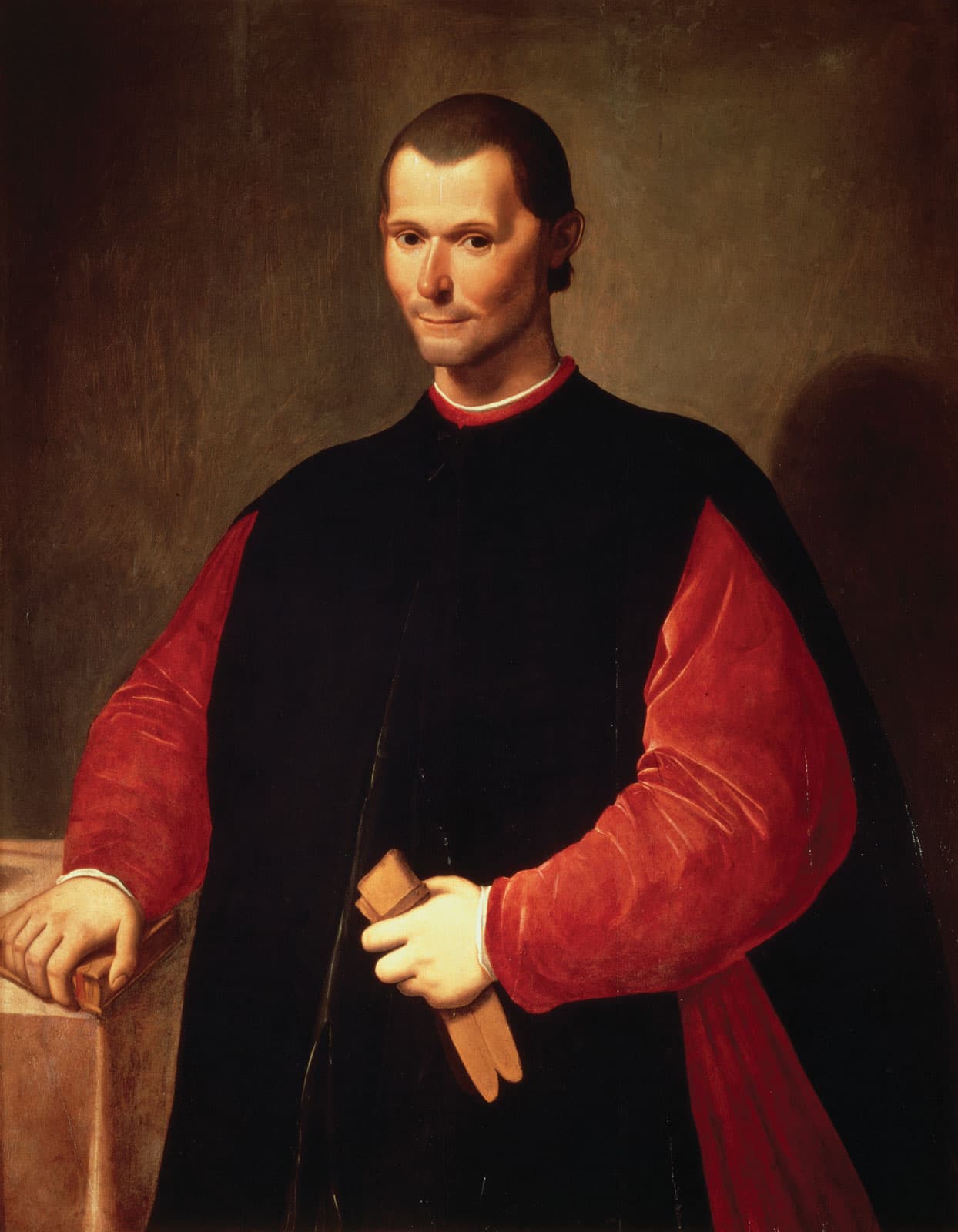
When the Medici family reclaimed control of Florence in 1512, Niccolò di Bernardo dei Machiavelli was stripped of his diplomatic post, falsely accused of treason, and cast into exile.
In the winter of 1513, in a modest farm estate at Sant'Andrea in Percussina, a disgraced diplomat would wait for the sun to set before performing a nightly ritual of resurrection. After a day spent bickering with local woodcutters and playing cards with the hostler at the village tavern, Niccolò Machiavelli would return to his study. On the threshold, he took off his mud-covered, filthy work clothes and dressed in the formal robes of an ambassador. Decently attired, he stepped into his library as if entering the ancient courts of rulers long since dead. They welcomed him warmly, and for four hours at a time, he felt no shame in talking to them, asking them to explain their actions, and they, out of kindness, answered him. In this twilight communion with the ghosts of Rome and Greece, Machiavelli forgot his poverty, forgot his recent torture, and ceased to fear death. He poured everything he knew of statecraft into a small, urgent tract he called a "whimsy"—a gift intended to win his way back into the favor of the Medici family who had ruined him. That booklet, The Prince, would eventually detach his name from his own humanity, transforming it into a global synonym for cold-blooded, unscrupulous tyranny.
The Florence of Machiavelli’s youth was a laboratory of spectacular political volatility. Born on May 3, 1469, to Bernardo di Niccolò Machiavelli, a jurist of noble but impoverished lineage, and Bartolomea di Stefano Nelli, Niccolò grew up under the shadow of his father's legal status. Because Bernardo was born illegitimately, he was barred from full citizenship and public office, a disenfranchisement that also affected his son. Yet Bernardo’s diaries reveal a household rich in books if poor in coin. The young Machiavelli was drilled in Latin, grammar, and rhetoric by Paolo da Ronciglione, absorbing the Roman historians with a hunger that bypassed the dry, scholastic trifling of his contemporaries. He was nine years old when the Pazzi family attempted to slaughter Lorenzo and Giuliano de' Medici inside the cathedral of Florence, an act of bloody theater that ended with the conspirators swinging from the windows of the government palace. He watched the rise of the fanatical friar Girolamo Savonarola, whose fiery sermons dominated the city after the Medici were expelled in 1494, and he stood among the crowd when Savonarola, having lost his grip on the populace, was burned at the stake as a heretic in 1498.
Days after the friar's ashes were thrown into the Arno, the twenty-nine-year-old Machiavelli was appointed secretary to the second chancery of the Florentine Republic. It was an astonishing appointment for a young man with no formal legal training, and it thrust him into the engine room of Florentine foreign policy. For the next fourteen years, as secretary to the council responsible for diplomacy and war, Machiavelli lived on horseback, writing thousands of official dispatches and representing the republic before the great powers of Europe. His education was forged not in libraries, but in the drafty tent of Cesare Borgia, the brilliant, ruthless son of Pope Alexander VI. Sent to Romagna in 1502 to watch the duke, Machiavelli witnessed Borgia pacify a chaotic province through calculated terror and then, in a masterstroke of political theater, lure his own rebellious captains to a feast in Sinigaglia and have them strangled. Where others saw a monster, Machiavelli saw a brilliant, self-reliant architect of statehood who knew how to use cruelty with surgical precision. Borgia became the glittering model for Machiavelli's political imagination, an archetype of the leader who understood that in a corrupted world, half-measures invite ruin.
12 links to entries not yet ingested in the Library.
This obsession with practical survival led Machiavelli to his most ambitious project: the creation of a native Florentine militia. Having watched Florence rely on mercenary captains who were expensive, treacherous, and cowardly—most notably the condottiere Paolo Vitelli, whose treason led to his execution in 1499—Machiavelli turned to his beloved Roman history. He argued that a healthy republic must be defended by its own citizens, men who fought for their homes rather than a paycheck. Supported by the Florentine leader Piero Soderini, Machiavelli traveled the Tuscan countryside, recruiting and training a force of four hundred iron-breasted, pike-wielding farmers. In 1509, his peasant soldiers successfully conquered the rebellious city of Pisa, a triumph that marked the pinnacle of his political career. Yet his deep-seated blind spot regarding the ethical dimension of human nature soon asserted itself; as the commander of this new force, he and Soderini selected Don Micheletto, Cesare Borgia’s notorious personal assassin, to lead the troops. Machiavelli failed to grasp that a ruffian of Micheletto's caliber could never inspire the moral devotion required of a patriotic army.
The house of cards collapsed in August 1512. A Spanish army, backed by Pope Julius II, marched on Florentine territory and brutally sacked the town of Prato. Machiavelli’s citizen militia dissolved in panic before the professional Spanish infantry. Soderini was forced into exile, the republic was dissolved, and the Medici returned to rule Florence. Machiavelli was immediately stripped of his offices, forbidden from leaving Florentine territory, and forced to pay a crushing surety of one thousand florins. Worse followed: his name was discovered on a list of potential sympathizers in an anti-Medici conspiracy. Arrested and thrown into a dungeon, he was subjected to the torture of the cord—his wrists bound behind his back, his body hoisted into the air until his shoulders dislocated. He survived the ordeal without confessing, and upon his release three weeks later, retired to his farm in Sant'Andrea to nurse his broken body and write.
Though The Prince remains his most famous legacy, it was only part of his desperate attempt to understand the mechanics of human power. In his deeper, more expansive work, the Discourses on Livy, written around 1517, Machiavelli revealed his enduring devotion to classical republicanism, arguing that a government of the people is stronger and more durable than any monarchy. Yet his reputation was forever sealed by the shorter, sharper book he wrote for the Medici. The Prince shattered the long tradition of Christian political philosophy, which had argued that a ruler must be virtuous to be successful. Machiavelli asserted the opposite: in a world where most men are ungrateful, fickle, and greedy, a prince who tries to be good in all circumstances will inevitably be ruined. Therefore, a ruler must learn how not to be good, and to use this knowledge or withhold it according to necessity. He must be both a lion to frighten wolves and a fox to recognize traps, keeping his word only when it serves his interests, and excusing the killing of his enemies if it secures the state.
Machiavelli died on June 21, 1527, at the age of fifty-eight, having never regained the political influence he craved. He left behind his wife, Marietta Corsini, and their seven children in genteel poverty. In his final years, he had turned to writing popular comedies to make a living, but his mind never truly left the chancery. He died just as Florence briefly expelled the Medici once again to restore the republic, yet the new democratic government viewed the former secretary with suspicion, seeing him as too closely aligned with the tyrants he had analyzed.
In the centuries that followed, Machiavelli’s name became an adjective of dark renown, condemned by religious authorities and seized upon by monarchs. Yet his true impact was far more complex. By treating politics not as a branch of theology or ethics, but as a cold science of human behavior, he paved the way for modern political thought. Enlightenment philosophers like Jean-Jacques Rousseau and James Harrington would look past the scandalous pages of The Prince to find in his Discourses a blueprint for modern republican liberty. Machiavelli did not invent the dark arts of statecraft; he merely took off his diplomatic robes, sat with the dead, and wrote down what he saw in the dark hearts of the living.