No state before had ever claimed the entire known world as its birthright, nor possessed the administrative machinery to actually govern it.
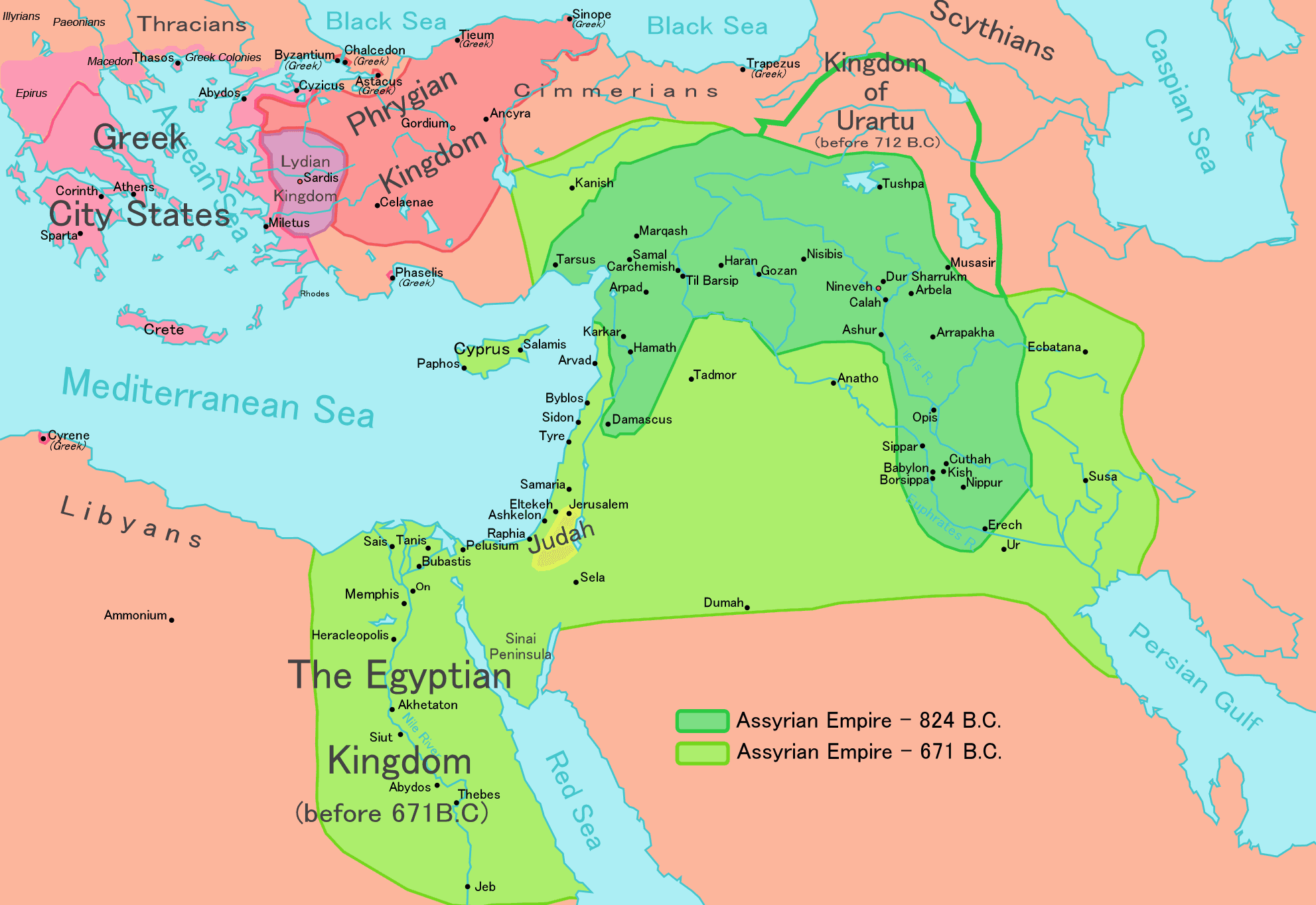
In the ninth century BCE, a visitor traveling toward the Tigris River would have encountered an unsettling monument to political authority. Outside the walls of newly conquered cities, the soldiers of the Assyrian king did not merely post decrees; they built towers of human heads, draped city walls with the skins of rebel governors, and impaled the defiant on stakes. This theater of calculated terror was the calling card of Ashurnasirpal II, a monarch who was both a ruthless warrior and a meticulous administrator. Yet this violence was not wanton. It was the scaffolding of a radical political experiment. Between 911 and 609 BCE, the Neo-Assyrian Empire constructed something the world had never seen: the first true world empire. For the first time in human history, a single state stretched from the Persian Gulf to the Mediterranean, eventually swallowing Egypt, the Levant, Mesopotamia, and parts of Anatolia and Iran. Driven by an ideology of universal dominion, the Assyrians did not merely demand tribute; they sought to dissolve the ancient boundaries of the Near East and rebuild humanity in their own image.
The rise of this colossus was born of a deep historical trauma. During the Late Bronze Age, the Middle Assyrian Empire had been a formidable power, but the catastrophic disruptions of the late eleventh century BCE had shorn the state of its conquests, shrinking Assyrian authority to a narrow, besieged heartland along the Tigris. When Adad-nirari II ascended the throne in 911 BCE—the moment modern historians mark as the birth of the Neo-Assyrian Empire—his chief objective was not global conquest, but a defensive reconquista. The early campaigns of Adad-nirari II and his successor, Tukulti-Ninurta II, were slow, grinding efforts to rescue isolated Assyrian pockets, secure vital trade routes, and reassert control over northern Mesopotamia and the Levant. The early kings moved with caution, often preferring to install puppet rulers or establish vassal states, such as Katmuḫu and Guzana, rather than risking the administrative burden of outright annexation. Adad-nirari II secured his southeastern border through a strategic treaty with Babylon, sealed by a mutual exchange of royal daughters, while his successor secured the empire’s northern flanks, extracting tribute and prized horses from eastern lands like Gilzan.
This cautious consolidation laid the groundwork for the explosive expansion of the mid-ninth century BCE. Under Ashurnasirpal II and his successor, Shalmaneser III, the Assyrian army became an unstoppable machine. Ashurnasirpal II pushed Assyrian arms to the shores of the Mediterranean, but his most enduring monument was peaceful: he abandoned the traditional, sacred capital of Assur and constructed a colossal new administrative center at Kalḫu (known in later traditions as Nimrud). This transfer of the capital symbolized a break from local, conservative priestly elites and the creation of a centralized imperial state. Shalmaneser III expanded these frontiers even further, though his long reign ended in a succession crisis that plunged the empire into a nearly century-long period of stagnation known as the "age of the magnates." During this era of central weakness, provincial governors and powerful generals wielded autonomous authority, and the crown's grip on the periphery slipped.
+ 12 further connections to entries not yet ingested
The crisis of central authority was shattered in 745 BCE by Tiglath-Pileser III, a usurper of extraordinary administrative genius. Tiglath-Pileser III did not merely conquer; he reorganized the very anatomy of the state. He broke up large, over-powerful provinces into smaller administrative units to prevent regional governors from challenging the throne, and he more than doubled the size of the empire, permanently annexing Babylonia and large swathes of the Levant. It was under his rule, and the subsequent Sargonid dynasty founded in 722 BCE, that the empire reached its apex. Sennacherib moved the imperial capital to Nineveh, transforming it into a glittering metropolis of gardens, canals, and monumental palaces. His successor, Esarhaddon, achieved what had once seemed impossible, marching his armies across the Sinai Peninsula to conquer Egypt, making the Neo-Assyrian Empire the largest geopolitical entity the world had ever known.
At the heart of this unprecedented success was a series of profound administrative and military innovations. The Assyrians were the first to deploy cavalry on a massive, standardized scale, pairing them with advanced siege warfare techniques that could breach the most formidable stone walls of the ancient world. To govern their vast domains, they constructed a sophisticated state communication system. Utilizing a network of well-maintained imperial roads and strategic relay stations, official royal messengers could carry intelligence across the Near East at a speed that was not surpassed in the region until the arrival of the telegraph and steamship in the nineteenth century.
Most transformative of all was the Assyrian policy of mass resettlement. Rather than leaving conquered populations intact to foster regional rebellions, the imperial administration systematically uprooted entire communities, moving hundreds of thousands of people from the periphery to the Assyrian heartland or to underpopulated, newly cleared agricultural frontiers. This policy served a dual purpose: it shattered localized ethnic identities, making organized rebellion nearly impossible to coordinate, and it concentrated diverse labor pools to build cities, dig canals, and cultivate new lands using advanced Assyrian agricultural techniques. An unintended but permanent consequence of this massive human reshuffling was the linguistic homogenization of the Near East. As diverse peoples were intermingled, their native tongues faded, and Aramaic—written on easily transportable papyrus rather than heavy clay cuneiform tablets—gradually rose to become the lingua franca of the region, a position of linguistic dominance it would retain for more than two thousand years.
The spiritual and intellectual legacy of this iron-fisted empire reverberated long after its armies fell silent. The Assyrian ideology of universal rule—the belief that their king was the earthly representative of the god Ashur, charged with bringing order to a chaotic world—introduced the concept of translatio imperii, the transfer of a divine right to global hegemony, which would inspire the political theology of empires well into the modern era. The political structures pioneered by Nineveh became the direct blueprints for the Neo-Babylonian, Achaemenid Persian, and Seleucid empires that followed. Furthermore, the traumatic collision between Assyria and the small kingdoms of the Levant left an indelible mark on Western monotheism. The kingdoms of Israel and Judah were profoundly shaped by Assyrian hegemony; numerous biblical narratives, laws, and theological concepts were formulated in direct response to, or drew inspiration from, Assyrian history, mythology, and imperial treaties.
Yet, for all its structural sophistication and military might, the end of the Neo-Assyrian Empire came with shocking, apocalyptic swiftness. At the height of its power under Esarhaddon and his successor Ashurbanipal, the empire appeared invincible. Yet the strain of maintaining garrisons from the Nile to the Zagros Mountains, combined with chronic internal succession disputes, had hollowed out the state. In the late seventh century BCE, a massive Babylonian uprising led by Nabopolassar allied with an invading army of Medes from the Iranian plateau. In a series of devastating campaigns between 612 and 609 BCE, the great imperial cities of Assur, Kalḫu, and Nineveh were systematically besieged, sacked, and burned to the ground. The collapse was so complete that within a few generations, the physical ruins of these grand capitals were buried beneath the dust of Mesopotamia, remembered primarily through the haunted accounts of the Hebrew Bible and Greek historians. The empire that had sought to unify the world under a single god and a single king vanished, leaving behind a reshaped human geography, a common language, and the enduring, terrifying blueprint of global empire.