Person · 1370 BCE – 1330 BCE · Ancient Egypt
Nefertiti
- Also known as
- Nafteta
- Naftetaa
- Nefer Neferou Aton
- Nefernefruaton Nefertiti
- Nefertete
- Nefertete
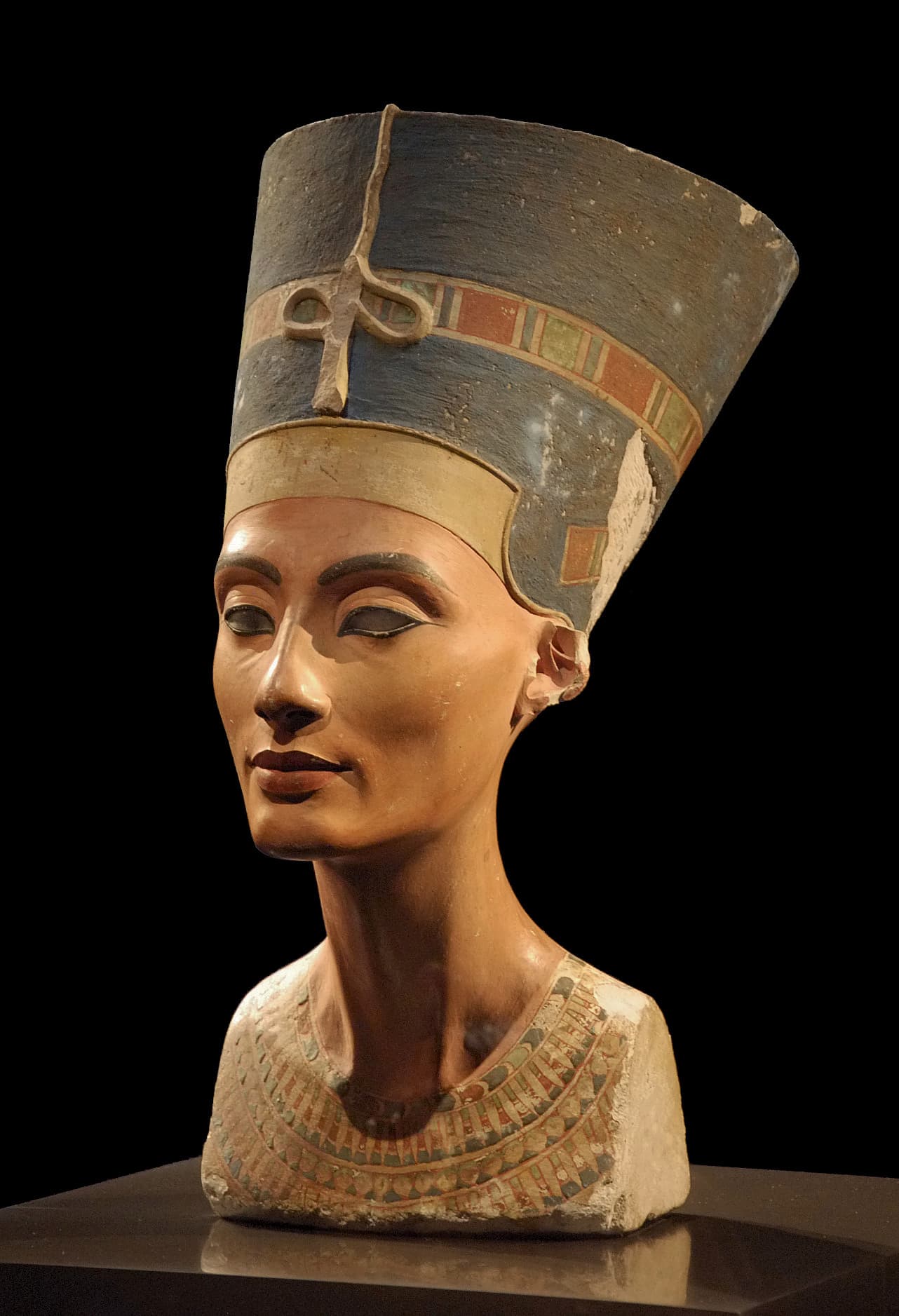
At the height of the Eighteenth Dynasty, when Egypt was at its wealthiest and most powerful, a queen emerged who would help dismantle centuries of religious tradition.
The transformation did not begin with a slow erosion of tradition, but with a sudden, blinding light. In the mid-fourteenth century BCE, the ancient Egyptian capital of Thebes witnessed a quiet but radical departure from the centuries-old religious order. In the damaged tomb of the royal butler Parennefer, and again on the walls of the grand vizier Ramose’s tomb, a newly crowned Pharaoh Amenhotep IV appeared alongside a woman of striking prominence. They were not merely performing the standard, passive roles of royal domesticity. Instead, they stood together in the Window of Appearance, offering devotion to a single, exclusive source of divine power: the Aten, the physical disc of the sun. The woman was Nefertiti, and her emergence marked the beginning of an era of unprecedented wealth, stylistic revolution, and a sweeping monolatry that would temporarily dismantle the religious foundations of the Nile Valley.
Her name, Nefer.t-jj.tj, translated in the contemporary tongue as "the beautiful one has come." Yet her origins remain shrouded in the dry sands of the desert, preserved only through circumstantial titles and later speculation. She was not designated as a "King's Daughter" or "King's Sister," suggesting she was not of the immediate royal bloodline. Instead, a complex web of court relations points elsewhere. A woman named Tey held the title of "Nurse of the Great Royal Wife," and Tey’s husband, Ay—a high-ranking official who wielded immense influence both during and after Nefertiti’s lifetime—bore the title "God’s Father," a designation often reserved for a pharaoh’s father-in-law. This has led many to believe that Nefertiti was Ay’s daughter, perhaps from a marriage prior to his union with Tey. Other early theories sought to cast her as a foreign import, identifying her with the Mitanni princess Tadukhipa, using her name as proof of an arrival from abroad. But Tadukhipa had married Akhenaten’s father, Amenhotep III, and there is no evidence of a foreign lineage for Nefertiti, nor any clear reason why a foreign princess would discard her identity so thoroughly. She was, by all appearances, an insider of the Egyptian court, positioned at the right hand of a young king poised to remake the world.
By the fifth year of his reign, the pharaoh abandoned his birth name for Akhenaten—"He who is useful to the Aten"—and Nefertiti assumed the longer, state-sanctioned moniker Neferneferuaten-Nefertiti: "Beautiful is the beauty of Aten, the beautiful one has come." To fully manifest this new cosmic order, the royal couple abandoned Thebes entirely. They established a brand-new capital, Akhetaten—"The Horizon of the Aten"—on a virgin stretch of desert along the Nile at modern-day Amarna. The boundaries of this sacred enclave were carved directly into the limestone cliffs on monumental stelae, declaring the city a sanctuary for the solar disc. Here, in a city of wide, open-air temples designed to catch the unobstructed rays of the sun, Nefertiti’s domestic and political life unfolded. She and Akhenaten raised six daughters: Meritaten, Meketaten, Ankhesenpaaten, Neferneferuaten Tasherit, Neferneferure, and Setepenre. For a time, she was thought to be the mother of the boy-king Tutankhamun, though genetic testing of the era's royal mummies has since disproven this connection.
At Amarna, Nefertiti was far more than a consort. Her image was woven into the very fabric of state ideology. In the early years of the Atenist revolution, her likeness appeared on salvaged stone blocks—the talatat used to build temples at Karnak—nearly twice as often as that of her husband. In the Mansion of the Benben, a temple dedicated specifically to her, she was depicted conducting rites alongside her eldest daughters, bypassing the traditional male priesthood entirely. Her imagery crossed the threshold from queenly support to pharaoh-like authority. She was carved into stone monuments riding her own chariot, presenting offerings to the Aten in the exact manner of a king, and smiting the enemies of Egypt, her throne decorated with captive foreign prisoners. She bore titles that spoke to an extraordinary breadth of influence: Hereditary Princess, Great of Praises, Lady of the Two Lands, and Mistress of Upper and Lower Egypt.
For decades, Egyptologists believed that this brilliant career ended abruptly around the twelfth year of Akhenaten’s reign. The historical record seemed to fall silent. Earlier scholars hypothesized that she had died in a plague, suffered a sudden fatal injury, or fallen into disgrace, pointing to fragments of her funerary ushabti figures found in the ruins of Amarna. The theory of her fall from grace was eventually debunked when it was discovered that the defaced monuments of the era belonged not to Nefertiti, but to another royal wife, Kiya. The mystery of her sudden "disappearance" was shattered entirely in 2012 with the discovery of a five-line red ochre ink inscription in a limestone quarry at Dayr Abū Ḥinnis. Dated to the sixteenth regnal year of Akhenaten—just one year before his death—the text explicitly mentions the "Great Royal Wife, His Beloved, Mistress of the Two Lands, Neferneferuaten Nefertiti" supervising ongoing construction on the Small Aten Temple in Amarna.
This late inscription fueled a growing consensus among modern scholars that Nefertiti did not perish or fade into obscurity, but instead transitioned into an even higher tier of power. As Akhenaten’s reign drew to a close, she appears to have been elevated to co-regent. When her name as queen finally vanished from the state record, it was replaced by that of a co-regent and eventual sovereign named Pharaoh Neferneferuaten. Rather than disappearing, Nefertiti likely took the throne herself, adopting a male-style pharaonic title to rule Egypt, much as Hatshepsut had done centuries earlier. While some alternative theories suggested she had disguised herself as a male co-regent named Smenkhkare, modern consensus suggests Smenkhkare was a separate male co-regent who predeceased Akhenaten, leaving the path clear for Nefertiti to assume sole authority.
If Nefertiti did rule as Pharaoh Neferneferuaten, her brief reign was a delicate exercise in political survival and damage control. Facing an empire fatigued by her husband's radical religious isolationism, she appears to have initiated a quiet retreat from the brink. It is highly likely that she began the process of restoring the traditional pantheon, reinstating the priesthood of Amun, and preparing her successor, the young Tutankhamun, to inherit a stabilized kingdom. Female-styled ushabtis and distinct feminine royal items found buried in Tutankhamun's tomb, alongside representations of her smiting enemies, suggest that she held the reins of state during this fragile transition. Yet, her efforts could not save the holy city she had helped build. Following her death, the grand palaces and open-air temples of Amarna were abandoned to the desert winds, and the seat of royal power was moved back to the ancient administrative capital of Memphis.
For millennia, the queen who had stood at the center of Egypt’s most radical epoch was forgotten, her monuments defaced by subsequent dynasties eager to erase the memory of the "heretic" Amarna period. But in December 1912, the German excavator Ludwig Borchardt, digging in the ruins of Amarna, uncovered the buried workshop of the ancient royal sculptor Thutmose. Amidst the debris of plaster and stone lay a painted limestone bust. The piece, capturing her elegant, slender neck, her distinctive tall blue crown, and a face of symmetrical, serene gravity, became an instant global sensation. Today, housed in Berlin's Neues Museum, the bust is one of the most widely copied and recognized works of ancient art in human history. It rescued Nefertiti from the obscurity of forgotten king-lists, transforming her into an archetype of classical majesty. To the modern world, she remains the defining face of ancient Egypt—a queen who stepped into the light of a single sun, took up the mantle of a king, and held an empire together as its old gods fell.
Connected to
- spouse · spouse ofAkhenaten14th c. BCE
+ 12 further connections to entries not yet ingested