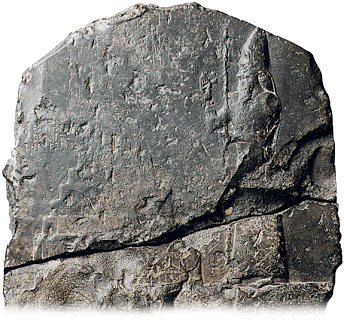
Before he ever sat upon the throne of Babylon, the young prince Nebuchadnezzar II secured his place in history on the battlefield of Carchemish.
To the writers of the Hebrew Bible, he was the instrument of divine wrath, a roaring lion from the north who shattered the walls of Jerusalem, burned Solomon’s Temple, and dragged the children of Israel into exile. To the Greek historians who looked back across the Aegean, he was a near-mythic potentate of the East, a master of gardens that floated in the air and walls so thick that two chariots could pass abreast upon their ramparts. His name in his native Akkadian was Nabû-kudurri-uṣur—"Nabu, watch over my heir"—a title that later generations of Western scribes would slide and soften into Nebuchadnezzar. He was the second ruler of the Neo-Babylonian Empire, a state built hastily upon the ashes of Assyria, and during his forty-three-year reign, from 605 to 562 BCE, he transformed his capital into the undisputed center of the ancient world. Yet behind the monumental brickwork and the biblical terror lies a more fragile reality: a king who spent the first half of his reign struggling to escape his father’s shadow, whose grandest military campaigns were often desperate efforts to hold a volatile empire together, and whose legacy was recorded not by his own scribes, but by the peoples he conquered.
The empire Nebuchadnezzar inherited was a young, precarious thing. For nearly a century, Babylon had writhed under the brutal hegemony of the Neo-Assyrian Empire. It was Nebuchadnezzar’s father, Nabopolassar, who had finally broken the Assyrian yoke, rallying the south and orchestrating a devastating war of liberation alongside the Medes. Though modern historians often refer to Nabopolassar’s line as the "Chaldean dynasty," his exact origins remain shrouded; he may have emerged from the urban elite of Uruk, where records suggest his family suffered horrific reprisals—including the desecration and dragging of an ancestor’s corpse through the streets—for their anti-Assyrian activities. Nebuchadnezzar grew up in the shadow of this existential struggle. As a young man, he was installed as the high priest of the Eanna temple in Uruk, where he went by the domestic nickname "Kudurru." But his true education was on the march. He accompanied his father’s armies in the final, grinding campaigns against the Assyrian rump state at Harran in 610 BCE, and by 607 BCE, he was commanding his own divisions in the rugged northern highlands.
The defining moment of Nebuchadnezzar’s youth, and the achievement that secured his path to the throne, came in the spring of 605 BCE at the ancient crossroads of Carchemish. The Assyrians were gone, but their late allies, the Egyptians under Pharaoh Necho II, had pushed north into the Levant, seeking to claim the western provinces of the collapsed empire and establish a permanent buffer against the rising Babylonian power. Nabopolassar, old and failing in health, stayed in the capital, leaving the young crown prince to lead the Babylonian host. At Carchemish, on the banks of the Euphrates, Nebuchadnezzar caught the Egyptian army and inflicted a crushing, decisive defeat. The victory reshaped the geopolitics of the Near East in an afternoon, establishing Babylon as the undisputed successor to Assyria. While pursuing the remnants of the shattered Egyptian forces southward, word reached the prince that his father had died in Babylon. Nebuchadnezzar raced back across the desert to claim the crown, arriving in the capital to be anointed king of the world’s newest superpower.
+ 12 further connections to entries not yet ingested
Yet the transition from victorious general to sovereign of a vast empire proved deceptively difficult. The early years of Nebuchadnezzar’s reign were characterized not by grand triumphs, but by frustration and political instability. The vassal states of the Levant, accustomed to playing Egypt and Mesopotamia against one another, viewed the new king with skepticism. When Nebuchadnezzar attempted a direct invasion of Egypt in the early years of his reign, the campaign ended in a disastrous, costly failure. This display of vulnerability sent shockwaves through his territories. Rebellion flared in the east, requiring immediate military suppression, while in the west, several vassals began openly questioning Babylon’s authority. Among these doubters was the Kingdom of Judah, a small but strategically vital hill country positioned between the warring giants of Egypt and Mesopotamia.
To restore his authority and secure his western frontier, Nebuchadnezzar launched a series of punitive campaigns into the Levant during the 580s BCE. The most famous of these sieges targeted Jerusalem. In 587 BCE, after a protracted and bitter investment, Babylonian troops breached the city walls. The city was systematically dismantled: its palaces were burned, its legendary temple was reduced to ash, and a significant portion of Judah’s political, religious, and artisan elite was deported to Babylonia. This event, which initiated the Babylonian captivity, was a catastrophic trauma for the Jewish people, yet to Nebuchadnezzar, it was standard imperial maintenance—a routine relocation of rebellious subjects designed to break their national identity and harness their labor for his ambitious building programs. Shortly thereafter, he turned his attention to the wealthy Phoenician port of Tyre, subjecting it to a legendary, grinding siege that lasted for years before a compromise was reached. Through these brutal, methodical campaigns, Nebuchadnezzar successfully stabilized his borders and flooded his capital with tribute and captive labor.
With the empire’s borders secured and its treasury overflowing, Nebuchadnezzar turned his attention to an obsession that would define the rest of his life: the reconstruction of Babylon. For a long time, modern historians viewed Nebuchadnezzar primarily as a builder rather than a warrior, largely because the vast majority of his surviving cuneiform inscriptions completely ignore his military victories, focusing instead on his architectural achievements. Under his direction, Babylon became a monument to the god Marduk and a physical manifestation of imperial cosmology. He restored the Esagila temple complex and rebuilt the Etemenanki, the great ziggurat that rose hundreds of feet into the sky and likely inspired the biblical legend of the Tower of Babel. He paved the great Processional Way with imported stone and flanked it with walls of glazed blue brick adorned with reliefs of lions and dragons. This road led to the magnificent Ishtar Gate, a towering monument of cobalt-blue tile that served as the primary ceremonial entrance to the city.
For all his monumental legacy, the historical record of Nebuchadnezzar’s later years remains frustratingly sparse. A significant gap in contemporary cuneiform sources exists between 594 and 557 BCE, leaving historians dependent on a complex tapestry of secondary sources written centuries later in Hebrew, Greek, and Latin. While these later narratives are often colored by the cultural biases of their authors—picturing Nebuchadnezzar either as a tyrannical madman humbled by the Hebrew God or as a semi-divine builder of architectural wonders—they provide the essential framework for understanding a reign that contemporary Babylonian tablets, focused on temple administrative details and construction accounts, chose to leave unvarnished. When Nebuchadnezzar died in 562 BCE after forty-three years on the throne, he left behind an empire that was wealthier and more physically imposing than any that had come before it. Yet the political structure he built was fragile, dependent entirely on the strength of a single ruler. Within less than a quarter-century of his death, the great gates of Babylon would open to Cyrus the Great, and the Neo-Babylonian Empire would vanish into history, leaving its formidable builder to live on primarily in the sacred texts of the people he had exiled.