Place · Gupta and Medieval India
Nalanda Mahavihara
- Also known as
- Mahavihara of Nalanda
- Nalanda
- Nalanda
- Nalanda
- Nalanda
- Nalanda
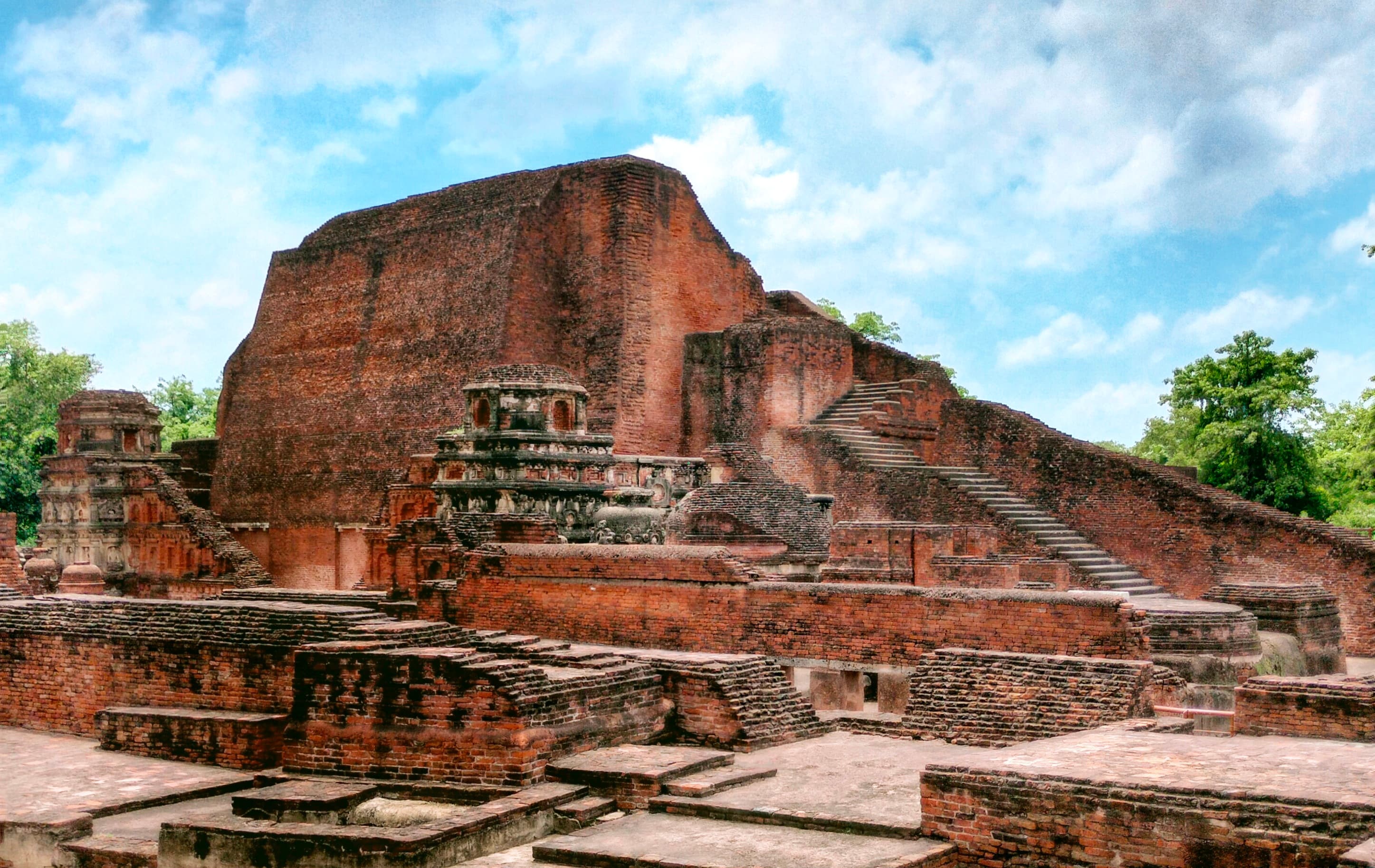
Long before the great universities of Europe were even conceived, a sprawling monastic metropolis in eastern India was already gathering thousands of minds to debate the nature of reality, medicine, and the stars.
To the Chinese pilgrim Faxian, who walked the dusty roads of Magadha in the early years of the fifth century CE, the landscape southeast of Pataliputra was holy but physically unremarkable. He was seeking the original Sanskrit scriptures of the Buddhist law, tracing the footsteps of the historical Buddha and his disciples. He visited the quiet mango groves near Rajagriha and noted where Sariputta, the Buddha’s chief disciple, was born and achieved nirvana. Yet in his otherwise exhaustive travelogue, Faxian made no mention of any great monastery or seat of learning in the area. When he passed through, there was simply nothing there to report—only an ancient, quiet landscape of manmade lakes and lotus-filled marshes.
A mere two centuries later, another Chinese pilgrim, Xuanzang, arrived at the same spot to find a spectacle that left him breathless. Towering multi-story brick pavilions rose above the plains, their richly carved towers and deep-red walls reflected in the waters of the surrounding lakes. What had been a silent countryside had transformed into Nalanda Mahavihara: a colossal, humming monastic city, home to thousands of resident monks, scholars, and thinkers. It was a place where, as Xuanzang marvelled, "the whole is truly marvellous to behold," and where the day was never long enough to exhaust the depth of the debates echoing through its courtyards. For nearly a thousand years, this great monastery would serve as the intellectual engine of the Mahayana Buddhist world, a crucible of philosophy, science, and translation that altered the cultural topography of Asia.
The catalyst for this sudden, monumental rise was the patronage of the Gupta Empire, specifically Emperor Kumaragupta I, who established the first major monastery at the site around 427 CE. Identified in seals and records by the epithet Shakraditya, this Hindu sovereign initiated a tradition of royal largesse that defied modern notions of sectarian division. Despite being built as a Buddhist institution, Nalanda’s early development was funded by a remarkably diverse coalition. Archaeological excavations have unearthed Gupta-era seals bearing the emblems of Lakshmi, Ganesha, Durga, and the Shivalinga alongside Buddhist iconography, demonstrating that the monastery’s support base crossed deep religious lines. Successive rulers added new monasteries, temples, and libraries, a pattern of expansion that continued long after the Guptas fell.
By the seventh century, the post-Gupta emperor Harsha of Kannauj had taken up the mantle of patron, granting the revenues of one hundred local villages to the institution. To sustain this sprawling scholarly population, Harsha decreed that two hundred households from each of these villages must supply Nalanda’s monks with daily provisions of rice, butter, and milk. While Chinese accounts of ten thousand resident monks may stretch the physical limits of the excavated ruins—which more likely accommodated a population closer to the three thousand reported by the later pilgrim Yijing—the scale of the enterprise was undeniably vast. Nalanda became a self-sustaining city of the mind, insulated from the mundane struggles of survival by royal endowments that stretched across borders. The network of patronage eventually extended overseas: the Buddhist kings of Sumatra in maritime Southeast Asia contributed entire Indian villages to the monastery’s endowment, and specialized funds were established specifically to support foreign scholars making the perilous trek from China.
At its core, Nalanda was much more than a theological seminary; it was a comprehensive intellectual laboratory. While it was the undisputed capital of Mahayana Buddhist philosophy—where the subtle doctrines of Madhyamaka, Yogachara, and Sarvastivada were dissected and debated—the curriculum was radically ecumenical. Students who passed the rigorous oral examinations at the monastery's gates were expected to master the Hindu Vedas, Sanskrit grammar, logic, mathematics, astronomy, medicine, and even alchemy. It was this rigorous training in logic and linguistics that produced a millennium of intellectual titans. The great philosophers Nagarjuna, Asanga, and Vasubandhu shaped its early intellectual traditions; later, the brilliant logician Dharmakirti and the poet-monk Shantideva composed works here that would form the bedrock of Tibetan and East Asian Buddhism.
The physical heart of this intellectual empire was its library, a legendary repository of Sanskrit manuscripts. It was here that pilgrims like Xuanzang and Yijing spent years painstakingly copying texts to carry back across the Himalayas and deserts to China. These Sanskrit manuscripts, containing complex systems of epistemology and tantric ritual, became the seeds from which Zen, Tibetan Vajrayana, and East Asian Buddhist schools grew. Without the scriptorium of Nalanda, the transmission of Indian thought to the wider Asian continent would have been radically diminished.
Yet Nalanda's prestige made it a target as much as a sanctuary. Its wealth and intellectual prominence drew the destructive attention of invaders who saw the great brick complex as a symbol of the established order. In the late fifth century, the Huns under Mihirakula swept through and attacked the mahavihara, and in the eighth century, it suffered severe damage during an invasion by the Gauda king of Bengal. Each time, however, the resilient community rebuilt, supported by the rulers of the Pala Empire and later the local Pithipatis of Magadha.
The final, catastrophic blow came around 1200 CE, when the forces of the Turkic commander Muhammad Bakhtiyar Khilji swept through the region. The grand brick monasteries were put to the torch, and its legendary libraries, filled with centuries of human thought, were consumed by fire. Yet, even this apocalyptic event did not bring an immediate end to Nalanda. For decades, and perhaps even centuries after Khilji’s raids, a diminished community of monks and teachers clung to the ruins, keeping the flame of learning alive in a rapidly changing world before the site was finally abandoned to the elements and buried by dust.
Today, the sprawling red-brick ruins of Nalanda are recognized as a UNESCO World Heritage Site, a silent landscape of excavated courtyards, stupas, and cells situated between the ancient manmade lakes of Bihar. The physical structures are quiet now, but the intellectual currents generated within their walls continue to flow. The texts translated and composed here remain central to the living traditions of Tibet, China, Japan, and Korea. In 2010, the Government of India sought to revive this ancient legacy by establishing a contemporary university near the ruins, naming it an Institute of National Importance. It is an acknowledgment that Nalanda was never merely a local monastery, but a global crossroads where the pursuit of human understanding briefly transcended the boundaries of geography, empire, and faith.
Connected to
5 links to entries not yet ingested in the Library.