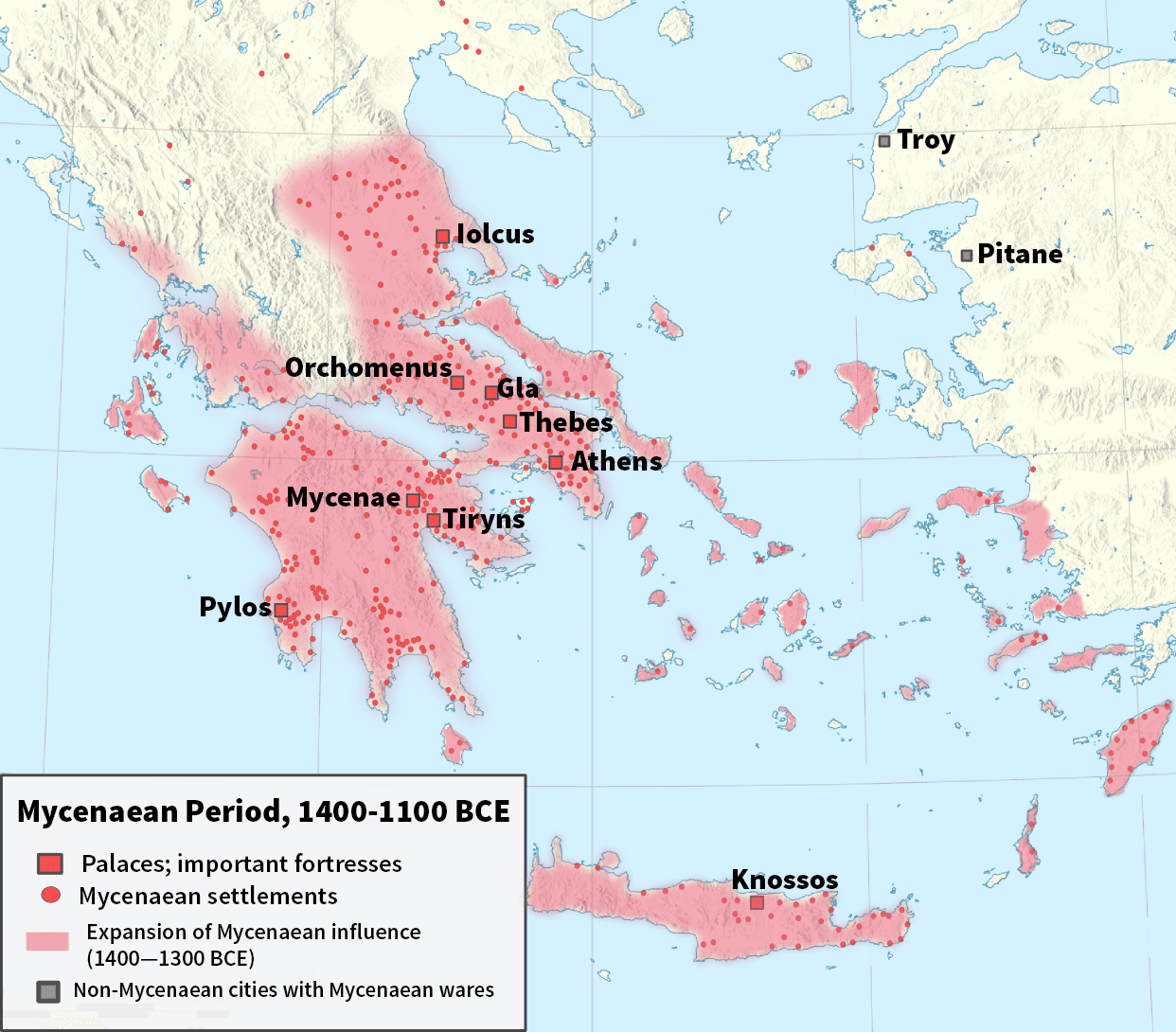
Centuries before the philosophers of Athens debated in the agora, a warrior elite ruled the Greek mainland from monumental palace-states like Pylos, Tiryns, and Mycenae itself.
Sometime in the sixteenth century BCE, on the dry, limestone acropolis of Mycenae in the northeastern Peloponnese, a group of people dug a series of deep, vertical shafts into the earth. Within these stone-lined pits, they laid their dead to rest with a sudden, astonishing display of wealth that shattered centuries of modest, provincial mainland living. Men were buried beneath heavy plates of beaten gold hammered into the likeness of stern, bearded faces; beside them lay bronze swords inlaid with scenes of lions chasing deer through papyrus marshes. Women were adorned in towering gold crowns and garments sewn with hundreds of shimmering gold discs. For generations, archaeologists assumed these graves represented the sudden arrival of foreign conquerors—perhaps chariot-riding invaders from the Eurasian steppe or the Black Sea. Yet modern genetic analysis and material studies suggest a different, more fascinating reality: these people were ethnically continuous with the older, quiet populations of the Greek mainland. They were not invaders; they were a native elite who had rapidly transformed themselves. Through sea trade, piracy, and mercenary service, they had connected their rugged valleys to the wider, wealthy networks of the Late Bronze Age Mediterranean, using their newfound fortunes to construct a fierce, monumentally scaled theater of power.
This sudden awakening marked the beginning of Mycenaean Greece, a civilization that flourished from roughly 1600 BCE to 1100 BCE as the first advanced, literate culture of the Greek mainland. For centuries, the Mycenaean world was defined by its relationship with the older, highly sophisticated Minoan civilization of Crete. The relationship was one of intense, creative mimicry and eventual conquest. The early Mycenaean elite adopted Minoan artistic styles, borrowed their religious iconography, and adapted their administrative administrative tools. Yet the mainlanders possessed a temperament radically different from the islanders. Where Minoan art was fluid, naturalistic, and largely devoid of overt military imagery, Mycenaean culture was intensely militaristic and obsessed with fortification. On the walls of Akrotiri on the volcanic island of Thera, a sixteenth-century BCE fresco depicts warriors wearing helmets made of overlapping rows of split boar’s tusks—a uniquely mainland piece of armor that required the hunting of dozens of wild beasts for a single helmet. While Minoan palaces were open, sprawling complexes integrated into the landscape, Mycenaean citadels like Tiryns, Midea, and Mycenae itself were crowned with massive, thick stone walls. Later Greeks, marveling at the sheer scale of the boulders used to construct these fortresses, believed that only the one-eyed giants known as the Cyclopes could have lifted them into place.
8 links to entries not yet ingested in the Library.
At the heart of these fortified strongholds sat the megaron, a large, rectangular central hall with a four-columned hearth, which served as the throne room and sacred center of the palace. From here, a king known as a wanax ruled over a highly stratified, rigidly organized bureaucratic state. Unlike the decentralized clans of later Greek history, the Mycenaean palatial states maintained an astonishingly tight grip on their economies. This control was facilitated by Linear B, a syllabic script adapted from the Cretan Linear A system. Deciphered in 1952 by the English architect and linguist Michael Ventris, Linear B was revealed to be an early, archaic form of the Greek language, establishing an unbroken thread of continuity running from the Bronze Age to the classical world of Athens and Sparta. The tablets, preserved accidentally when the palaces were burned and the clay was baked hard, contain no poetry, history, or personal letters. Instead, they are dry, obsessive administrative ledgers. They record the precise number of sheep assigned to a shepherd in Pylos, the quantities of bronze allocated to palace metalsmiths, the jugs of perfumed olive oil prepared for export, and the names of deities—including Zeus, Poseidon, and Athena—who would later form the core of the classical Olympic pantheon.
By the fifteenth century BCE, this highly organized military machine began to project its power outward, aggressively eclipsing its former Cretan mentors. Around 1450 BCE, a Mycenaean warrior elite seized control of the palace of Knossos on Crete, establishing a hybrid Minoan-Mycenaean administration. With the collapse of Minoan maritime hegemony, the Mycenaeans inherited and vastly expanded the trade routes of the Aegean, ushering in an era of cultural uniformity known as the Mycenaean koine. Their ships, heavy with painted stirrup jars of olive oil, wine, and scented unguents, traversed the entire Mediterranean. Mycenaean pottery and artifacts have been recovered from the southern Italian islands of Lipari and Vivara, the coasts of Spain, Cyprus, and the Levant, and as far south as the Egyptian tombs of Saqqara and Gurob.
To the great empires of the East, this rising maritime power was a force to be reckoned with. In the official archives of the Hittite Empire in central Anatolia, scribes wrote of a powerful western kingdom called Ahhiyawa—a name that modern scholars confidently equate with the Homeric Achaeans, one of the collective terms used for the Greeks in the Iliad. Hittite documents from the fourteenth and thirteenth centuries BCE treat the king of Ahhiyawa as an equal, a "great king" who commanded fleets, forged alliances, and occasionally destabilized Hittite control on the Anatolian coast. Similarly, Egyptian records from the reign of Pharaoh Thutmoses III refer to a distant land called Danaya (the Homeric Danaoi), identifying cities that can be linked directly to Mycenae, Thebes, and Nauplion. For a brilliant, fleeting period of two centuries, the warlike principalities of the Greek mainland were part of a globalized, highly interconnected network of Bronze Age superpowers, bound together by royal diplomacy, gift exchange, and trade.
This entire world vanished in a spectacular, cascading catastrophe during the twelfth century BCE. Between roughly 1200 BCE and 1100 BCE, the great palaces of Greece were systematically destroyed, looted, and burned. The complex administrative systems vanished; the art of writing in Linear B was completely forgotten; and the population of the Peloponnese plummeted as settlements were abandoned. For decades, historians blamed this sudden collapse on a single catastrophic event: the "Dorian Invasion" of migrating tribes from the north, or the violent raids of the mysterious "Sea Peoples," whom Egyptian records, such as those mentioning the Ekwesh (likely Ahhiyawans), depict as ravaging the Mediterranean. More recent scholarship, however, favors a complex web of systemic failures. A combination of prolonged droughts, agricultural failure, and localized earthquakes may have disrupted the fragile, top-heavy palace economies. Deprived of trade and facing internal peasant revolts against the rigid demands of the wanax, the highly centralized Mycenaean states likely collapsed from within, leaving them vulnerable to external raids.
What remained after the smoke cleared was a quiet, decentralized landscape that historians call the Greek Dark Ages. The monumental stone fortresses crumbled into ruin, and the memory of the kings who built them became distorted and magnified by time. Yet the Mycenaeans did not truly disappear. Their language survived in the spoken dialects of the Greek valleys, and their legends became the bedrock of Western literature. When eighth-century BCE poets like Homer sang of Agamemnon’s "golden Mycenae," of the massive bronze shields, and of the distant wars fought across the Aegean, they were looking backward through centuries of ruin at a half-remembered golden age. The Mycenaeans left behind a landscape haunted by their scale, bequeathing to classical Greece not just the names of its gods and the roots of its language, but the enduring myth of an era when men were grander, stronger, and walked in the company of the gods.