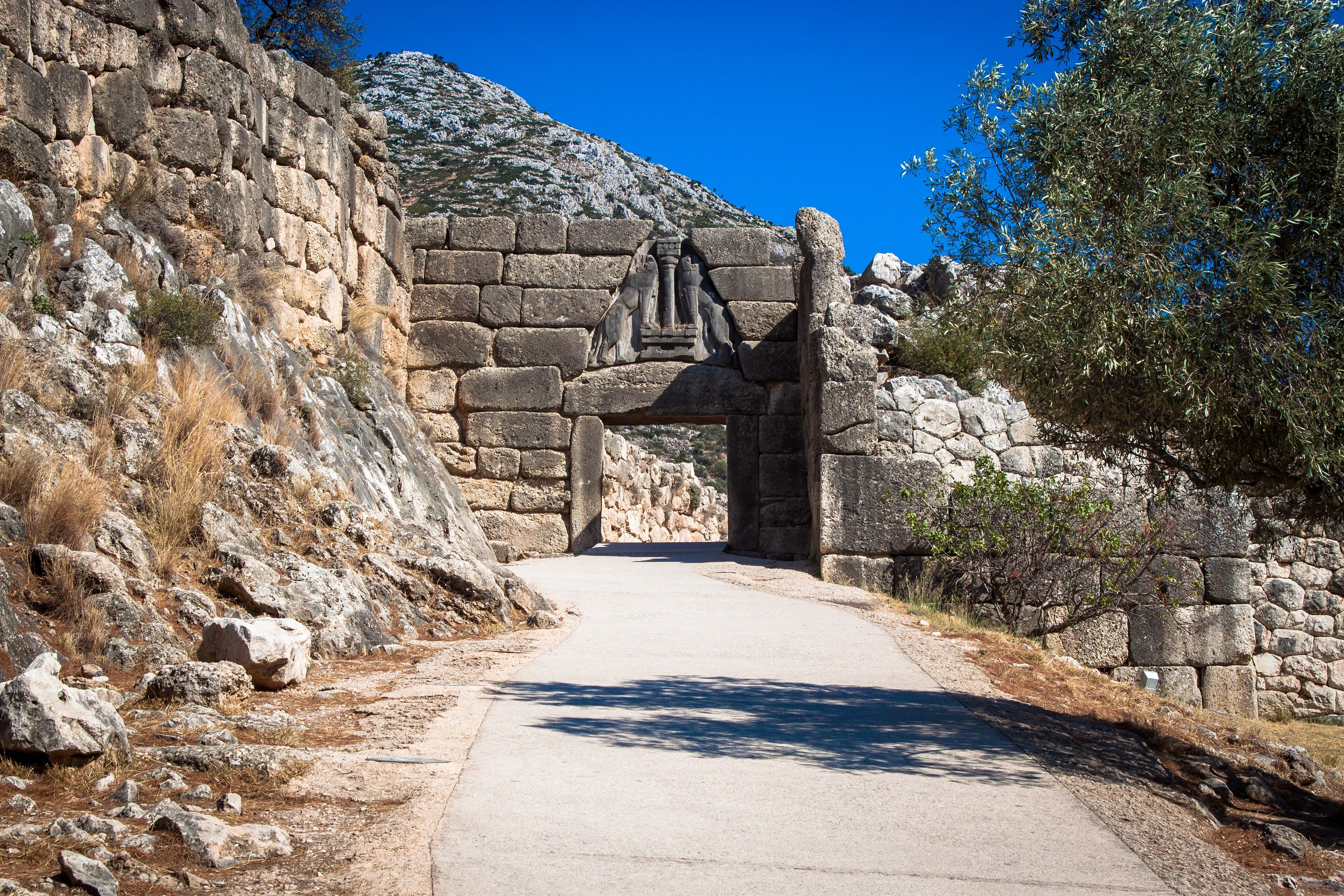
High on a hill rising 274 meters above the Argive plain, the ruins of Mycenae command the strategic routes leading to the Isthmus of Corinth.
In the north-east corner of the fertile Argive plain, where the mountains of the Peloponnese begin to rise toward the Isthmus of Corinth, a limestone hill stands nine hundred feet above the Aegean. It is a natural fortress, flanked by deep ravines, looking out over a landscape of silver-green olive groves toward the Saronic Gulf. For thousands of years, this hill was simply a high place of refuge, occupied by Neolithic farmers who left behind nothing but faint traces of their existence and a few shards of painted pottery. Yet by the late second millennium BCE, this rocky outcrop had become the nerve center of a militarized empire so dominant that its name would be grafted onto an entire epoch of human history. To the scribes of New Kingdom Egypt, writing on stone at Kom al-Hetan, it was Mukana. To the authors of the Homeric epics, composing centuries after its fall, it was Mycenae, "rich in gold," the seat of Agamemnon, King of Men.
The power of Mycenae was built on geography and carved from stone. From its acropolis, a ruling elite commanded every land route connecting the southern peninsula to the Greek mainland. It was an inland stronghold, but it did not exist in isolation; it worked in tandem with Tiryns, its sister fortress down on the coast, the two sites acting as the twin anchors of a single, highly organized culture. By 1350 BCE, at the height of its prosperity, the citadel and the lower town sprawling beneath it housed some thirty thousand people across thirty-two hectares of terraced slopes. The rulers of this crowded city-state directed a sphere of influence that crossed the seas, projecting military and economic power over Crete, the Cyclades, and the southwestern coast of Anatolia.
To walk through the ruins of Mycenae is to confront an architecture designed to intimidate. The walls of the citadel, built during the fourteenth and thirteenth centuries BCE, are constructed of blocks so colossal that later Greeks believed only the Cyclopes—the mythical one-eyed giants—could have lifted them. Some of these stones, including the massive lintels and gate jambs, weigh well over twenty tonnes, with some estimates reaching close to one hundred. The primary entrance to this stronghold is the Lion Gate, where two monumental stone beasts stand confronted, their front paws resting upon a low altar-like structure that supports a central pillar. The relief is carved into a "relieving triangle," a masterful engineering technique designed to distribute the immense weight of the wall away from the lintel below. Through this gate, a stepped ramp rose past a sacred enclosure and climbed toward the palace on the summit, where a great megaron—a throne room centered around a raised hearth beneath a four-columned roof—served as the administrative and ceremonial heart of the kingdom. Here, plaster walls and floors were covered in vibrant frescoes, and the business of a highly bureaucratic state was recorded in Linear B, the earliest written form of the Greek language, pressed into soft clay tablets.
12 links to entries not yet ingested in the Library.
For all their architectural might, the lords of Mycenae were defined by how they buried their dead. The evolution of their society is written in the earth of the hillsides surrounding the acropolis. In the early days of their rise, during the transition from the Middle to the Late Bronze Age around 1650 to 1500 BCE, the elite were buried in deep shaft graves. Two distinct circular enclosures, Grave Circle A and Grave Circle B, preserved these early tombs. Circle B, the older and simpler of the two, lay outside the early walls and contained burials marked by stone stelae, accompanied by broken drinking vessels and animal bones that spoke of elaborate funeral feasts. Circle A, which was eventually enclosed by a grand western extension of the Cyclopean walls around 1250 BCE, contained graves of unimaginable wealth. When these shafts were excavated in the late nineteenth century, they yielded a treasure trove of warrior culture: engraved and inlaid swords, bronze daggers, arrowheads, silver vessels sourced from various parts of the Mediterranean, and the famous gold death masks, including the one famously, if erroneously, dubbed the "Mask of Agamemnon."
As the dynasty matured, these vertical shafts were replaced by the tholos, or beehive tomb, a design that represented the pinnacle of Bronze Age engineering. Built into the sloping hillsides, these tombs were approached by a dromos—a long, walled stone passage—leading to a monumental doorway. The tomb chamber itself was a vast, corbelled dome of masonry, mimicking the shape of a colossal beehive. Nine of these structures survive at Mycenae, divided by archaeologists into three distinct architectural phases. The earliest, such as the Cyclopean Tomb and the Tomb of Aegisthus, date to the fifteenth century BCE. The grandest and latest of them, the Treasury of Atreus, dates to the thirteenth century BCE. Spanning nearly fifty feet in both diameter and height, its interior vault was once adorned with bronze ornaments, and its facade was flanked by richly carved columns of spiraled green alabaster. Though these tombs were systematically plundered in antiquity, their sheer scale ensured they were never entirely forgotten; local tradition long regarded them not as graves, but as the secret storehouses where ancient kings hid their fortunes.
The security of this golden citadel was a constant anxiety for its rulers. Toward the end of the thirteenth century BCE, as regional instabilities began to mount across the Mediterranean, the Mycenaeans undertook a final, defensive expansion of their walls. On the northeastern side of the acropolis, they constructed a sally port and a hidden, corbelled passage that descended ninety-nine steps through the solid rock beneath the fortress wall. This passage led to a subterranean cistern fifteen meters below the surface, fed by an underground clay pipe from a natural spring high in the hills. It was a marvel of siege engineering, ensuring that even if the city were surrounded, the defenders on the acropolis would have an uninterrupted supply of fresh water.
Yet even these defenses could not withstand the systemic collapse that swept across the Aegean world around 1200 BCE. Mycenae was destroyed, its palace burned, and its trade networks severed in the general catastrophe that ended the Bronze Age. Though a diminished population lingered on the site, the complex administrative machinery, the writing, and the monumental arts vanished. By the fifth century BCE, Mycenae was a minor town. Its remaining citizens, temporarily regaining their independence from nearby Argos with the help of Sparta, sent a small force to fight against the Persians at the Battle of Plataea in 479 BCE. It was their final act on the stage of classical history. In 468 BCE, the neighboring city of Argos, long a rival for dominance of the plain, besieged and dismantled Mycenae, dispersing its remaining inhabitants. The site never revived. By the time the geographer Strabo wrote in the early Roman Empire, he could claim that not a trace of the city remained, though the travel writer Pausanias, visiting in the second century CE, was still able to identify the ruins of the great walls and the Lion Gate.
Mycenae faded into the realm of myth, its physical remains half-buried and its history preserved only through the distorted lens of epic poetry. It was not until 1700, during a land survey of the Peloponnese by the Venetian engineer Francesco Vandeyk on behalf of the governor Francesco Grimani, that the site was correctly identified in modern literature, using Pausanias's ancient guide to match the ruins with the myth. Today, the limestone ruins stand silent under the Mediterranean sun, a designated UNESCO World Heritage site since 1999. They remain not as a monument to a living city, but as a testament to the abruptness with which a highly sophisticated civilization can vanish into the earth, leaving behind only the colossal stones that even the centuries could not move.