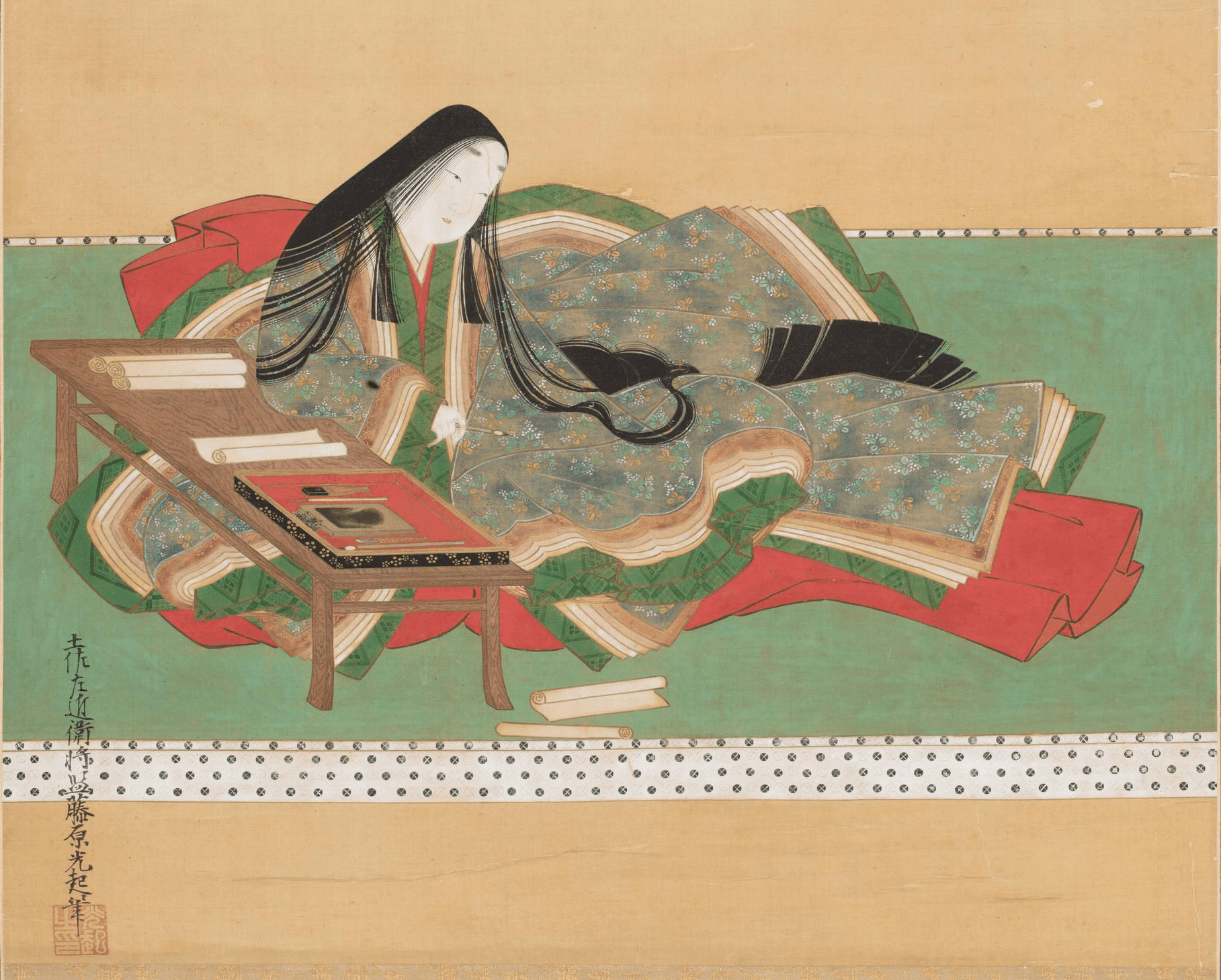
In the highly stratified world of Heian-kyō, a woman’s personal name could be easily lost to history, yet her private observations could define an entire civilization.
To enter the Imperial court of Heian-kyō at the turn of the eleventh century was to step into a world sealed under layers of silk, incense, and extraordinary aesthetic rigor. It was a society of roughly one hundred thousand people concentrated in the capital, yet its political and cultural heart beat within the narrow confines of the Heian Palace. Here, the aristocracy lived in an isolation so absolute that the provinces of Japan were treated as places of bleak exile, and the muddy realities of the outside world were entirely shut out. Within this closed space, life was governed not by open exercises of brute force, but by a microscopic attention to form. Emotions were rarely spoken directly; instead, they were coded into the choice of a perfume, the calligraphic stroke on a sheet of tinted paper, the precise layering of twelve-layer silk robes whose color combinations had to match the exact shift of the seasons, or the impromptu composition of a thirty-one-syllable waka poem. To display an incorrect color combination or to fail to recognize an allusion in a poetic exchange was to suffer immediate social death. Women of high status lived in near-constant physical seclusion, sitting in dim chambers behind heavy hanging screens, bamboo blinds, or sliding paper partitions. They were glimpsed by men only as silhouettes or as trailing sleeves of brilliant silk slipping beneath a screen. Yet, from this shadow-world of screens and whispers emerged a literature of stunning psychological realism and stylistic genius. For it was here, between about 1000 and 1012, that a widowed lady-in-waiting known to history as Murasaki Shikibu wrote The Tale of Genji—a fifty-four-chapter, eleven-hundred-page masterpiece that is widely recognized as the world’s first true novel, written a millennium before the form was even named or defined in Europe.
This highly stylized court was not merely a playground of aesthetic pleasures; it was a battleground of quiet, deadly political dynasticism, fought through the bodies of young women. The northern branch of the Fujiwara clan had spent two centuries securing a monopoly on imperial power through the strategic marriage of their daughters to emperors, ruling as regents over the resulting offspring. By the late tenth century, this practice reached its absolute zenith under the ambitious Fujiwara no Michinaga. In his drive to dominate the court, Michinaga engaged in an unprecedented and shocking political maneuver: he placed his twelve-year-old daughter Shōshi into the harem of Emperor Ichijō, despite the fact that the Emperor already had an Empress, Teishi, whom he loved deeply. To solidify Shōshi’s standing and neutralize Teishi’s influence, Michinaga arranged for Shōshi to be named Empress concurrent with Teishi, inventing a new title to bypass historical precedent. The court was thus split into two rival literary and political salons. Teishi’s salon had been legendary for its brilliance, anchored by the sparkling, sharp-witted lady-in-waiting Sei Shōnagon, whose caustic and brilliant observations were immortalized in . To counter this legacy after Teishi’s death, Michinaga sought to surround his daughter Shōshi with the most talented female minds of the age, transforming her quarters into a rival salon of unmatched intellectual prestige. It was for this specific purpose, around 1005 or 1006, that he summoned Murasaki Shikibu to court as a companion-tutor to the young Empress.
From the archives
Murasaki Shikibu writing the diary — from the illustrated Murasaki Shikibu Diary Emaki, 13th century.
Public domain · via Wikimedia Commons
A scene from the Tale of Genji Emaki, the earliest surviving illustrated Genji manuscript (12th century).
Public domain · via Wikimedia Commons
Murasaki at Ishiyama-dera, by Tosa Mitsuoki — the legend that she began Genji during a moon-viewing retreat.
Public domain · via Wikimedia Commons
Connected to
12 links to entries not yet ingested in the Library.
To understand the friction Murasaki experienced at court, one must look closely at a secret education that was considered highly irregular, even subversive, for a woman of her era. Heian-kyō operated under a strict linguistic apartheid. Men wrote formally in classical Chinese, the language of administration, government, historical chronicles, and public life. Women were expected to write only in Japanese, using the newly developed phonetic kana script—a system dismissed by high officials as "woman’s hand" but which, precisely because of its freedom from the rigid, public conventions of Chinese, became the perfect vehicle for intimate diaries, personal letters, and imaginative vernacular prose. Murasaki, however, had crossed this linguistic border in her childhood. Because her father, Fujiwara no Tametoki, was a respected scholar of the Chinese classics, her younger brother Nobunori was tutored in Chinese to prepare him for a government career. Sitting in the background of her father's study, the young Murasaki listened to her brother's lessons. She proved so astonishingly quick that she could easily comprehend and memorize passages that baffled and frustrated her brother. Her father, recognizing her brilliant mind, could only lament her gender, famously sighing, "Just my luck! What a pity she was not born a man!" This classical Chinese education gave Murasaki an intellectual depth that set her apart, but it also made her a target of suspicion. She was keenly aware of the hostility toward women who flaunted "unfeminine" knowledge. Indeed, when portions of her manuscript of The Tale of Genji were read aloud to Emperor Ichijō and his courtiers, one listener remarked on her profound learning, prompting a resentful lady-in-waiting to mockingly nickname her "The Lady of the Chronicles," a reference to the classical Chronicles of Japan. In response, Murasaki went to great lengths to hide her intelligence, pretending to be illiterate in Chinese to avoid appearing pretentious or difficult.
We can capture the texture of Murasaki's secret life at court through a scene she describes with vivid, conspiratorial intimacy in her own diary. It is the late summer of an unnamed year. The heavy heat of the Kyoto season hangs over the wood-and-paper pavilions of the imperial palace, and the noisy, gossiping ladies-in-waiting have finally dispersed, leaving the Empress Shōshi’s quarters momentarily quiet. In these stolen, silent minutes, Murasaki slips into the Empress’s presence. She does not carry the Japanese poetry collections expected of a lady-in-waiting, but rather the Chinese ballads of Bai Juyi. The young Empress, eager to learn but hemmed in by the rigid expectations of her rank, sits with Murasaki in the shadows. Together, they read the forbidden characters, Murasaki translating and explaining the difficult Chinese syntax in hushed tones, constantly listening for the sound of approaching footsteps. "Since last summer," Murasaki recorded in her diary, "very secretly, in odd moments when there happened to be no one about, I have been reading with Her Majesty... There has of course been no question of formal lessons... I have thought it best to say nothing about the matter to anybody." This secret act of female education was, in the words of modern scholar Richard Bowring, "almost subversive." It violated the fundamental gender boundaries of the Heian state, yet it forged a deep bond between the lonely, serious-minded Empress and her brilliant, melancholy companion.
Murasaki’s diary reveals a woman who was deeply alienated by the very court she immortalized. She was a quiet, sensitive, and fiercely observant introvert thrust into a world of loud, drunken revelry and performative socializing. She found the courtiers clumsy, haughty, and often stupid when drunk, and she shrank from their advances. Her relationship with the other literary women of Shōshi's court was marked by a quiet, protective professional distance. She was highly critical of her contemporaries. In her diary, she dismissed the famously passionate poet Izumi Shikibu as an amusing letter-writer whose poetry was careless and lacked true depth without a classical model to copy. Her most famous barbs, however, were aimed at her deceased rival, Sei Shōnagon. Though the two never served at court at the same time, Shōnagon’s shadow loomed large over the palace. Murasaki wrote that Shōnagon was "dreadfully conceited," criticizing her for littering her writings with Chinese characters that "left a great deal to be desired," and viewing her flirtatious, ostentatious style as exhausting and affected. Where Shōnagon was witty, outward-looking, and sharp, Murasaki was withdrawn and analytical. She knew that her peers viewed her as "pretentious, awkward, difficult to approach, prickly... haughty, prone to versifying... and scornful." Yet she maintained that this cold exterior was merely a shield: "I am wrapped up in the study of ancient stories... living all the time in a poetical world of my own scarcely realizing the existence of other people... But when they get to know me, they find to their extreme surprise that I am kind and gentle."
It was within this poetical world of her own that she crafted The Tale of Genji. Spanning three distinct parts, the work follows the life, romantic entanglements, political fortunes, and eventual decline of the "shining prince" Hikaru Genji, before shifting its focus in its final chapters to his descendants in the melancholy, mist-shrouded suburbs of Uji. In creating this work, Murasaki did not merely write a longer version of the traditional Japanese monogatari (tales), which had previously relied heavily on folk legends, supernatural occurrences, and simplistic fairy-tale plots like those of The Tale of the Bamboo Cutter. Instead, she synthesized the lyricism of Japanese waka poetry, the structural discipline of Chinese historical chronicles, and the psychological intimacy of contemporary diaries to create an entirely new literary form. The Tale of Genji is a work of startling psychological realism. Its characters are not archetypes of virtue or vice; they are complex, flawed human beings driven by conflicting desires, anxieties, and social pressures. The novel's central aesthetic and philosophical theme is mono no aware—the beautiful, aching sadness of the transience of all things. In a world where love affairs had to be conducted in near-total darkness through screens and paper walls, and where a person's life could be cut short by sudden epidemics, every moment of beauty was shadowed by its impending loss. Murasaki’s characters navigate this fragility with a refined, sometimes agonizing sensitivity. The novel was an immediate sensation at court. Michinaga himself recognized its immense value as cultural capital for his daughter’s salon, providing Murasaki with luxury paper, high-grade ink, and professional calligraphers to copy her drafts. Imperial interest was so great that Emperor Ichijō had the chapters read aloud to him, and within a decade of its completion, handwritten copies of the massive work had found their way into the remote provinces of Japan, where they were eagerly sought after by the provincial gentry.
For all her fame, the woman who created this enduring masterpiece remains largely a ghost to history, her life obscured by the very courtly conventions she documented. Her personal name is entirely lost to us. "Murasaki Shikibu" is a descriptive moniker constructed from her social circumstances and her literary success. "Shikibu" refers to the Ministry of Ceremonials (Shikibu-shō), where her father held a mid-level bureaucratic post. "Murasaki" meaning "violet," is a name that was likely bestowed upon her at court as a compliment, referencing either the purple wisteria of her Fujiwara clan name or, more famously, the beloved heroine of her own novel, the young girl Murasaki whom Prince Genji raises and marries. Historians have speculated that her actual birth name may have been Fujiwara no Kaoruko (also read as Kyōshi), an imperial lady-in-waiting mentioned in a court diary from 1007, but this remains a matter of scholarly debate.
The dates of her life are similarly shrouded in uncertainty. Scholars generally place her birth around 973, in the capital of Heian-kyō. Her branch of the northern Fujiwara clan had slipped from the highest ranks of the aristocracy down to the middle tier of provincial governors, a decline that filled Murasaki with a lifelong, painful sense of social inferiority during her time at court. Her childhood was marked by the early loss of her mother, and she was raised unconventionally in her father's household alongside her brother Nobunori. While Heian noblewomen typically married at puberty, Murasaki remained unmarried until her mid-to-late twenties, a highly unusual choice for the era. In 996, she took the rare and grueling five-day journey to Echizen Province with her father for his gubernatorial posting. She returned to the capital around 998 to marry her second cousin, Fujiwara no Nobutaka, a much older, wealthy, and extravagant court official who kept multiple households and wives. Though their marriage lasted only two years before Nobutaka died in a cholera epidemic in 1001, it produced a daughter, Kenshi, who would grow up to become a celebrated court poet in her own right under the name Daini no Sanmi. It was during the heavy, lonely grief of her early widowhood that Murasaki began to write her great masterpiece, perhaps as an escape from the unbearable isolation of her empty house.
The end of Murasaki's life is as mysterious as its beginning. Following the death of Emperor Ichijō in 1011, Empress Shōshi retired from the palace to live in a Fujiwara mansion in Biwa, and Murasaki is recorded as being there with her as late as 1013. Some historians believe she died shortly thereafter, in 1014, pointing to her father’s sudden, hasty return to Kyoto from his provincial post that year as evidence of a family tragedy. Others, however, suggest she may have lived as late as 1025, continuing to serve Shōshi and witnessing her daughter Kenshi's rise at court. A persistent legend claims that she retired to the temple of Ishiyama-dera overlooking the moonlit waters of Lake Biwa, where she spent her final years in religious devotion and writing, but this is dismissed by modern critics as a romantic myth. When she did pass away, she left behind her monumental novel, her intimate diary, and a collection of 128 poems that serve as a poetic memoir of her inner life. Her legacy quickly grew to mythical proportions; by the twelfth century, The Tale of Genji was required reading for all serious poets, and by the seventeenth century, she was revered as a model of Confucian virtue and literary genius, her image painted by master artists who depicted her seated at her desk, staring at the autumn moon for inspiration.
In the end, Murasaki Shikibu remains an enigma at the center of Japanese classical culture. She was a woman who lived her life behind screens, who hid her knowledge of the dominant language of her day, and who viewed the glittering court of her era with a cold, critical eye—yet she used that very isolation to observe the human condition with an intimacy and precision that had never been achieved before in literature. She captured the fleeting beauty of a world that has long since vanished, leaving us to wonder how a widowed lady-in-waiting, writing by candlelight in the corners of a highly restrictive palace, managed to write a book that still speaks to the universal sorrows and joys of human relationships a thousand years later. What was it about the silent, enclosed world of the Heian court that allowed women writers, denied the public language of power, to map the human heart so completely, and what other voices from those shadowed corridors have been lost to the silence of history?