Person · 780 CE – 850 CE · Islamic Caliphates
Muḥammad ibn Musa al-Khwarizmi
- Also known as
- Abdalah Muhamad Musa
- Abdallāh Muḥammad ibn Mūsā
- Abu Abdallah Muḥammad ibn Mūsā al-Jwārizmī
- Abu Abdullah Mohammad Ibn Musa al-Khawarizmi
- Abu Abdullah Muhammad bin Musa al-Khwarizmi
- Abu Abdullah Muhammad bin Musa al-Khwarizmi
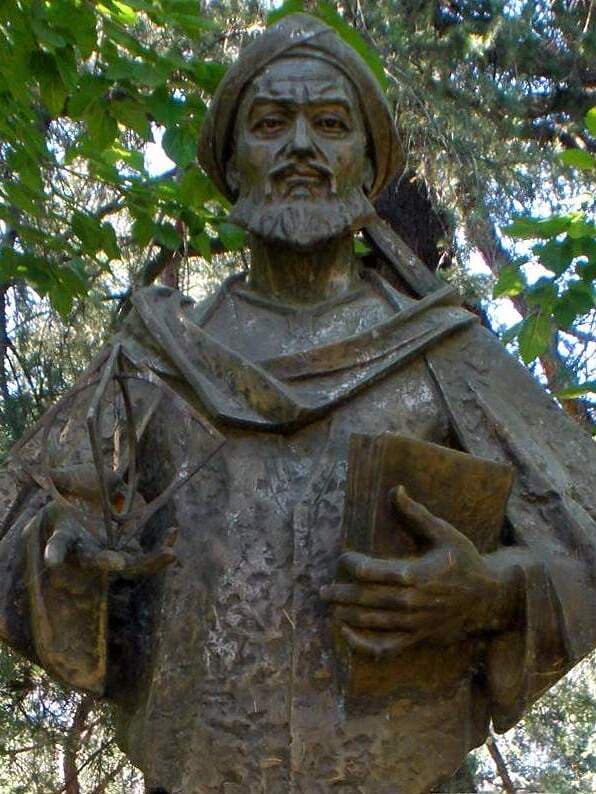
Every time a modern computer runs an algorithm, it pays silent tribute to Muḥammad ibn Musa al-Khwarizmi, a ninth-century scholar whose Latinized name gave the instruction set its title.
In the opening decades of the ninth century, a scholar walking through the bustling markets of Baghdad would have encountered a world run on a dizzying tangle of calculations. Merchants haggled over exchange rates, surveyors partitioned agricultural plots along the Tigris, and state jurists struggled to divide complex family estates according to the exacting requirements of Islamic inheritance law. To solve these problems, one had to rely on a patchwork of localized traditions—using Greek geometry, Roman fractions, or Indian arithmetic—often requiring immense mental gymnastics to resolve even everyday transactions. It was inside the House of Wisdom, the grand library and translation bureau established by the Abbasid Caliph al-Ma’mun, that a Persian-born mathematician named Muhammad ibn Musa al-Khwarizmi looked at this chaotic landscape of numbers and sought a universal language to simplify it.
Al-Khwarizmi’s life is largely obscured by the dust of the centuries, with only a few biographical fragments surviving. He was born around 780 CE, likely in Khwarazm, a fertile, oasis-like region of Greater Iran situated in what is today Uzbekistan and Turkmenistan. His heritage was Persian, though like many intellectuals of his era, he wrote entirely in Arabic, the lingua franca of scientific inquiry from Spain to Central Asia. Some early records hint at an even more complex heritage; the historian al-Tabari affixed the epithet "al-Majusi" to his name, suggesting al-Khwarizmi’s ancestors—and perhaps even the mathematician himself in his youth—had been adherents of the ancient Zoroastrian faith. By the time he attained prominence in Baghdad, however, he was an orthodox Muslim, writing pious introductions to his treatises. His intellect eventually drew the attention of Caliph al-Ma’mun, who appointed al-Khwarizmi around 820 CE as the astronomer and head of the library of the House of Wisdom.
It was within this intellectual crucible that al-Khwarizmi composed the work that would fundamentally reshape how humanity calculates: Al-Kitab al-mukhtasar fi hisab al-jabr wal-muqabala (The Compendious Book on Calculation by Completion and Balancing). Compiled between 813 and 833 CE, the book was explicitly designed as a practical manual. Al-Khwarizmi was not interested in abstraction for its own sake; he wrote to resolve the concrete problems of trade, land surveying, and legal inheritance. Yet, to solve these practical dilemmas, he codified an entirely new way of thinking about quantitative relationships. He isolated the operations of al-jabr ("completion" or "restoration," the process of removing negative terms by adding equivalent quantities to both sides of an equation) and ("balancing," the cancellation of like terms on opposite sides). In doing so, he decoupled arithmetic from specific physical objects, introducing a systematic method to solve linear and quadratic equations up to the second degree.
Connected to
- died inBaghdad762 CE
- religionIslam631 CE
+ 10 further connections to entries not yet ingested