Mongol invasion of Europe
- Also known as
- Avropanın monqollar tərəfindən istilası
- Avrupa’nın Moğollar tarafından istilası
- Invado de Eŭropo far Mongoloj
- invasi Eropa oleh Mongol
- invasion mongola de Europa
- invasion mongole de l'Europe
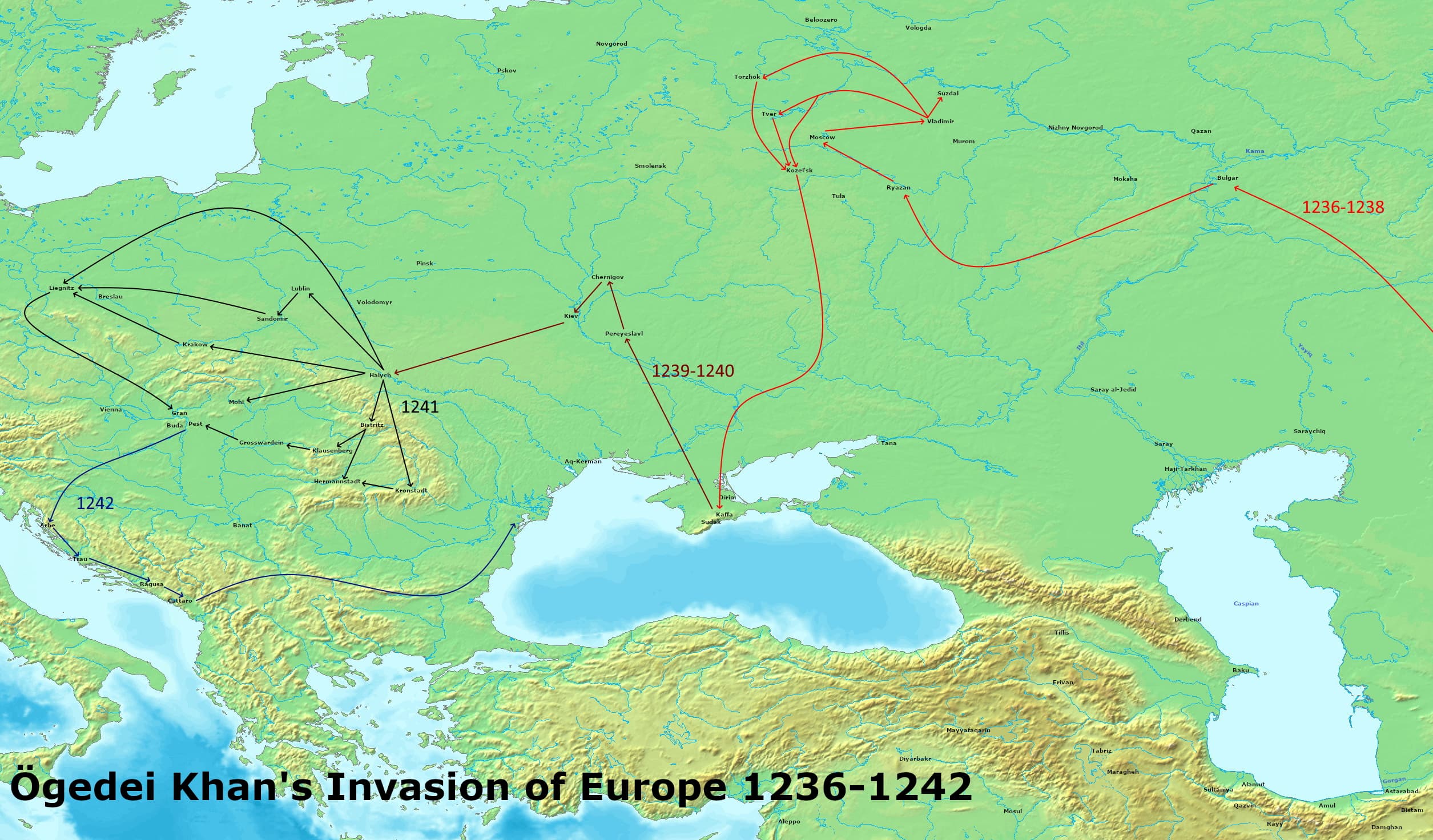
In the early thirteenth century, the fragmented kingdoms of Europe woke to a threat that bypassed their traditional rivalries and forced a temporary, panicked peace.
In December 1237, the forest-guarded borders of the Rus' principalities became the gateway for a military apparatus unlike anything Europe had ever encountered. The Grand Prince of Yuri was slain on the Sit River, and the ancient timbered capitals of the east—Ryazan, Vladimir, Torzhok, and Kozelsk—were systematically reduced to ash. By December 6, 1240, Kiev, the crown jewel of the southern Rus', lay in ruins, and the western frontier of the Eurasian steppe lay entirely open. What appeared to contemporary European chroniclers as a chaotic deluge of biblical "Tatars" was, in truth, an exceptionally disciplined, ethnically diverse war machine numbering in the tens of thousands. Though its supreme command was held by Batu Khan, a grandson of Genghis Khan, and its elite cavalry consisted of Mongol Borjigin, Merkit, and Khitan horsemen, the overwhelming majority of the invading force was made up of Turkic nomads—Cumans, Kipchaks, Bashkirs, and Volga Bulgars. Behind this vanguard marched Chinese siege engineers, prized for their expertise in gunpowder, metallurgy, and road construction, while Iranian bureaucrats managed the censuses, taxes, and conscription that fueled the westward march. At the tactical center of this leviathan was General Subutai, the aging master strategist who had spent years sending spies as far west as Austria to map the internal political fractures of the European kingdoms.
In the spring of 1241, Subutai unleashed a terrifyingly synchronized, multi-pronged offensive designed to neutralize Central Europe before its heavily armored knights could form a united front. The northern wing of the invasion, led by the Mongol princes Baidar, Orda, and Kadan, struck into fragmented Poland. They moved with a speed that defied medieval logistics. After routing an inferior Polish army and burning Lublin, Orda's reconnaissance units crossed into the Margravate of Meissen and the March of Lusatia, putting much of the city of Meissen to the ground. Near Polaniec on the Czarna Hańcza, a small, desperate band of Cracovian knights attempted a surprise attack on the Mongol camp. Though their initial fury claimed many Mongol lives, the knights succumbed to distraction, pausing to loot the fallen. Once the invaders realized the numerical weakness of their attackers, they reformed their lines, broke the Polish ranks, and scattered the survivors into the nearby woods. The climax of this northern campaign came on April 9, 1241, at the Battle of Legnica. Here, the Mongol vanguard met a coalition of Polish forces and allied knights led by Henry II the Pious, Duke of Silesia. Henry’s forces were utterly annihilated, his head paraded on a spear, leaving the road to the Holy Roman Empire seemingly unguarded.
Yet the destruction of Poland was merely a flanking maneuver to protect the central thrust directed at the Kingdom of Hungary. King Béla IV of Hungary had received ample warning of the storm gathering on his eastern borders. As early as 1237, a Dominican friar named Julianus had returned from the upper Volga carrying a letter from Batu Khan demanding unconditional surrender. Two years later, the desperate Cuman tribes, fleeing the Mongol conquest of the eastern steppes, sought and received asylum in Hungary, followed by frantic warnings from defeated Polish princes in early 1241. But Hungary, which had lived free from nomadic incursions for generations, was psychologically unprepared. When Béla appealed to his magnates to assemble, many refused or delayed, hoping a royal defeat would curtail the king’s efforts to centralize power. Help from the west was virtually nonexistent; the Duke of Austria, Frederick II, arrived with only a small, token detachment of knights.
Connected to
4 links to entries not yet ingested in the Library.