Person · 1466 CE – 1520 CE · Mesoamerican Civilizations
Moctezuma II
- Also known as
- Emperor of Mexico Montezuma II
- Hastiin Moctezuma II
- Hastiin Montecuhzoma Xocoyotzin
- II Montezuma
- II. Moctezuma
- II. Montezuma
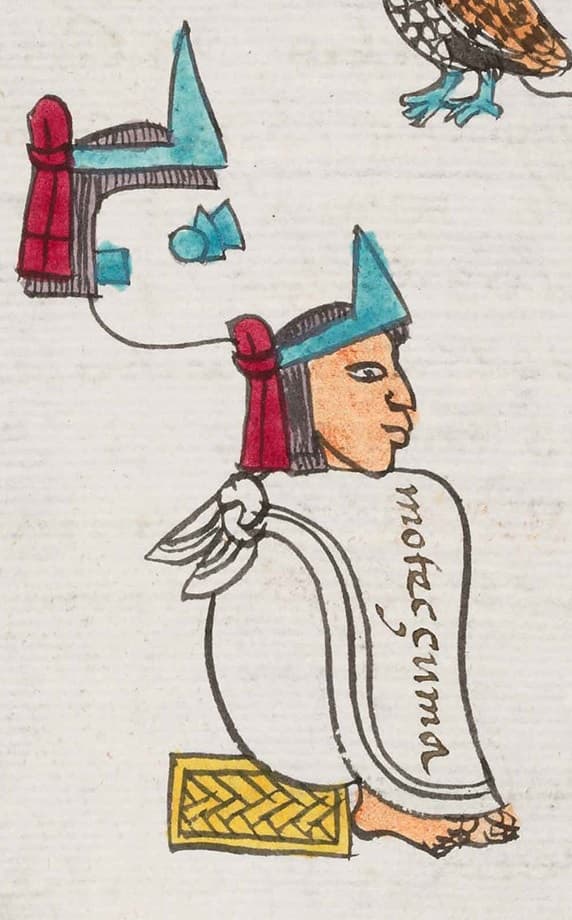
The name of the man who ruled the Mexica Empire at its zenith translated from Classical Nahuatl as "he frowns like a lord," or "he who is angry in a noble manner." Moctezuma Xocoyotzin, who took the throne around 1502 or 1503, presided over an empire that reached its greatest…
He was named for the anger of lords, a compound of Classical Nahuatl words meaning "he who frowns in a noble manner," and his life was defined by the terrible burden of maintaining that dignity at the edge of an abyss. When Moctezuma Xocoyotzin—the "honored young one," retroactively numbered Moctezuma II by European historians—was chosen as the ninth tlatoani of the Mexica Empire in 1502 or 1503, he did not inherit a peaceful realm. He inherited an empire of fragile tribute networks, volatile social shifts, and a landscape periodically ravaged by the wrath of the gods. Before his face was hidden behind the royal veil, before he became the captive centerpiece of the Spanish conquest of Mexico, he was known as a man of fierce religious devotion, a proven warrior who had captured at least four enemy commanders to earn the rank of tequihua, and a high priest of Huitzilopochtli. He was a product of the calmecac, the rigorous elite school where he had been enrolled since the age of five, and he believed deeply in the preservation of cosmic and social order. But the order he spent his life constructing was destined to be shattered, first by the internal pressures of a fracturing society and finally by the arrival of men from across the sea.
To understand the tragedy of Moctezuma’s reign, one must look past the ruins of Tenochtitlan to the opening years of his rule, which were defined not by foreign invasion but by the cruelties of nature. In 1505, a devastating three-year drought descended upon central Mexico, causing widespread crop failures and leaving the population of the capital and its sister city, Tlatelolco, in the grip of starvation. As desperation mounted, noblemen began selling their own children into perpetual slavery simply to secure food. Moctezuma, alongside the allied lords of Texcoco and Tlacopan, scrambled to manage the crisis, raising tributes for a year to import massive quantities of maize from the unaffected coastal region of Totonacapan. In a striking act of legal intervention, Moctezuma ordered the tlacxitlan—the criminal court of Tenochtitlan—to systematically free these children and provide direct food relief to their impoverished noble families. The crisis also prompted him to abolish the huehuetlatlacolli system, a archaic form of hereditary serfdom that bound families to perpetual servitude. Yet, the cost of surviving these early disasters was high. To keep the empire afloat, Moctezuma was forced to permanently increase tribute demands on provinces near the Valley of Mexico, such as Amaquemecan, which was ordered to supply stone and wood multiple times a year for the capital’s building projects. The seeds of resentment were sown deeply in these tributary soils; when the Spanish arrived years later, provinces like Totonacapan and Chalco would remember the heavy hand of Tenochtitlan and eagerly turn their backs on the emperor.
Connected to
- citizen ofAztec Empire1367 CE
- born in · died inTenochtitlan1325 CE
+ 12 further connections to entries not yet ingested