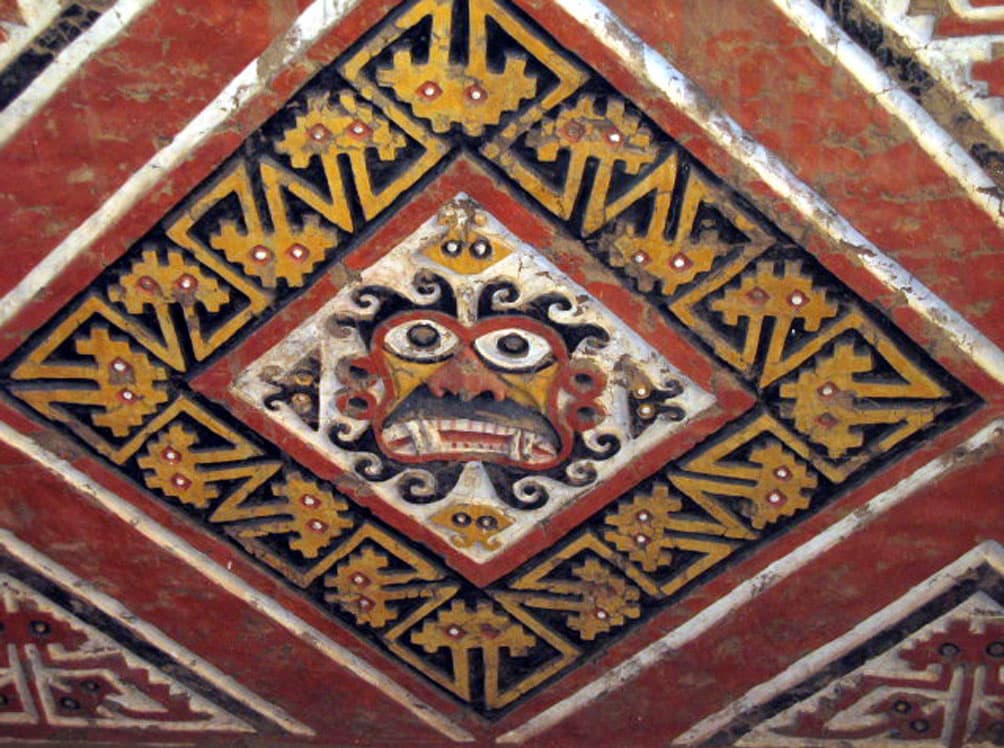
Along two hundred and fifty miles of Peru’s arid northern coastline, a network of river valleys nurtured a civilization bound not by a single crown, but by a shared and vivid imagination.
In the dry, sun-bleached coastal valleys of northern Peru, where the Pacific Ocean crashes against one of the most arid deserts on earth, there are places where the earth still bleeds red and yellow. These are the huacas—massive, eroded stepped pyramids built of millions of sun-dried adobe bricks. For seven centuries, between roughly 1 CE and 700 CE, these structures served as the ceremonial beating hearts of the Moche. In the sixteenth century, Spanish conquistadors, driven by rumors of buried gold, diverted the waters of the Río Moche to wash away nearly half of the Huaca del Sol, the largest pre-Columbian structure in Peru. What they found, and what modern archaeologists continue to uncover in the better-preserved chambers of the nearby Huaca de la Luna, was not just precious metal, but a visual culture of startling, sometimes terrifying intensity. Painted on the plaster walls of these temples are vibrant, multi-storied murals of fanged deities, warriors leading naked captives by ropes around their necks, and complex geometric borders. The Moche did not leave a written script, but they left an archive in clay, plaster, and gold that speaks of a world obsessed with flow, stasis, and the heavy price of keeping the cosmos in motion.
To understand the Moche is to understand the precarious geography of the Peruvian coast. Stretching over two hundred and fifty miles of desert shoreline and reaching up to fifty miles inland, the Moche world was not a single, centralized empire, but rather a constellation of autonomous valleys sharing a singular, highly stylized cultural vocabulary. Scholars divide this sphere into two distinct geographic and political entities: the Southern Moche, centered in the Chicama and Moche valleys, and the Northern Moche, which encompassed the upper Piura, lower Lambayeque, and lower Jequetepeque valley systems. Each valley was a green ribbon of life sustained by a monumental engineering feat. The Moche diverted turbulent rivers flowing from the Andes into a sophisticated network of irrigation canals, turning the hyper-arid desert into fields of maize, beans, and squash. This artificial agricultural abundance was the foundation of their wealth, but it was a wealth constantly threatened by the twin perils of drought and torrential El Niño floods.
This anxiety of water and survival shaped their entire cosmology, which was fundamentally preoccupied with the concept of circulation. Because irrigation was their lifeblood, Moche art and ritual focused intensely on the passage of fluids—not just water through canals, but life fluids through the vulnerable orifices of the human body. This is expressed with visceral clarity in their ceramics, which are widely considered some of the most expressive and technically accomplished pottery in the ancient world. Using a limited palette of yellowish cream and rich red slip, Moche potters utilized mold technologies to mass-produce vessel forms, yet they infused each piece with astonishing specificity. Thousands of surviving vessels depict defeated warriors losing blood from their noses, or helpless sacrificial victims having their eyes torn out by birds of prey. The flow of blood was not merely a consequence of violence; it was a sacred currency, a necessary transaction to ensure the fertility of the earth and the return of the rains.
5 links to entries not yet ingested in the Library.
This preoccupation with physical reality extended to an extraordinary tradition of ceramic portraiture. Unlike the idealized or stylized faces common in other ancient American art, Moche portrait vessels depict actual, recognizable individuals, capturing the unique contours of a jawline, the lines of aging, and distinct expressions of sorrow, pride, or contemplation. Many of these portraits render individuals with noticeable physical disfigurements or genetic defects with the same fidelity as they do powerful elites and decorated warriors. Alongside these portraits are the famous "sex pots," of which at least five hundred survive. These vessels depict explicit sexual encounters, dominated by representations of heterosexual anal sex—often with an infant shown breastfeeding from the woman simultaneously—as well as male masturbation and fellatio, while vaginal penetration is notably rare and cunnilingus is entirely absent. Far from being simple pornography, these vessels likely served as sophisticated didactic models. Passed down through generations, they communicated complex ideas about procreation, the transfer of life-force, the nature of physical embodiment, and the cyclical relationship between decay and renewal.
Moche ceremonial life was deeply theatrical, structured around precise movements and calculated pauses. Iconography on murals and ceramics reveals that rituals often took place in what anthropologists call liminal spaces—the "in-between" zones of the sacred architecture, such as sunken steps, steep ramps, and raised platforms. At the Huaca de la Luna, a massive mural depicting a procession of warriors and their bound captives winds across the plaza wall, only to turn ninety degrees upon reaching a highly decorated, elevated building known as recinto 1. Here, the procession freezes. In Moche cosmology, these moments of static pause, or stasis, were as spiritually charged as the kinetic energy of the ritual dance or the combat that preceded it. It was within these elevated, highly visible spaces that the elite performed the ultimate drama of their society: the presentation of the sacrificial cup.
For centuries, scholars debated whether the hyper-violent scenes painted on Moche pottery—priests cutting the throats of prisoners and collecting their blood in large chalices—were mythic allegories or historical realities. The answer came in the late twentieth century with the excavation of spectacular, unlooted tombs across the Moche landscape. At San José de Moro, in the northern Jequetepeque Valley, archaeologists discovered deep chamber tombs reserved for high-status women. Buried with elaborate headdresses and copper cups, these women were laid to rest with the exact regalia worn by the "Priestess" depicted in Moche sacrifice iconography. At Sipán, the tomb of a ruler known as the Lord of Sipán revealed a man buried in an ocean of gold, silver, and turquoise ornaments, accompanied by the specific crescent-shaped knives and banners associated with the "Priest" who receives the cup of sacrificial blood. These discoveries confirmed that the terrifying ceremonies depicted on the pots were literal performances. The elite did not just rule; they incarnated the gods, translating cosmic myth into physical, bloody theater on the summits of the huacas.
To maintain this elaborate theater, the Moche developed highly specialized industries. While ordinary households produced their own modest, monochrome textiles using cotton and camelid wool from vicuñas and alpacas, elite workshops employed master artisans who wove intricate, brightly dyed tapestries, gauze, and unique male head cloths. Moche metalworkers were equally revolutionary. Long before European metallurgists developed similar techniques, Moche smiths discovered electrochemical replacement plating and depletion gilding. By using boiling water and naturally occurring corrosive salts, they could coat intricate copper ornaments in micro-thin layers of gold or silver, creating spectacular, shimmering regalia that made their rulers appear like living embodiments of the sun and moon when they stepped out onto the high platforms of the temples.
By the late sixth century, however, this highly synchronized world of ritual, water, and clay began to fracture. During the Late Moche period, between 500 CE and 800 CE, the coastal valleys experienced a time of intense climatic instability, marked by decades of severe drought followed by catastrophic El Niño floods that washed away precious irrigation systems. The old religious centers, including the great valley capitals of the south, began to lose their grip on the population. In response, there was a shift toward urban nucleation. At sites like Pampa Grande in the Lambayeque Valley, a massive city of over four hundred hectares was rapidly constructed, dominated by the Huaca Fortaleza, the tallest ceremonial platform in Peru. But the old rituals could no longer contain the mounting social pressures. By 700 CE, the grand adobe palaces and temples were being abandoned, and the distinctive Moche style began to dissolve into new, emerging regional traditions.
The Moche left no written empire, yet they shaped the memory of the Andean coast forever. Their sophisticated engineering techniques laid the physical foundations for the later Chimú state, and their deep-seated traditions of textile weaving continue to be practiced by their descendants in the coastal villages of modern Peru. What remains in the desert silence are the huacas themselves—weathered, half-melted by centuries of rare rains, yet still standing as monuments to a civilization that looked into the harsh dryness of the coastal desert and built a world of vibrant color, exquisite clay, and flowing blood.