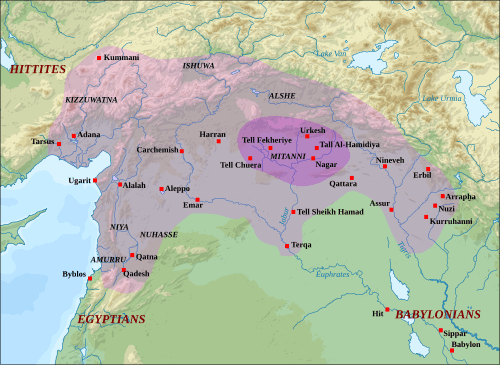
For centuries, a great empire in northern Syria and southeast Anatolia commanded the respect of the ancient world's most formidable dynasties, yet left behind no royal annals, chronicles, or histories of its own.
To the ancient Egyptians of the Eighteenth Dynasty, it was Naharin, the land of the river-bend, a distant and formidable shadow looming over the northern Euphrates. To the Hittite kings ruling from the rocky gorges of Anatolia, it was Hurri, the land of the Hurrian-speakers. To the Assyrians, who would eventually watch its ruins crumble into the dust of the upper Tigris, it was Hanigalbat. But to the dynasty of chariot-driving kings who ruled it during the mid-second millennium BCE, it was Mittani: the "united kingdom," a sprawling, polyglot empire that for three centuries held the balance of power in the Ancient Near East.
Yet, for all its contemporary grandeur, Mittani is the great ghost of Bronze Age history. No library of royal annals, no great archive of state chronicles, and no boasting royal monuments have ever been recovered from its long-lost capital of Washukanni. It is an empire reconstructed almost entirely from the perspective of its rivals, its history pieced together from the clay letters of Egyptian pharaohs, the military reports of Hittite conquerors, and the legal records of its provincial subjects. This silence is a historical paradox. At its height in the fifteenth century BCE, Mittani stretched from the Taurus Mountains of modern Turkey to the Zagros foothills of Iraq, reducing Assyria to a vassal state and compelling the pharaohs of Egypt’s golden age to treat its kings as equals.
The rise of this mysterious northern power was driven by a quiet but relentless southward migration. As early as the late third millennium BCE, Hurrian-speaking peoples had established themselves in the Khabur River valley and the highlands east of the Tigris. We catch fleeting glimpses of them in ancient sealings—such as that of King Tupkish of Urkesh from around 2300 BCE—but they remained a peripheral presence. By the seventeenth century BCE, however, during the twilight of the Old Babylonian period, this ethnic landscape shifted. Akkadian texts from the reign of Ammi-Saduqa begin to mention a region called Habigalbat. Soon after, as the Old Hittite Kingdom fractured and Babylon fell to invaders, a new political entity coalesced in northern Mesopotamia.
This state was defined by a fascinating cultural syncretism. While its primary population was Hurrian, its ruling elite bore names that echoed across the Hindu Kush. Rulers like Shuttarna, Barattarna, and Tushratta possessed distinct Indo-Aryan linguistic roots, and they worshipped deities—among them Mitra, Varuna, and Indra—that would later populate the Sanskrit Vedas. This Indo-Aryan element was closely associated with the , an elite caste of chariot warriors whose technical mastery of horse-breeding and mobile warfare revolutionized Bronze Age combat. By marrying this military sophistication to the dense Hurrian populations of northern Syria, the early kings of Mittani forged a military apparatus capable of challenging the oldest empires in the world.
5 links to entries not yet ingested in the Library.
For generations, that challenge was met with blood. The expansion of Mittani brought it into direct, violent collision with the expansionist pharaohs of Egypt’s New Kingdom. When Thutmose I led his armies north to the Euphrates around the turn of the fifteenth century BCE, his officers marvelled at the strange land of Naharin, where the great river flowed "backward"—from north to south—unlike their familiar Nile. Decades later, Thutmose III’s military scribes recorded their campaigns against the "wretched enemy of Kadesh," noting that the rebellious Syrian coalitions were backed by the horses and armies of Mittani. It was a war of attrition for control of the Levant, a struggle fought in the olive groves of Syria and the fortified towns of the Phoenician coast.
Yet, the true genius of Mittani statecraft lay in its adaptability. Recognizing the rising, existential threat of a revitalized Hittite Empire to their north, the kings of Mittani realized that the endless war with Egypt was a luxury neither empire could afford. In the early fourteenth century BCE, King Shuttarna II negotiated a dramatic diplomatic pivot. The battlefields of Syria were exchanged for the courts of diplomacy. Peace was sealed with gold and royal brides. Shuttarna sent his daughter, Gilu-Hepa, along with a magnificent retinue, to Egypt to marry Pharaoh Amenhotep III. This was not a submission, but an alliance of equals. The Amarna Letters, a trove of diplomatic correspondence discovered in Egypt, reveal a world of intimate, if tense, brotherhood. Tushratta, Shuttarna’s successor, wrote frequently to the Egyptian court, addressing the pharaoh as "my brother," gossiping about dynastic marriages, and famously pleading for gold, noting that in Egypt, "gold is as common as dust."
At this diplomatic and military zenith, the material culture of Mittani flourished, leaving a distinctive footprint across the Near East. Archaeologists trace the empire's sphere of influence through the spread of "Nuzi ware"—a highly elegant, dark-slipped pottery decorated with delicate white floral and geometric patterns—and the prevalence of Hurrian personal names across northern Syria. To live under Mittani rule was to exist within a highly organized feudal system where local kings, like Idrimi of Alalakh, ruled as vassals, swearing oaths of absolute loyalty to the great king in Washukanni in exchange for protection from the Hittite war machine.
But the golden age was brief. The very alliances and dynastic marriages that secured Mittani’s borders eventually sowed the seeds of its destruction. When Shuttarna II died, the Mittani court was torn apart by a vicious war of succession. Tushratta seized the throne, but his legitimacy was challenged by his brother, Artatama II. This internal schism fractured the empire’s delicate network of vassals. Sensing weakness, the ambitious Hittite king Suppiluliuma I launched a series of devastating campaigns into Syria, while to the east, the long-subjugated Assyrians saw their opportunity for liberation.
The end of Mittani was a slow, agonizing dissolution. Under Eriba-Adad I and his successor Ashur-uballit I, Assyria systematically threw off the Mittani yoke. They intervened directly in the Hurrian civil wars, backing rival claimants to the throne and gradually clawing back territory. By the mid-fourteenth century BCE, the pro-Assyrian faction within the Mittani court had grown so strong that the kingdom was effectively split in two, its western half prostrate before the Hittites and its eastern provinces absorbed by a resurgent Assyria. Washukanni, the capital whose location still eludes modern excavators, was sacked.
By 1260 BCE, the name of Mittani had vanished from the diplomatic map of the Near East, replaced in the royal inscriptions of the Middle Assyrian Empire by the dry, provincial designation of Hanigalbat. The empire of the chariot lords was erased, its cities rebuilt by Assyrian governors, its Hurrian-speaking population slowly absorbed into the Semitic-speaking landscape of Mesopotamia. Yet, in their rise and fall, the people of Mittani did more than simply occupy the space between greater empires. They acted as the great cultural conduit of the Late Bronze Age, transmitting Hurrian myth, Indo-Aryan military technology, and sophisticated international diplomacy across a interconnected world that, for a few brilliant centuries, they helped to hold together.