Place · 800 CE – 1600 CE · Pre Columbian North American
Mississippian culture
- Also known as
- an cultúr Misisípeach
- Budowniczowie kopców
- civilisation du Mississippi
- civilisation mississippienne
- Cultura de Mississipí
- Cultura del Misisipi
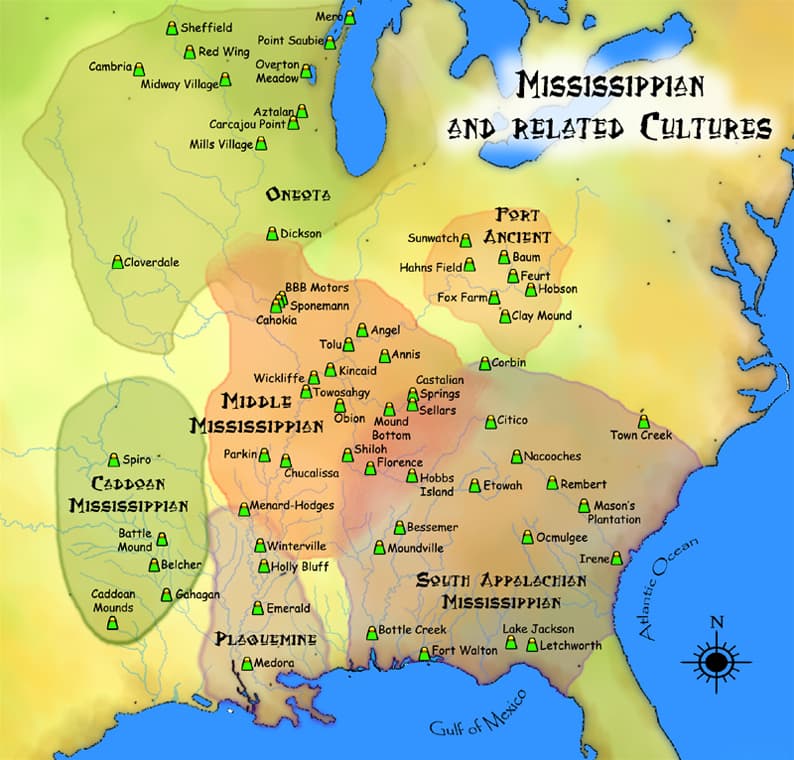
Long before European sails appeared on the horizon, the floodplains and river valleys of the American Mid-Atlantic, Midwest, and Southeast were dominated by a sprawling network of urban centers and satellite villages.
Before any European explorer set foot on the continent, a vast network of cities and towns, linked by rivers and shared beliefs, rose across the valleys of the American Midwest, South, and Southeast. Between 800 and 1600 CE, the floodplains of the Mississippi River and its sprawling tributaries became the stage for a dramatic transformation in human organization. Here, ancestral populations abandoned the fluid, decentralized tribal lifeways of the Late Woodland period to construct something unprecedented in the region: a highly stratified world of complex chiefdoms, intensive agriculture, and massive, flat-topped earthen pyramids that dominated the landscape. This was not a single empire under a solitary ruler, but a collection of distinct societies sharing a profound cultural grammar—a phenomenon archaeologists call the Mississippian culture.
To look upon a Mississippian town of the eleventh century was to see a landscape radically reshaped by human hands. At the center of these settlements stood the mounds, enormous truncated pyramids of earth, rectangular or square, built entirely without draft animals, wheeled vehicles, or stone tools. Laborers carried hundreds of thousands of basketloads of clay and soil to construct these elevated platforms, atop of which sat the temples, council houses, and elaborate domestic residences of the ruling elite. Below these mounds lay sprawling public plazas, residential sectors, and satellite villages, all systematically organized. At its peak, the largest of these urban centers was Cahokia, situated in present-day southern Illinois near East St. Louis. Flourishing between 1050 and 1350 CE, Cahokia was the grandest pre-Columbian settlement north of Mexico, a bustling metropolis where astronomical observation, copper working, and ritual pageantry converged. At Cahokia, a timber circle known as Woodhenge tracked the movements of the sun, while the Rattlesnake Causeway aligned precisely with the southern moonrise, anchoring the city to the movements of the cosmos.
This architectural and social complexity was fueled by a revolution in the dirt. Around the ninth century, communities began a widespread transition to intensive, maize-based agriculture. They cleared the fertile river valleys, working one plot of land at a time to cultivate surplus corn that could sustain dense, permanent populations. This agricultural surplus enabled a steep social hierarchy to harden into place. Power, both political and religious, became centralized in the hands of a small elite. Institutionalized inequality became a defining feature of Mississippian life, visible in the stark differences between the spacious homes atop the platform mounds and the modest dwellings of the commoners below, as well as the dramatic ritual retainer burials excavated at Cahokia’s Mound 72. Craftsmen specialized in fine arts, tempering their ceramics with crushed riverine or marine shells to create distinctive, durable pottery, and cold-hammering naturally occurring copper deposits into intricate ritual plates and ornaments.
Connected to
- has partCahokia1050 CE
+ 3 further connections to entries not yet ingested