Europe’s first civilization did not announce itself with statues of conquering kings or monuments to dynastic power.
In the early twentieth century, an English archaeologist named Arthur Evans began excavating a dry, olive-studded hill in northern Crete called Knossos. What he uncovered was not merely a city, but an entire sensory universe that had vanished from human memory three millennia prior. He found walls washed in brilliant ochre and Egyptian blue, depicting slim-waisted youths leaping over charging bulls, women with elaborate, tiered skirts holding writhing serpents, and stylized octopuses wrapping their tentacles around elegant clay jars. The architecture was immense, chaotic, and seemingly organic—a vast, multi-storied maze of lightwells, grand staircases, and columned halls. Evans, invoking the ancient Greek myth of the labyrinth and the beast that lay at its heart, named this lost culture the Minoan civilization, after the legendary King Minos. Yet as decades of subsequent archaeology have revealed, the civilization Evans found was far stranger, more decentralized, and more elusive than any classical Greek myth of kings and monsters could ever capture.
The people whom the Egyptians called the Keftiu did not emerge from a vacuum, nor did they arrive as conquerors. Their story began in the deep soil of Crete around 7000 BCE, when Neolithic farming communities from Anatolia or the Levant settled the island's fertile plains and coastal fringes. For millennia, these people lived in open, egalitarian villages. But around 3100 BCE, during the Early Minoan I period, a quiet transformation began. Settlements crept from the low-lying plains toward the more rugged highlands and outer islands, a migration enabled by the mastery of less hospitable terrains. By the middle of the third millennium BCE, the introduction of masted ships and Cycladic-style canoes catalyzed an "international era." Cretan sailors pushed beyond the Aegean, navigating the open waters of the Mediterranean to trade with Egypt and the ports of Syria. Lacking local sources of metal, they traded their own agricultural surpluses and delicate luxury crafts for the copper, tin, and gold of the ancient Near East. Along with these metals came ideas: the Minoans adopted and reshaped foreign concepts, transforming the ancient Near Eastern seal into a distinctively Cretan medium of administrative and personal identity.
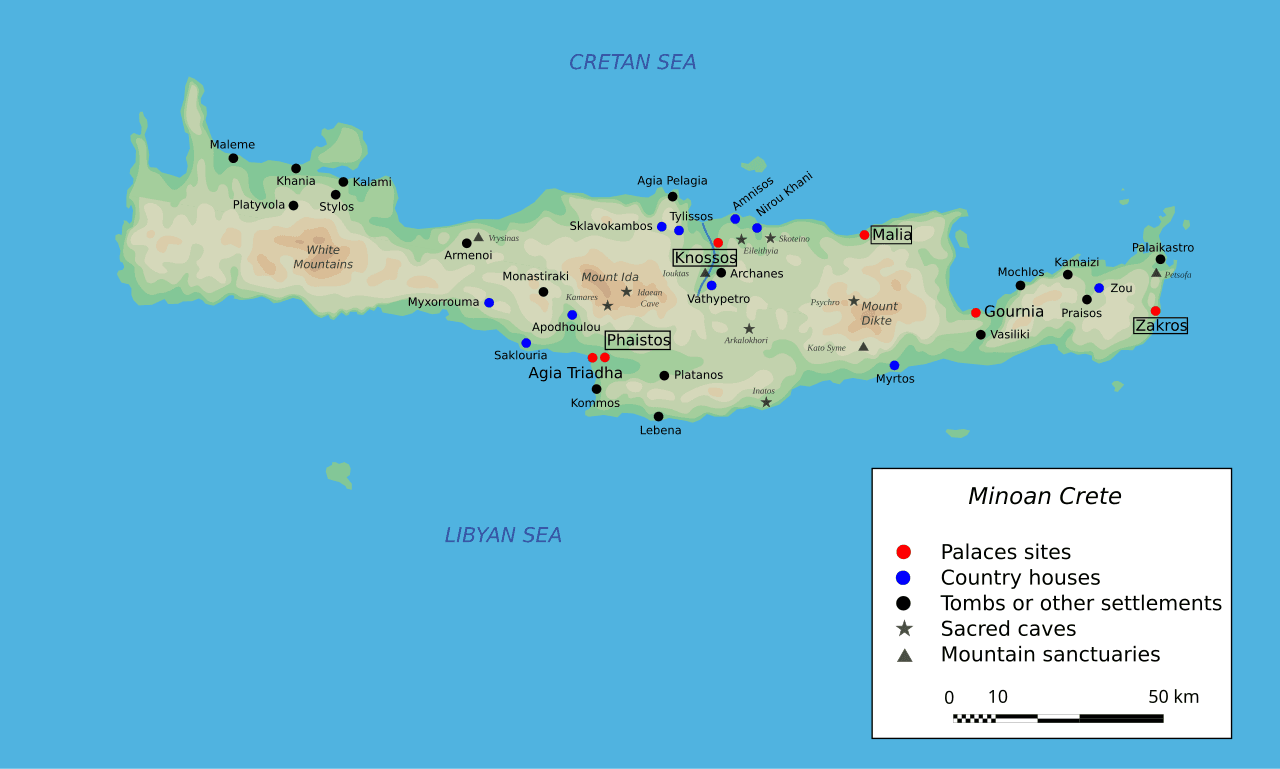
The true pivot of Minoan history occurred around 1925 BCE, during the Middle Minoan IB period, with the sudden construction of the first great "palaces" at Knossos, Phaistos, and Malia. Built upon sites that had been used for communal ceremonies since the Neolithic, these monumental structures were not the fortified castles of warlords, nor is there any clear evidence they were royal residences. Indeed, despite the abundance of Minoan art, there is not a single unambiguous depiction of a monarch. Instead, these labyrinthine complexes served as massive, multi-functional civic, economic, and religious hubs. They were places where agricultural goods were gathered, recorded, and redistributed; where artisans used the newly introduced potter's wheel to throw eggshell-thin, vibrantly painted Kamares ware; and where communities gathered for ecstatic rituals.
9 links to entries not yet ingested in the Library.
To step into a Neopalatial Minoan space was to enter a world that celebrated motion, nature, and the supernatural. Unlike the static, monumental art of contemporary Egypt or Mesopotamia, Minoan frescoes and figurines possess a fluid, almost kinetic energy. Swallows dart through lilies, dolphins leap through stylized waves, and human figures are rendered with an elasticity that suggests dance or ritual possession. Religious life was not confined to temple walls; it breathed through the landscape. The Minoans worshipped at windy peak sanctuaries on mountain summits and within the dark, dripping chambers of sacred caves. In these spaces, and within the central courts of the palaces, they performed rituals that remain tantalizingly obscure. Young men and women are depicted grasping the horns of charging bulls, vaulting over their backs in a terrifying, graceful display of athletic devotion. Nearby, priestesses or goddesses—exemplified by the famous faience "snake goddess" figurines—gaze wide-eyed, holding serpents aloft in their hands, embodying a religious pantheon whose names and structures we still cannot read.
This entire world was recorded in scripts that remain one of antiquity’s great unsolved riddles. By the early second millennium BCE, the Minoans had developed two distinct writing systems: a pictographic script known as Cretan hieroglyphs, and a more stylized, linear script called Linear A. Because neither has been deciphered, the Minoan language remains a phantom, unrelated to any known Indo-European or Afroasiatic family. We know of their daily transactions and holy dedications only through the silent patterns of their signs pressed into clay tablets, leaving their internal voices completely closed to us.
This brilliant, maritime-oriented society was also profoundly fragile, shaped by the volatile geology of the southern Aegean. Crete is a seismically active island, and the history of the Minoans is punctuated by destruction and rebirth. Around 1700 BCE, a series of massive earthquakes shattered the first palaces. Rather than collapsing, Minoan society rebuilt on a grander, more innovative scale, ushering in the Neopalatial golden age. But a more catastrophic test came around 1600 BCE, with the eruption of the volcano on the nearby island of Thera. It was one of the largest volcanic explosions in human history, ejecting up to one hundred cubic kilometers of material. While the eruption instantly buried Cycladic settlements like Akrotiri and devastated the northeastern coast of Crete, the core of Minoan civilization proved resilient. In the decades that followed, during the Late Minoan IB period, Knossos and other central sites actually entered a phase of ambitious building and artistic triumph, characterized by the whimsical "marine style" of pottery, where octopuses and shells swam across the clay.
The end, when it came, was not a natural disaster, but a human one. Around 1470 BCE, a wave of systematic, deliberate destruction swept across Crete. Palaces and towns were torched, but in a pattern that suggests targeted violence rather than an earthquake or a random raid: at Knossos, the surrounding town was burned to ash, while the grand palace itself was spared. Historians remain divided over whether these ruins represent a bloody internal civil war or the arrival of conquerors from the Greek mainland. What is certain is that in the aftermath of these fires, the cultural landscape of Crete changed forever.
By the Late Minoan II and III periods, the mainland Mycenaean Greeks had established dominance over the island. Knossos was the only palace left standing, and its administrative offices now hummed with a new script: Linear B. Deciphered in 1952 by Michael Ventris, Linear B used modified Minoan characters to write an early form of Greek. The clay tablets from this final, hybrid phase reveal a highly bureaucratic, militaristic administration supervising the palace's final year. When Knossos was finally destroyed by fire sometime before 1075 BCE, the palace-centric system of the Bronze Age dissolved entirely.
In their final centuries, during the widespread Late Bronze Age collapse, the surviving Minoans abandoned their vulnerable coastal harbors. They retreated into the mountains, establishing small, defensible villages built around ancient highland shrines. In these isolated redoubts, they preserved their distinct language—which survived in a few post-Bronze Age inscriptions known as Eteocretan—and kept the embers of their culture burning until the dawn of the Iron Age. When their civilization finally faded into the mists of Greek myth, they left behind a memory of a wealthy, island-ruling sea empire, and a legacy of artistic and architectural sophistication that would linger as the very foundation of Europe's early cultural heritage.