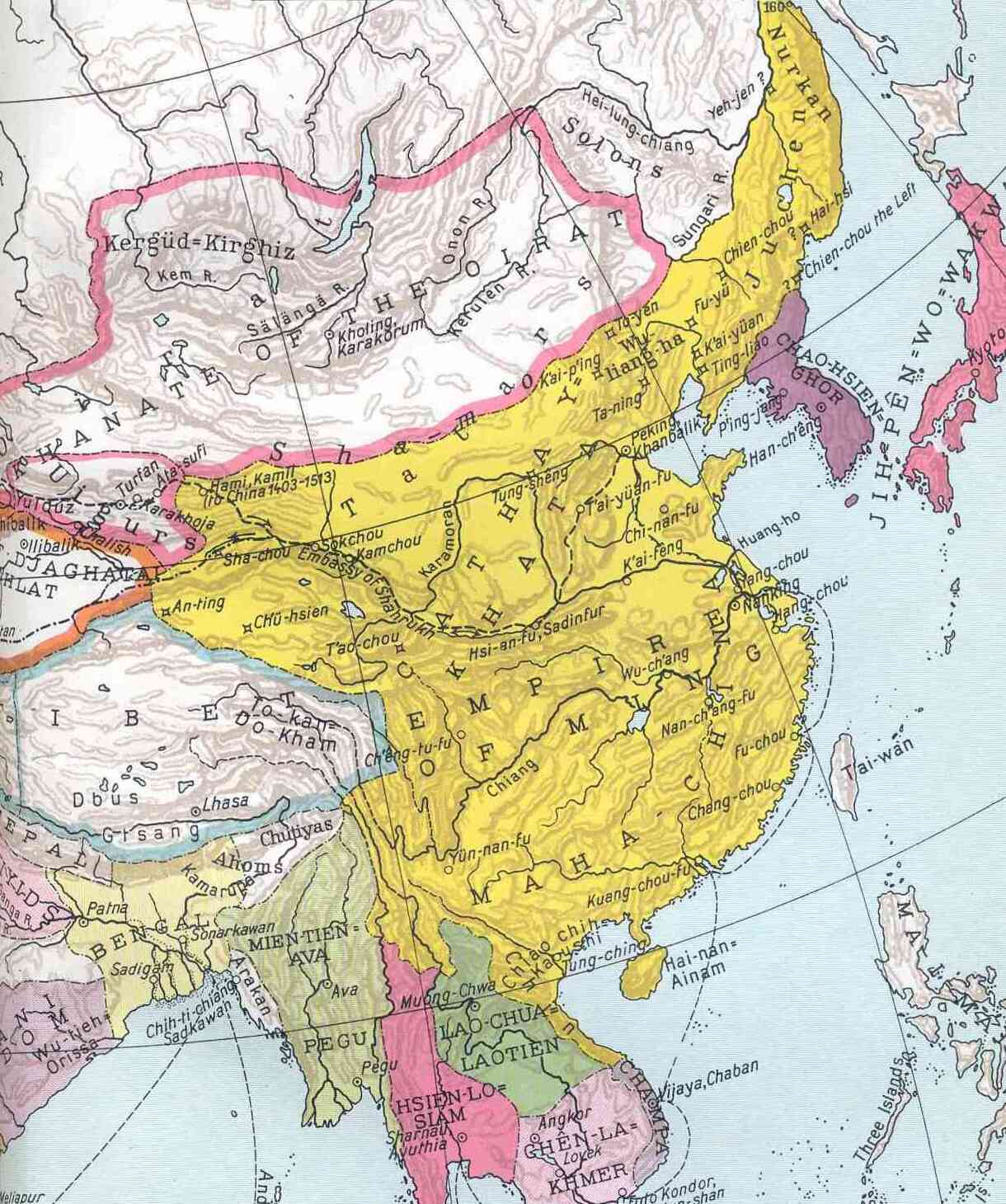
When the Mongol-led Yuan dynasty collapsed in 1368 CE, the rise of the Great Ming restored Han rule to the imperial throne, inaugurating nearly three centuries of immense military and architectural ambition.
The water of Lake Poyang was choked with fire and blood in the late summer of 1363. On this vast inland sea in southeastern China, two rival rebel armadas collided in what was perhaps the largest naval battle in human history. To the west lay the ships of Chen Youliang, a towering force of three-decked "castle ships" painted iron-gray, carrying an army claimed to be 650,000 strong. To the east was Zhu Yuanzhang, a man born to the dirt, leading a fleet of smaller, nimbler vessels carrying a third of that number. For three days, the horizon burned. Zhu’s forces deployed small fire-drift rafts, packing them with gunpowder and straw, steering them directly into the lumbering leviathans of his rival. When the smoke cleared, Chen was dead—struck in the eye by an arrow—and his fleet was ashes. Zhu, a former penniless peasant and novice Buddhist monk who had spent his youth begging for scraps of bread, was now the uncontested master of the wealthy Yangtze Valley. Five years later, his armies marched north to raze the palaces of the Mongol-led Yuan dynasty in Dadu, renaming the city Beiping and declaring the birth of the Great Ming.
Taking the reign name Hongwu, meaning "Vastly Martial," the new emperor set about designing a society that would never again know the chaos of his youth. The late Yuan era had been a nightmare of broken dikes, runaway inflation, and black plagues. In response, Hongwu envisioned a rustic, self-sufficient utopia: an empire of immutable villages where peasants stayed in their fields, soldiers farmed their own military colonies, and the state kept track of every soul through decennial censuses and meticulously compiled registers. To secure his dynasty, he raised a standing army of over a million men, yet sought to keep it cheap by organizing soldiers into hereditary military units (weisuo) that grew their own food. Suspecting his ministers of plotting against him, Hongwu took the drastic step of executing his chancellor in 1380, abolishing the office entirely, and consolidating absolute power directly into his own hands. He established a terrifying network of secret police—the Embroidered Uniform Guard—who dragged suspected dissidents to torture chambers. Some 100,000 people perished in his paranoid purges. Yet, even as he banned Mongol dress and promoted a return to Han Confucian ideals, Hongwu was a realist; he retained Mongol hereditary military systems, welcomed thousands of Mongol guards into his capital at Nanjing, and used the diplomatic machinery of the fallen Yuan to demand tribute from the surrounding world, presenting himself not as a rebel usurper, but as the legitimate, heaven-sent heir to global order.
This delicate balance of absolute autocracy and institutional stability faced its first great rupture upon Hongwu’s death. When his teenage grandson, the Jianwen Emperor, attempted to strip his powerful uncles of their regional fiefdoms, the Prince of Yan—Hongwu’s battle-hardened fourth son—launched a civil war. After three years of devastation, the prince seized the throne in 1402 as the Yongle Emperor. Yongle was a man of colossal, restless ambitions. He shifted the empire’s center of gravity northward, transforming his old power base of Yan into the grand capital of Beijing and constructing the Forbidden City, an immense labyrinth of red walls and golden roofs designed to project cosmic authority. To supply this northern capital, he restored the silted-up Grand Canal, creating a bustling aquatic highway that bound the agricultural wealth of the south to the defensive frontiers of the north. Where his father had feared court eunuchs and barred them from power, Yongle embraced them as a loyal counterweight to the rigid, moralizing Confucian scholar-bureaucrats.
+ 9 further connections to entries not yet ingested
It was under Yongle’s aegis that the Ming dynasty reached outward with unprecedented audacity. He commissioned the grand eunuch Zheng He to construct the "Treasure Fleet"—an armada of massive wooden ships, some of the largest ever built, constructed in the sprawling state dockyards of Nanjing. Between 1405 and 1433, Zheng He led seven epic voyages across the Indian Ocean, reaching the Persian Gulf, the Red Sea, and the eastern shores of Africa. These expeditions were not missions of conquest or colonization, but grand spectacles of prestige; they returned to Beijing laden with tributary envoys, exotic spices, and giraffes that the imperial court celebrated as auspicious mythical beasts. Yet, this global golden age was brief. The immense cost of the voyages, coupled with expensive military campaigns in the northern deserts, alienated the Confucian bureaucracy. When a subsequent emperor, Yingzong, was disastrously captured by Mongol forces during the Tumu Crisis of 1449, the empire’s outward confidence shattered. The Ming retreated behind its borders. The great treasure ships were left to rot in their slips, their logbooks suppressed or destroyed. In place of blue-water naval power, the state turned its resources inward, marshaling millions of draft laborers to connect, fortify, and clad in stone the ancient earthen ramparts of the northern frontier, forging the iconic, crenellated Great Wall that still snakes across the mountains today.
While the state withdrew politically, the world forced its way in economically. By the sixteenth century, Portuguese, Spanish, and Dutch merchants were probing the southern coasts of China, establishing trade outposts on small islands near Guangzhou, such as Macau. They brought with them the biological bounty of the Americas. Maize, sweet potatoes, and chili peppers—crops of the Columbian Exchange—quietly revolutionized Chinese agriculture. These highly productive plants thrived in marginal upland soils where traditional rice and wheat could not grow, dramatically reducing the threat of localized famines and fueling a population explosion that surged toward 200 million by the late Ming era. But the most disruptive import was not food; it was silver. European merchants purchased Chinese silk, tea, and porcelain with mountains of silver mined in the Andes and shipped across the Pacific. This torrent of foreign specie re-monetized a domestic economy whose paper currency had collapsed under the weight of hyperinflation. Chinese life became thoroughly commercialized. Rich merchants built lavish estates, challenging traditional Confucian social hierarchies, while philosophers like Wang Yangming argued for a more pragmatic, flexible moral philosophy that accommodated this dynamic, changing world.
But this silver-fueled prosperity carried a fatal vulnerability. In the late sixteenth century, the grand secretary Zhang Juzheng instituted sweeping fiscal reforms, decreeing that all taxes must be paid in silver rather than grain or labor. This worked brilliantly until the seventeenth century, when the global climate plunged into the depths of the Little Ice Age, ravaging harvests across northern China. Concurrently, disruptions in the Spanish and Portuguese silver trade caused the supply of imported bullion to contract sharply. As silver grew scarce, its value skyrocketed relative to local copper coins. For ordinary Chinese farmers, the economic math became impossible: they had to sell twice as much grain to acquire the silver needed to pay their imperial taxes.
As agricultural yields plummeted, the government treasury dried up, leaving the state unable to pay its soldiers or maintain the critical dikes of the Yellow River. Floods, crop failures, and a devastating epidemic swept the provinces, turning millions of desperate, starving peasants into bandits and rebels. In 1464, the Ming had easily crushed regional rebellions with massive armies, but by 1644, the center could no longer hold. A rebel leader named Li Zicheng swept across the north and entered Beijing, prompting the last Ming monarch, the Chongzhen Emperor, to hang himself from a tree on a hill overlooking the Forbidden City. In the chaos, a desperate Ming general, Wu Sangui, opened the gates of the Great Wall at Shanhai Pass to the Manchu-led Eight Banner armies, choosing to ally with northern invaders rather than surrender to the peasant rebels. The Manchus swept through the pass, defeated Li Zicheng, and established the Qing dynasty. Though Ming loyalists fled south, maintaining a desperate, fracturing resistance known as the Southern Ming until 1662, the grand project of the Han restoration had come to its end. The Ming dynasty left behind an empire of unparalleled cultural refinement, architectural grandeur, and economic integration—a civilization that had forged the modern image of China even as it bound its own destiny to the volatile currents of global trade.