Person · 1475 CE – 1564 CE · Early Modern Europe
Michelangelo
- Also known as
- Bounarroti Michelangelo
- jan Michelangelo
- jan Mikelanselo
- Maket Angget
- Micelangelo
- Michael Agnolo
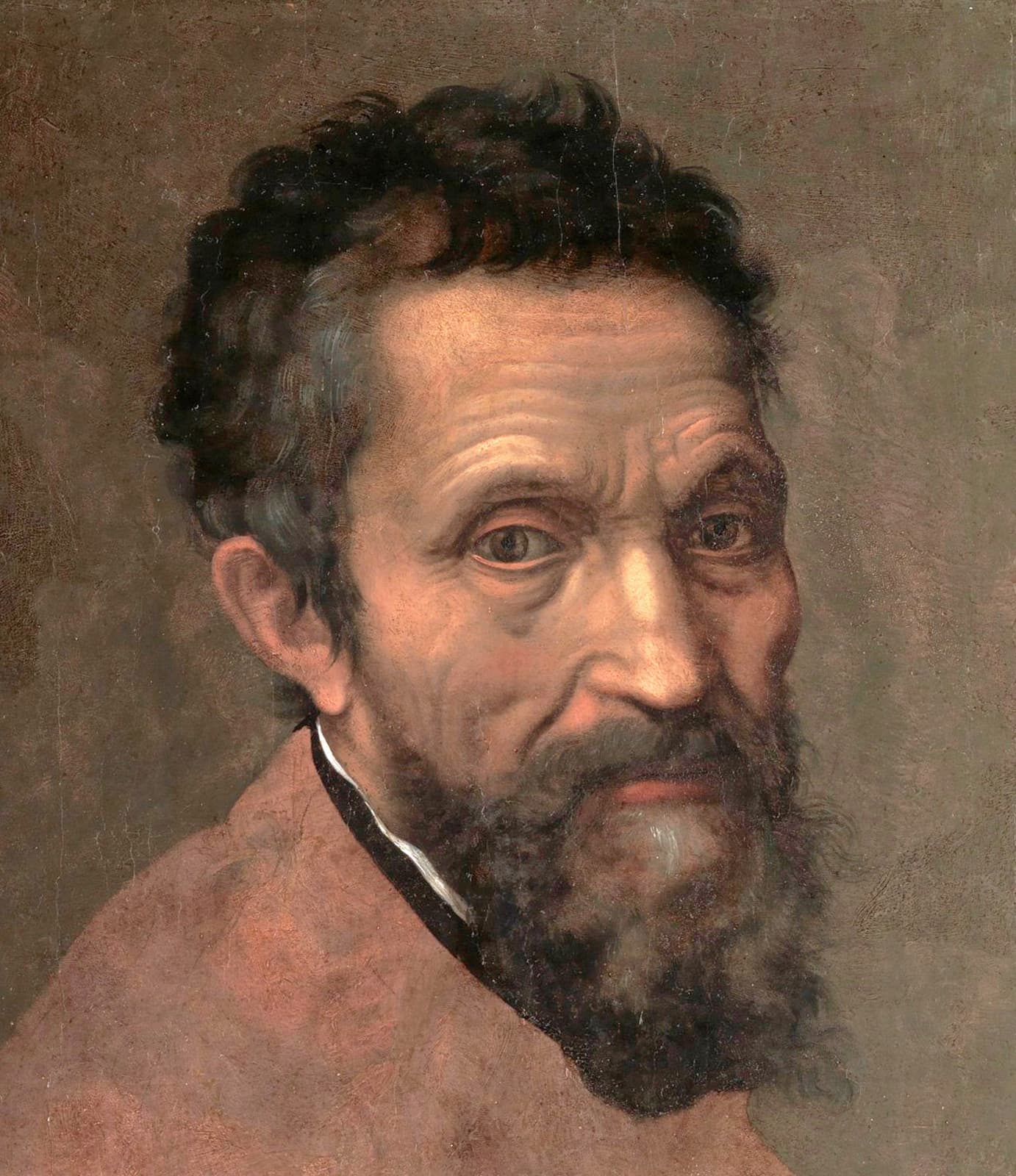
To his contemporaries, Michelangelo di Lodovico Buonarroti Simoni was simply Il Divino, the divine one, an artist whose work possessed a fierce, awe-inspiring power they called terribilità.
The knack of handling the chisel, Michelangelo would later say, was absorbed with his nurse’s milk. He was born in the spring of 1475 in the rugged Tuscan town of Caprese, where his father, a proud but impoverished gentleman named Ludovico Buonarroti, served a brief term as a local magistrate. The Buonarrotis were of old, patrician Florentine stock, a family that had once run a small-scale bank and claimed a prestigious, if entirely fictitious, descent from the Countess Matilde di Canossa. When the family returned to Florence shortly after his birth, the infant Michelangelo was sent to be wet-nursed by the wife of a stonecutter in the nearby hills of Settignano, a village defined by its quarries and the grit of gray sandstone. It was an upbringing that rooted his imagination in the physical reality of stone long before he had any formal understanding of art. To his father’s immense chagrin, the boy showed no interest in the respectable career of a banker or a scholar of grammar. Ludovico viewed the manual labor of an artist as a degradation of the family’s gentility, but the boy’s stubbornness was absolute. By 1488, at thirteen, Michelangelo had forced his father’s hand, securing an apprenticeship in the bustling Florence workshop of Domenico Ghirlandaio, the city's premier master of fresco and perspective.
In Ghirlandaio’s workshop, Michelangelo mastered the demanding mechanics of painting, but the flat surface of a wall could not long contain his instinct for mass and volume. He spent his free hours drawing in the Brancacci Chapel, copying the heavy, solemn frescoes of Masaccio, and studying the civic masterpieces of Donatello and Lorenzo Ghiberti that adorned the public squares. His talent was swift and fierce, accompanied by a sharp tongue and a temperament so abrasive that a fellow student, Pietro Torrigiano, struck him across the face during an argument, permanently crushing his nose and leaving him disfigured for life. Yet this rugged, prideful teenager caught the attention of Lorenzo de' Medici, the de facto ruler of Florence. Summoned to the sculpture school Lorenzo had established in the Medici gardens, Michelangelo was introduced to a rarefied world of classical antiquity and intellectual fervor. For three years, he lived almost as a son in the Medici household, dining at the same table with the philosophers Marsilio Ficino and Pico della Mirandola, and absorbing a Christian Platonism that would forever define his understanding of beauty as a reflection of the divine.
The security of this golden era shattered in 1492 with the death of Lorenzo. Under the weak rule of Lorenzo's heir, Piero, Florence began to fracture, increasingly swayed by the apocalyptic sermons of the Dominican friar Girolamo Savonarola. Michelangelo, prone throughout his life to dark, sudden anxieties, sensed impending ruin and fled the city in 1494, just before the Medici were expelled. He traveled first to Venice and then to Bologna, where he carved small, robust figures for the Shrine of St. Dominic, studying the dramatic, heavy-limbed reliefs of Jacopo della Quercia. When he returned briefly to a transformed Florence—now a stern, ascetic republic dominated by Savonarola’s puritanical zeal—he found little patronage. Instead, he carved a sleeping Cupid in imitation of classical sculpture, which a Medici cousin suggested could be artificially aged and sold in Rome as an antique. The deception succeeded, but when the purchaser, Cardinal Raffaele Riario, discovered the fraud, he was so struck by the superb quality of the carving that he demanded to meet the young sculptor, inviting him to Rome in the summer of 1496.
Connected to
12 links to entries not yet ingested in the Library.