Meroë
- Also known as
- Meroe
- Meroe
- Meroe
- Meroe
- Meroe
- Meroe
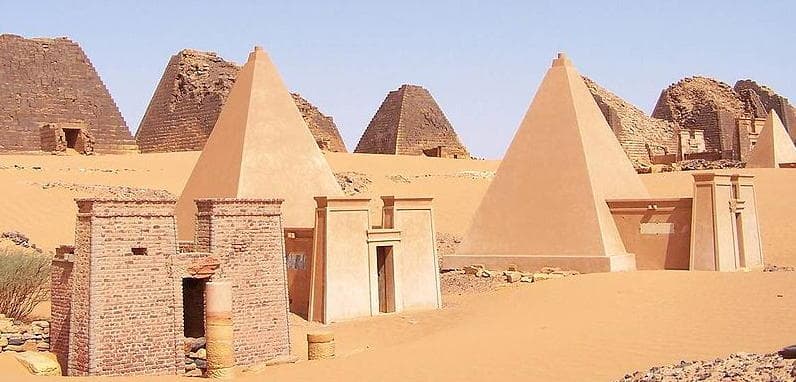
Rising from the dry scrub of the Sudanese desert, some two hundred kilometers northeast of modern Khartoum, more than two hundred steep-sided, slender pyramids mark the site of Meroë.
Buried beneath the shifting sands of the Sudanese desert, some two hundred kilometers northeast of Khartoum, lies a field of steep, narrow stone pyramids. They do not possess the staggering, mountain-like scale of the monuments at Giza, but their sheer density—more than two hundred clustered in silent, ruined groups on the east bank of the Nile—evokes a different kind of power. This is Meroë, once the beating heart of the Kingdom of Kush. To the ancient Greeks, it was a legendary metropolis, the "mother city" of the people they called Ethiopians. To the Romans, it was a formidable southern adversary whose warriors once swept down the Nile to plunder the bust of Augustus Caesar, burying his bronze head beneath the steps of a victory temple so that every passing citizen would trample the emperor’s face. For centuries, Meroë stood as one of the most brilliant, technologically advanced, and wealthy urban centers on the African continent, thriving in a landscape where the river met the rain-swept savannah.
The rise of Meroë was a triumph of strategic relocation. For centuries, the Kushite state had been ruled from Napata, farther north near the Fourth Cataract. But in approximately 591 BCE, after the Egyptian Pharaoh Psamtik II sacked Napata, the Kushite court made a decisive move southward. King Aspelta transferred the capital to Medewi—transcribed by foreign contemporaries as Meroë—positioning the center of Kushite power safely between the Fifth and Sixth Cataracts. This was not merely a retreat into the hinterlands; it was a brilliant economic realignment. While Napata had been dry and heavily dependent on the narrow agricultural strip of the Nile, Meroë lay on the edge of the Butana grass-plains, inside the summer rainfall belt. Here, the earth was rich in iron ore, and the surrounding savannahs abounded with hardwood. The seasonal rains allowed for a flexible, decentralized system of agriculture and pastoralism, while the city's geographical position offered direct access to lucrative trade routes leading east to the Red Sea.
From this savanna-fringed capital, the kings and queens of Kush orchestrated a complex economy. It was an empire where political authority was measured not by the borders drawn on a map, but by the control of human labor and the flow of prestige goods. The state centralized the production of fine crafts, most notably an extraordinarily sophisticated pottery tradition. Elaborately decorated, thin-walled ceramic vessels were produced under royal oversight, holding immense social and ritual value, particularly in the elaborate mortuary rites of the elite. Yet it was iron that truly defined Meroë’s industrial landscape. The city’s ironworkers were among the most skilled in the ancient world, smelting the local ore in bloomeries and blast furnaces fueled by abundant hardwood. The scale of this metalworking was so vast that early modern visitors, marveling at the colossal mounds of industrial slag framing the ruins, dubbed Meroë the "Birmingham of Africa."
This industrial might fueled an international trade network that stretched from the Mediterranean deep into the African interior. Down the Nile and across the desert tracks went Kushite iron, copper, fine textiles, and exquisite jewelry. The region of Nubia—its very name perhaps derived from nub, the ancient Egyptian word for gold—poured its yellow wealth into the royal treasuries. Meroë also acted as the primary gateway for exotic luxury goods sought by the Mediterranean elite: ivory, rare animal skins, ostrich feathers, ebony, and wild animals captured in the southern forests. The introduction of the sakia, an ox-driven waterwheel, revolutionized local agriculture, allowing the Meroitic people to irrigate larger tracts of land and sustain a dense urban population that supported this sprawling commercial empire.
At the apex of this society sat an autocrat whose power was balanced by a unique political institution: the Kandake, or Queen Mother. Though her precise administrative role remains partially veiled in the obscurity of undeciphered Meroitic texts, the Kandake possessed immense authority, co-ruling alongside the king, directing temple ceremonies, and occasionally leading armies. When the shadow of Rome fell over northeastern Africa following the Roman conquest of Egypt, it was a fierce, one-eyed Kandake named Amanirenas who helped lead the resistance.
The clash began in 23 BCE. In response to Kushite incursions into southern Egypt, the Roman governor Publius Petronius marched his legions south, sacking Napata. The Kushites retaliated with speed, raiding Roman-held towns near the First Cataract at Aswan, pulling down statues of the Emperor Augustus and carrying the bronze spoils back to Meroë. Though Petronius claimed victory, the conflict ended not in Kushite subjugation, but in diplomacy. In 22 BCE, envoys from Meroë negotiated a highly favorable peace treaty with Augustus himself. The frontier was stabilized, and the decades that followed saw a tremendous boom in Roman trade goods flowing into Meroë. Rome’s curiosity about this wealthy southern neighbor persisted; in 61 CE, the Emperor Nero dispatched a small detachment of Praetorian guards to explore the Nile. The soldiers reached Meroë, where they were received with hospitality and provided with an escort to journey further south, eventually turning back only when they encountered the impenetrable, malaria-ridden swamps of the Sudd.
For all its resilience, Meroë could not escape the shifting currents of global trade and regional politics. By the second and third centuries CE, the kingdom’s traditional industries began to wane, and its environmental resources—particularly the hardwood forests needed to fuel the insatiable iron furnaces—crept toward exhaustion. To the east, a rival power was rising: the Kingdom of Aksum, based in the highlands of modern-day Eritrea and Ethiopia. Aksum’s growth intercepted the trade routes to the Red Sea, slowly choking Meroë’s economic lifeline. Around 330 CE, an Aksumite king, likely Ezana, left a Ge'ez inscription at the site of Meroë, claiming dominion over the region. By 350 CE, the end arrived. Broken by economic isolation and ultimately invaded by Aksum, the centralized state of Meroë collapsed. Its palaces fell into ruin, and its territories were eventually absorbed by the Christian kingdom of Alodia.
Yet the memory of Meroë lingered, transforming into myth and legend across the ancient world. In Jewish oral tradition, the city—under its older name of Saba—became the stage for a grand romance and military campaign led by a young Moses, who supposedly conquered the heavily fortified river-city through a combination of clever military strategy and the help of a local princess. Today, the wind whistles through the steep-sided pyramids of Bagrawiyah, stripping the golden sandstone of its outer plaster. These tombs, standing in silent, geometric rows against the desert sky, remain as monuments to an African empire that did not merely copy the traditions of Egypt to its north, but forged its own distinct, iron-scented civilization—a power that once stood eye-to-eye with the masters of Rome.
Connected to
4 links to entries not yet ingested in the Library.