Person · 1844 CE – 1913 CE · East African Civilizations
Menilek II
- Also known as
- 2 ምኒልክ
- 2ኛ ምኒሊክ
- Aba Dagnew
- Aba Dagnew
- Aba Dagnew
- Aba Dagnew
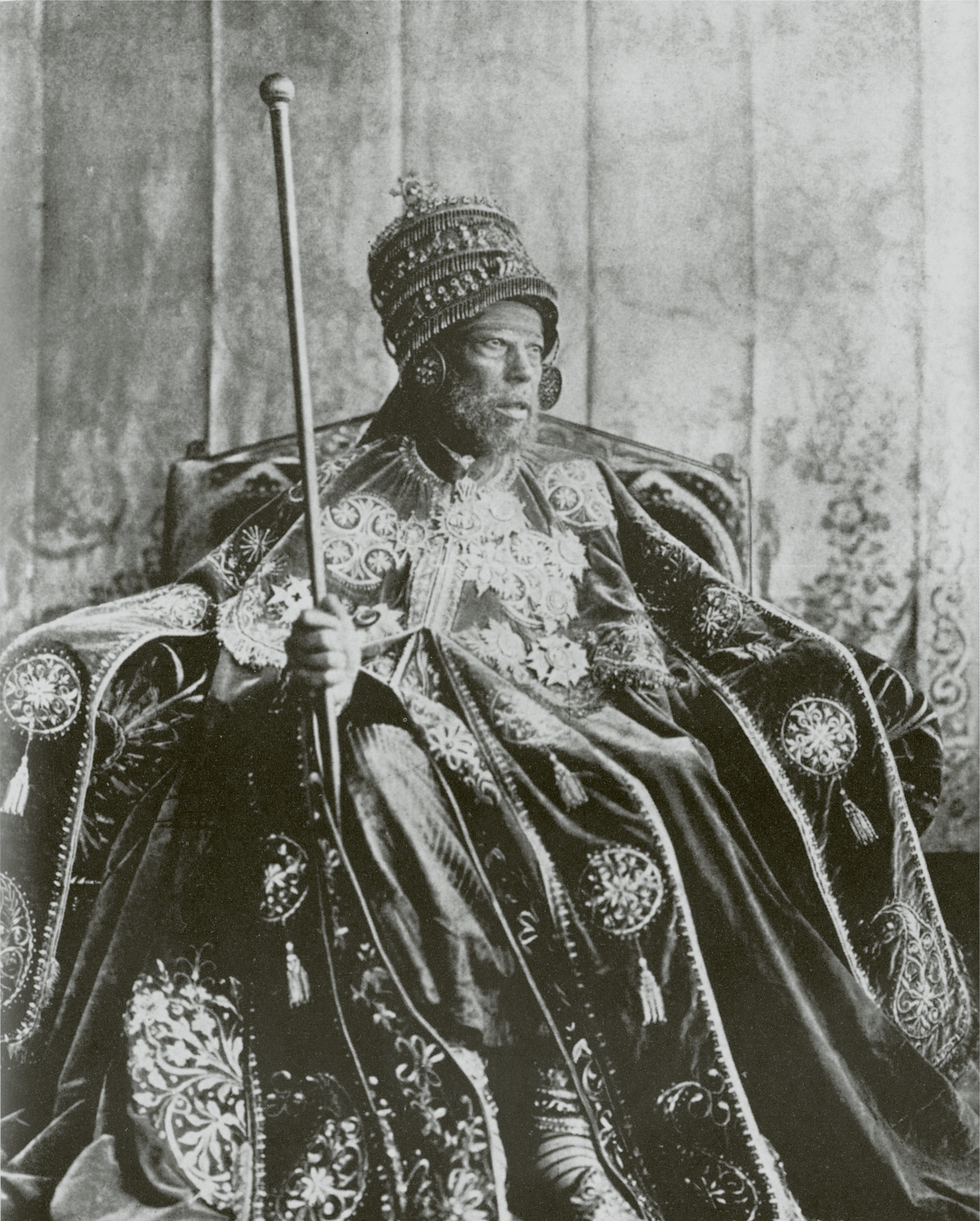
The path to the throne of Ethiopia for the boy born Sahle Maryam began in a fortress prison.
In the early hours of July 1, 1865, a twenty-one-year-old prince slipped over the ramparts of the fortress of Magdala, descending into the dark, fractured ravines of the Wollo region. His name was Sahle Maryam, but his grandfather had named him Menilek, invoking the legendary first king of Ethiopia, the son of Solomon and the Queen of Sheba. For a decade, the young prince had been a captive-guest of Emperor Tewodros II, a brilliant and increasingly erratic ruler who had unified much of the fragmented empire under a heavy hand. Tewodros had killed Menilek’s father, the King of Shewa, and annexed his homeland, yet he had raised the captive prince with the care due to a son, educating him in statecraft, military strategy, and the perils of ruling a fractured realm. As the Emperor’s power began to fray under the weight of rebellions and his own growing brutality, Menilek saw his moment. His escape was not merely a flight to freedom; it was the first move in a calculated, lifelong campaign to reclaim his ancestral kingdom of Shewa and, ultimately, to reshape the Horn of Africa.
Upon reaching Shewa, Menilek was welcomed by a population eager for the restoration of their royal line. He quickly marginalized the local usurper, Bezabeh, and was proclaimed Negus, or king, of Shewa in August 1866. From the outset, Menilek’s governance of his kingdom signaled a sharp departure from the rigid centralization of his former captor, Tewodros. Where Tewodros had used force to crush dissent and enforce religious uniformity, Menilek deployed a sophisticated pragmatism. He prioritized diplomacy, reconciliation, and an unusual degree of religious tolerance, issuing a strict edict that forbade destabilizing theological disputes and guaranteed freedom of worship to the Muslims, animists, and Orthodox Christians of his realm. While the northern heartlands of Ethiopia devolved into civil war following Tewodros’s suicide in 1868, Menilek quietly and methodically built a powerhouse in the south. He astutely avoided premature conflicts with northern rivals, submitting in 1878 to the new Emperor, Yohannes IV, after a brief, failed attempt to leverage an Egyptian invasion to his own advantage. This strategic submission granted Menilek the breathing room he needed to expand his own domain.
Operating as a quasi-independent monarch under Yohannes’s nominal suzerainty, Menilek embarked on a massive territorial expansion to the south and east. His armies marched into territories inhabited by the Oromo, Wolayta, and Gurage peoples, eventually capturing the strategic eastern trading hub of Harar in 1887 under the command of his cousin, Ras Makonnen. These conquests were violent and transformative, resulting in the establishment of fortified garrison towns known as katamas and the introduction of the neftenya landlord system. To critics among the newly incorporated populations, Menilek’s expansion was an era of harsh subjugation, land expropriation, and cultural suppression that sowed the seeds of long-lasting ethnic tensions. To Menilek, however, the southern campaigns were the economic engine of his imperial ambitions. The conquered lands yielded vast revenues from the trade of ivory, gold, coffee, and slaves, which he channeled directly into the global arms market. Recognizing that Ethiopia’s survival depended on modernizing its military, Menilek bypassed traditional diplomatic channels to deal directly with European merchants and advisors. He forged a particularly close partnership with the Swiss engineer Alfred Ilg, using European expertise to acquire thousands of modern firearms and artillery pieces.
The true test of Menilek’s statecraft arrived in 1889. Following the death of Emperor Yohannes IV at the Battle of Metemma, Menilek was crowned Emperor of Ethiopia at Mount Entoto. Seeking to secure his newly won throne and establish stable foreign relations, he signed the Treaty of Wuchale with Italy that same year. The treaty, however, contained a devastating duplicity. In the Amharic text of Article XVII, Ethiopia was permitted to use the diplomatic channels of Italy for its foreign affairs; in the Italian version, this permission was framed as an obligation, effectively reducing Ethiopia to an Italian protectorate. When Menilek and his politically astute consort, Empress Taytu Betul, discovered the deception, they did not waver. Menilek formally rejected the treaty in 1891, asserting Ethiopia’s absolute sovereignty. He spent the next four years stockpiling weapons and unified a remarkably diverse coalition of regional rulers, many of whom had been historical rivals, under a single national banner.
The climax of this confrontation came on March 1, 1896, near the northern town of Adwa. The Italian colonial army, confident in its technological and racial superiority, marched into the mountainous terrain of Tigray, only to find themselves vastly outnumbered by a highly disciplined, modernly equipped Ethiopian force of over 100,000 men. The Battle of Adwa was a swift and total rout of the Italian forces. It remains one of the most stunning military victories in African history, shattering the myth of European invincibility and forcing the European powers to formally recognize Ethiopia's independence. In the aftermath of Adwa, Menilek secured his nation’s borders through a series of bilateral treaties with Britain, France, and Italy, ensuring that Ethiopia remained the only major African polity to retain its independence during the "Scramble for Africa."
With his external sovereignty secured, Menilek turned his formidable administrative energy toward the physical and institutional modernization of his empire. He established a permanent capital at Addis Ababa, founded a state bank, opened modern schools, and established centralized government ministries to replace the feudal system of administration. His crown jewel of modernization was the initiation of the Addis Ababa–Djibouti Railway, a massive engineering project designed to link his landlocked capital directly to the Red Sea trade networks. Even as strokes began to incapacitate him from 1906 onward—leading to a period of regency dominated by Empress Taytu and Ras Tessema Nadew—the structures Menilek had put in place held the empire together.
When Menilek II died on December 12, 1913, he left behind a nation profoundly transformed. He was succeeded briefly by his grandson, Lij Iyasu, and later by his daughter, Empress Zewditu, alongside the young regent Ras Tafari Makonnen, who would eventually ascend the throne as Haile Selassie. To the wider world, Menilek became a towering symbol of African sovereignty and resistance to colonial encroachment. Within the borders of the modern state he founded, his legacy remains a complex and contested tapestry: he is remembered by many as the visionary father of modern Ethiopia, and by others as an imperial conqueror whose centralized state building came at a devastating cost to the diverse peoples of the south. Ultimately, his reign redrew the map of East Africa, proving that an indigenous African empire could meet the industrial powers of Europe on their own terms, both on the diplomatic floor and on the field of battle.
Connected to
12 links to entries not yet ingested in the Library.