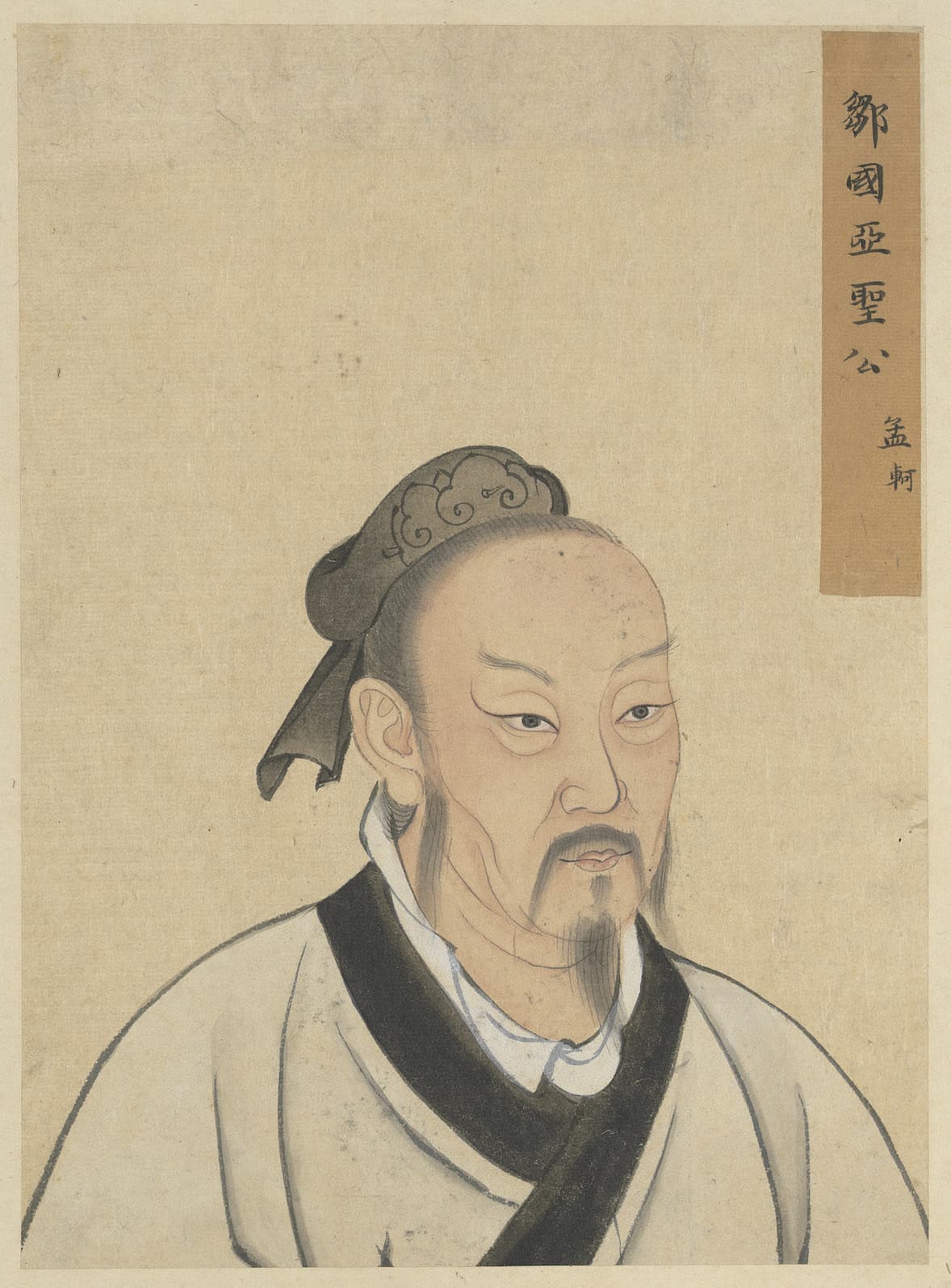
To believe that human beings are fundamentally good, even while watching the Chinese world fracture into the bloody chaos of the Warring States period, required a singular kind of intellectual courage.
Around the middle of the fourth century BCE, a young boy in the small Chinese principality of Zou spent his days playing at burying the dead. He lived with his widowed mother next to a cemetery, and with the uncanny mimicry of childhood, he spent his hours digging imitation graves, arranging mock mourners, and wailing in theatrical grief. His mother, a widow of the Zhang family whose husband Meng Ji had died when their son was only three, watched this grim game and decided it was no place to raise a child. She packed their few belongings and moved to a house near a bustling market. There, the boy quickly abandoned his funerals to mimic the haggling, shouting, and posturing of the local merchants. Again, his mother shook her head: this was not a fitting destiny for a son of the Meng clan. She moved a third time, settling next to a school. Soon, the boy was imitating the quiet dignity, the precise bows, and the diligent study of the scholars. There they stayed.
This boy was Meng Ke, known to history as Mencius, the "Second Sage" of Confucianism. The story of his mother’s three flittings—the famous mèngmǔ sānqiān—became China’s founding parable on the power of environment over the human soul. It was a theme that would define Mencius’s entire philosophy. Unlike the austere lawgivers of his era, Mencius believed that human nature was fundamentally, beautifully good. To prove this, he did not point to ancient texts or divine decrees, but to a sudden, visceral human reaction: if any person, no matter how wicked or cold, were to suddenly see a child crawling toward the edge of a deep well, they would instantly feel a spasm of alarm and distress. They would not feel this because they wanted to curry favor with the child’s parents, nor to win the praise of their neighbors, nor to avoid a bad reputation. They would feel it because the impulse toward mercy is as natural to a human being as having four limbs.
Yet Mencius did not live in a world that looked naturally good. He lived during the brutal twilight of the Zhou dynasty, a period known with dark literalism as the Warring States. The old feudal order was dissolving into a bloodbath of seven rival kingdoms. Princes usurped the title of king, smaller states were devoured by their larger neighbors, and the battlefields were choked with the dead. Scholars and strategists wandered from court to court, selling lethal military tactics or schemes of statecraft to the highest bidder. To Mencius, these cynical advisors were "little men." He watched the rulers of his day tax their subjects to the point of starvation while their own stables were filled with fat horses, and he lamented that "the multitudes were oppressed; the supplies of food and drink flowed away like water."
+ 7 further connections to entries not yet ingested
Against this backdrop of anarchy, Mencius set out to do what Confucius had attempted a century earlier: to find a ruler willing to govern through benevolence (ren) and righteousness (yi). For forty years, accompanied by a retinue of disciples, he traveled the fragmented landscape of China, lecturing kings and dukes. He was a bolder, brasher figure than Confucius. Where the First Sage was always a model of deferential courtliness, Mencius was intellectually fierce, confident, and occasionally insolent. When he served as an official at the Jixia Academy in the state of Qi between 319 and 312 BCE, or when he advised King Hui of Liang, he did not beg for a hearing. He asserted his equality with kings. When asked if the citizens of a state had the right to overthrow a tyrant, Mencius did not flinch. To depose a ruler who ignored his people's needs was not regicide, he argued, because a king who rules without benevolence is no longer a king at all—he is merely a "villain" occupying a throne.
This revolutionary political vision was anchored in his economic pragmatism. Mencius understood that moral elevation was a luxury of the well-fed. While a highly cultivated philosopher might maintain his integrity in the face of starvation, the common people required "permanent property" to maintain permanent morals. If a peasant was constantly worried that his family would freeze or starve, he would inevitably turn to crime, deceit, and desperation. Therefore, Mencius advocated for practical, humane statecraft: low tax rates, an end to state-run monopolies, free trade without import tariffs, and a system where the wealthy bore a progressive share of the tax burden. He envisioned a marketplace left largely to regulate itself, believing that if people were secure in their livelihoods, they would naturally find the time to care for their families, learn proper rites, and become good citizens.
This view of human nature placed Mencius at the center of a fierce philosophical civil war. To his right stood his near-contemporary Xunzi, a fellow Confucian who argued with equal vigor that human nature is innately dark, selfish, and evil, requiring the harsh, external constraints of ritual and law to keep it in check. To his left were the Taoists, who believed that humanity was indeed naturally good but required absolutely no cultivation or education—merely an effortless surrender to the cosmic flow. Mencius positioned himself precisely between them. He argued that while we possess the "Four Beginnings" of virtue—the capacity for compassion, shame, deference, and a sense of right and wrong—these are not fully formed virtues. They are merely sprouts. Just as a seed requires fertile soil, water, and the diligent care of a farmer to become a tree, the moral sprouts of the human mind require a favorable environment, education, and individual effort to grow into active righteousness.
For Mencius, the purpose of education was not the rote memorization of ancient classics, which he dismissed as dangerous. "One who believes all in the Book of Documents," he famously warned, "would be better off without the Book." Instead, education was the active, critical cultivation of the mind—a process of recovering the innocence and moral clarity we are born with. "The way of learning," he wrote, "is none other than finding the lost mind." It was a philosophy of self-reliance tempered by a deep respect for destiny. He believed that while we cannot control the unforeseen paths of life, we must live in harmony with them. A wise man does not tempt fate; he "will not stand beneath a tottering wall."
Mencius’s wandering crusade ultimately ended in quiet disappointment. Like Confucius before him, he failed to find a single ruler willing to abandon the machinery of war for the quiet strength of benevolence. Frustrated by the stubborn violence of the kings of his age, he retired from public life to write and teach, dying in 289 BCE at a very advanced age. He was buried northeast of his birthplace in Zoucheng, where today a massive stone tortoise, crowned with carved dragons, guards his memorial stele.
Though he died believing his political mission had failed, Mencius’s intellectual victory was total. In the centuries that followed, especially during the Neo-Confucian revival of the Song dynasty under the philosopher Zhu Xi, his teachings were canonized. The Mencius, a compilation of his sharp-tongued debates and dialogues, became one of the Four Books at the very heart of the imperial examination system. For nearly a thousand years, every scholar, magistrate, and emperor of China was educated in his image. By insisting that rulers are ultimately subordinate to the masses, and that the spark of moral greatness resides not in heaven or in the state, but within the chest of every ordinary human being, the boy from Zoucheng who played among the graves reshaped the moral architecture of East Asia forever.