Place · 7000 BCE – 2600 BCE · Indus Valley Civilization
Mehrgarh
- Also known as
- Mehrgahr
- Mehrgar
- Mehrgarha
- Mehrgaŕh
- Mehrgárh
- Mehrqarh
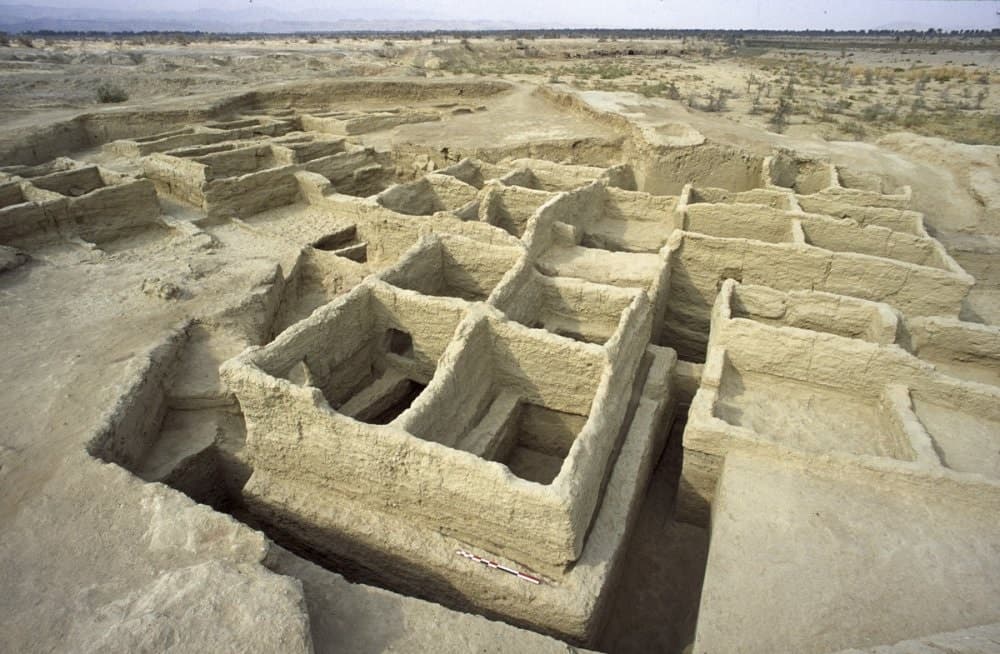
Long before the grand brick cities of the Indus Valley Civilisation rose to prominence, a small farming village took root on the Kacchi Plain of Balochistan.
In the dry, windswept Kacchi Plain of Balochistan, where the rugged highlands of Iran and Afghanistan descend to meet the fertile Indus Basin, lies the Bolan Pass. For millennia, this natural corridor has funnelled migrants, traders, and armies between Central Asia and the Indian subcontinent. It was here, in 1974, that a team of French archaeologists led by Jean-François and Catherine Jarrige discovered a sprawling 495-acre archaeological complex known as Mehrgarh. Beneath the silts of the Bolan River lay six distinct mounds containing some thirty-two thousand artefacts. These mounds held the physical record of a profound human transformation: the transition from a mobile, semi-nomadic existence to a settled agricultural life. Long before the rise of the monumental cities of Harappa and Mohenjo-daro, Mehrgarh was a crucible of innovation, harboring the earliest known farming, herding, and craft technologies in South Asia.
The antiquity of Mehrgarh’s earliest settlement, designated Period I, has been a subject of intense scientific debate. While initial estimates placed its founding before 7000 BCE, modern radiocarbon dating of human teeth suggests the first mud-brick village was established between 5250 and 4650 BCE. These early residents were semi-nomadic pastoralists who began to domesticate six-row barley, einkorn and emmer wheat, jujubes, and dates. They herded sheep, goats, and cattle, slowly shifting away from a reliance on wild game. The architectural footprint they left behind consists of unbaked mud-brick buildings divided internally into four neat compartments, which likely served as homes and granaries. Though this earliest phase was entirely aceramic—lacking any pottery—the material culture was far from primitive. The dead were buried with elaborate care within narrow mud walls. In these graves, archaeologists found baskets lined with waterproof bitumen, stone and bone tools, and the earliest stratified ground stone axes ever recovered in South Asia.
These burials also revealed a society deeply plugged into expansive, prehistoric trade networks. Even in its infancy, Mehrgarh was not isolated. Graves yielded ornaments made of turquoise, limestone, sandstone, and deep blue lapis lazuli—the latter sourced from the remote mines of Badakshan in northern Afghanistan. Shells harvested from distant sea coasts were fashioned into bangles and pendants, proving that these early farmers were linked to maritime trade routes hundreds of miles to the south. Yet, perhaps the most startling revelation of Period I was found not in the grave goods, but in the teeth of the dead. In 2001, physical anthropologists examining nine adult skeletons discovered eleven molar crowns that had been precisely drilled with flint tipped tools. This evidence of in vivo proto-dentistry—the oldest ever discovered in the global archaeological record—suggests that the community possessed a sophisticated understanding of physical anatomy and micro-drilling techniques, likely adapted from their bead-making industries.
By the onset of Period II (4650–4000 BCE) and Period III (4000–3500 BCE), Mehrgarh had fully entered the ceramic Neolithic and Chalcolithic eras. The introduction of the potter’s wheel in Period III revolutionized daily life and material culture. Potters began producing Togau ware—a highly distinctive, wheel-made ceramic style decorated with geometric designs and animal motifs, which spread widely across Balochistan and eastern Afghanistan. Industrial activity accelerated. The simple mud-brick village expanded into a bustling manufacturing hub characterized by stone and copper drills, large pit kilns, sophisticated updraft kilns, and crucibles for melting copper. It was during this era, around 4000 BCE, that an artisan at Mehrgarh cast a small, wheel-shaped copper amulet using unalloyed copper. This modest object represents the oldest known example of the lost-wax casting technique in human history, an extraordinary feat of metallurgical innovation that was later abandoned in favor of alloyed metals.
This technological evolution ran parallel to a shift in how the people of Mehrgarh represented themselves and their world. Human figurines, sculpted from terracotta, occur in every phase of the site's occupation. The earliest figurines from the aceramic period were simple, abstracted human forms. Over the centuries, however, they grew remarkably sophisticated. By 4000 BCE, artisans were sculpting detailed female figurines with elaborate, highly stylized hairstyles, heavy ornaments, and prominent breasts. Many of these figures hold infants in their arms, leading early researchers to identify them as representations of a "mother goddess," though modern scholars prefer the more cautious designation of "female figurines with likely cultic significance." For thousands of years, these representations were exclusively female. It was only during Period VII, after 2600 BCE, that male figurines finally appeared, gradually growing more numerous as the social fabric of the settlement evolved.
This cultural continuity, however, masks a complex demographic history. For decades, historians debated whether the agricultural revolution at Mehrgarh was imported whole from the Near East or developed independently. The domesticated wheat varieties, herding practices, and early pottery styles show undeniable similarities to Neolithic sites in eastern Mesopotamia, suggesting a vast "cultural continuum" stretching across the Iranian plateau. Yet the unique, localized style of Mehrgarh’s architecture and crafts led Jean-François Jarrige to argue for an independent, local origin. Modern physical anthropology and genetic studies offer a nuanced middle ground. Dental analysis conducted by anthropologists Albert Lukacs and Brian Hemphill revealed a fascinating paradox: while the cultural traditions of Mehrgarh show unbroken continuity from the Neolithic to the Chalcolithic, the physical population underwent a significant change. The Chalcolithic residents of Mehrgarh were not the direct genetic descendants of the Neolithic founders. Instead, the descendants of those original Neolithic farmers appear to have migrated south and east into northwestern India and the Deccan Plateau, while new populations, likely carrying genetic markers from Iran and the Middle East, moved into the Kacchi Plain, bringing with them genes associated with lactose tolerance and West Eurasian ancestry.
By the mid-third millennium BCE, the world around Mehrgarh was changing. The regional population was expanding, and smaller, scattered villages were coalescing into larger, more complex social units. During Period VII (2600–2000 BCE), the quality of Mehrgarh's once-exquisite pottery began to decline, showing signs of hasty mass production as bronze and copper vessels became more prestigious. The settlement pattern also shifted. Sometime around 2500 BCE, the ancient mounds of Mehrgarh were largely abandoned. The population migrated five miles away to the newly established, fortified town of Nausharo.
This abandonment coincided with the integration of the region into the mature phase of the Indus Valley Civilisation. The pioneering experiments in farming, dentistry, metallurgy, and urban planning that had played out over three thousand years on the Kacchi Plain were not lost; they became the foundations upon which the great cities of Harappa and Mohenjo-daro were built. Mehrgarh, having served as a vital bridge between the worlds of Central Asia and the Indus Valley, fell silent, slowly buried by the river silts until its rediscovery in the late twentieth century.
Connected to
3 links to entries not yet ingested in the Library.