Place · Islamic Caliphates
Mecca
- Also known as
- 'A Mecca
- A Meca
- A Meca
- A Mecca
- ang Meka
- Bakka
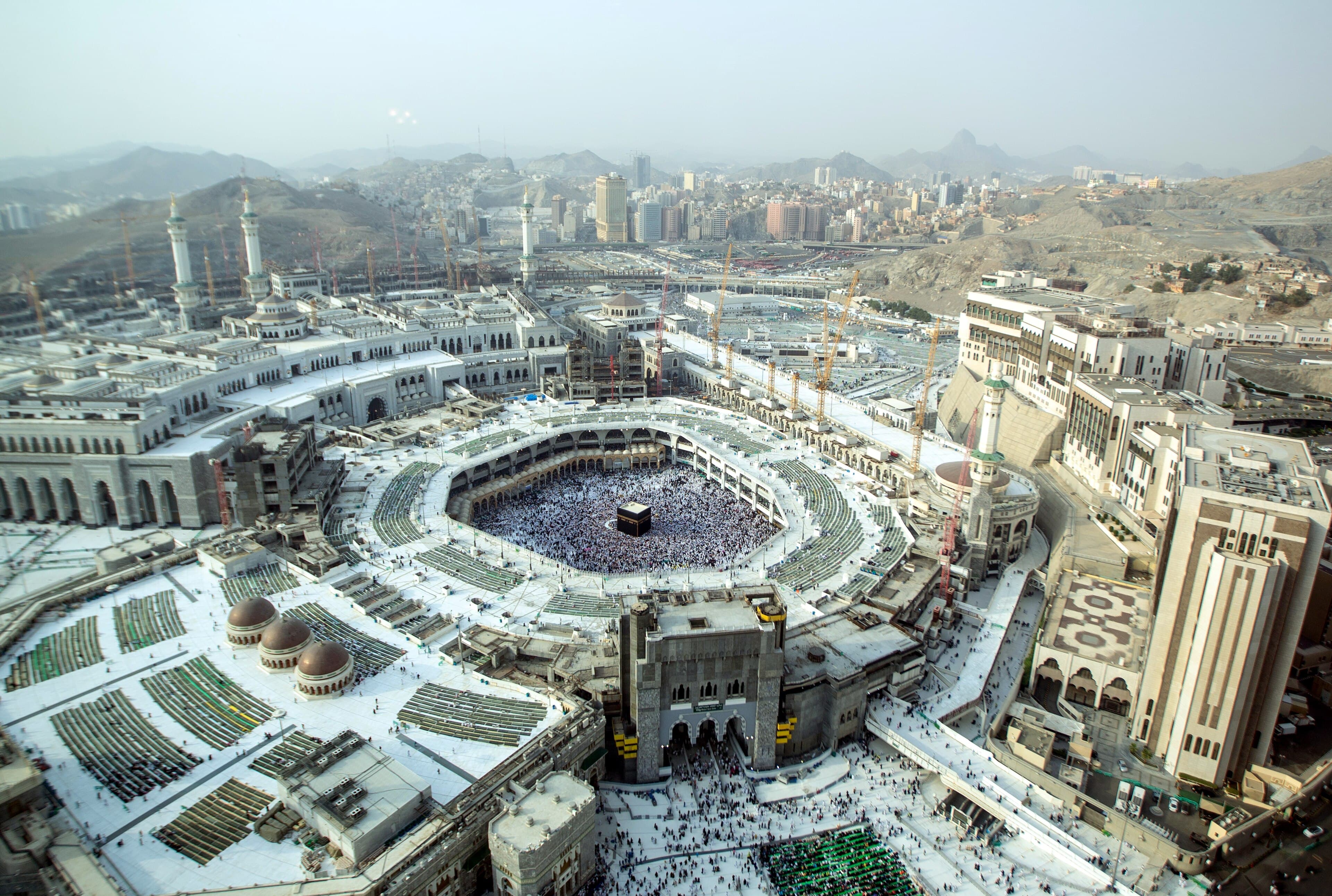
Long before a traveler catches sight of the Great Mosque, the sheer scale of modern Mecca, officially Makkah al-Mukarramah, announces itself through the towering presence of the Clock Towers, one of the tallest structures on Earth.
In the heart of the Hejaz, where the coastal lowlands of western Arabia buckle into a labyrinth of rough, barren hills, lies a narrow valley that should never have supported a city. The earth here is famously sterile, a scorched basin of rock almost entirely devoid of cultivation, date palms, or natural springs. Yet, for at least two millennia, this geographical improbability has functioned as one of the most powerful magnets on Earth. Known to antiquity perhaps as Macoraba, recorded in the Quran as both Makkah and Bakkah, and historically referred to as Tihamah or Umm al-Qurā—“the Mother of all Settlements”—Mecca has always existed at the intersection of acute physical isolation and global human convergence. It is a place defined by a permanent paradox: a city closed to non-Muslims by sacred decree, yet home to one of the most ethnically diverse, shifting populations in human history.
Long before the rise of Islam in the seventh century CE, Mecca’s survival depended on a delicate alignment of commerce and the divine. Situated forty-five miles inland from the Red Sea port of Jeddah, the valley commanded two great passes that pierced the inner mountain wall of the Arabian Peninsula, making it a natural bottleneck for the ancient trade routes that ran between the fertile highlands of Yemen and the markets of Syria. Because the valley itself was incapable of producing food, the early Meccans—most notably the Quraysh tribe, who seized control of the settlement in the fifth century—pioneered a sophisticated system of international trade. They did so by transforming a local sanctuary into a universal space of truce.
In the unsettled landscape of pre-Islamic Arabia, where tribal warfare was the default state of existence, commerce was impossible without religious sanction. The Meccans established a sacred territory, the Haram, centered around a simple, cube-shaped stone structure known as the Kaaba. According to Islamic tradition, this first house of worship had been built by Adam, destroyed in the Great Flood, and later reconstructed by Abraham and his son Ishmael, whom Abraham had left in the barren valley at God’s command. By the fifth and sixth centuries, the Kaaba had also become a pantheon for the deities of Arabia’s pagan tribes, housing figures like Hubal, the premier deity of the Quraysh. To facilitate trade, the Meccans utilized a system of intercalation in their lunar calendar to align a four-month sacred truce with the annual harvest seasons. During this time, war was strictly prohibited. Bedouin tribes descended from the highlands to gather at a series of annual fairs surrounding Mecca—at Okaz, Majanna, and Dhul-Majāz—where they exchanged hides, raisins, and wild herbs for imported luxury goods. The Meccans, practicing a legendary hospitality, bought up these raw materials, processed them into valuable leather goods, and dispatched massive caravans to Gaza and Damascus.
The victory of Muhammad in the early seventh century swept away the pagan pantheon but preserved the physical geography of Meccan life. When the Prophet’s forces entered the city through the western pass of Kada in 630 CE (8 AH), the Kaaba was purged of its idols and redesignated as the absolute focal point of monotheistic prayer—the qibla toward which every Muslim must turn. Almost overnight, the merchant aristocracy of the Quraysh was absorbed into a vast, expanding empire, and the political capital of that empire quickly migrated away from the desert to Damascus, Baghdad, and Cairo. Yet, while Mecca lost its political primacy—surviving a brutal siege in 692 CE when the Umayyad general Hajjaj executed the Meccan pretender Ibn Zubair and hung his body from a cross—its spiritual authority became absolute. The ancient trade fairs of heathenism were replaced by the Hajj, the annual pilgrimage required of every able-bodied Muslim once in their lifetime.
This transition transformed the city’s economy from one of active trade caravans to one of passive service. For centuries, the citizens of Mecca have lived almost entirely by the Hajj: acting as ritual guides, renting out rooms in towering stone houses, constructing hospices for pilgrims from India and Java, and organizing camel transport across the desert. In the twelfth century, the Spanish-born traveler Ibn Jubair described the market of Mecca during the Hajj as an astonishing global bazaar, its streets overflowing with gems, precious drugs, and rare ointments carried from Iraq, Khorasan, and India.
The physical layout of Mecca reflects this eternal tension between the sacred center and the surrounding rock. The city lies in a sinuous valley, its houses traditionally built of local stone, rising four or five stories high with terraced roofs and projecting windows that cling to the steep mountain spurs of Jebel Abu Kobais and the Red Mountain. At the center of this depression sits the Masjid al-Haram, the Great Mosque. It is a vast courtyard enclosed by colonnades, containing the Kaaba and the Zamzam well, and flanked by the Mas'a—the sacred course between the eminences of Safa and Merwa where pilgrims perform the ritual running.
In the modern era, particularly since the Saudi conquest of the Hejaz in 1925, the sheer scale of the pilgrimage has forced a radical, often controversial, reshaping of this ancient landscape. To accommodate a seasonal influx that now more than triples the city’s permanent metropolitan population of 2.4 million, the Saudi government has executed monumental engineering projects. Historic landmarks, such as the Ottoman-era Ajyad Fortress, have been demolished to make way for the expansion of the Great Mosque and its auxiliary facilities. Today, the ancient stone houses that once climbed the valley walls are dwarfed by modern megastructures. Towering directly over the Masjid al-Haram is the Abraj Al Bait, or Clock Towers—the world's fourth-tallest building—which stamps a starkly vertical, contemporary silhouette onto a skyline that was once defined solely by the mosque’s seven minarets.
Yet, beneath the concrete, steel, and high-speed transit networks, the elemental rhythms of Mecca remain unchanged. Every year during Dhu al-Hijjah, the twelfth month of the Islamic calendar, millions of believers from every corner of the globe converge on this narrow valley. Representing over fifty-five percent of the city’s temporary population during the peak season, they move in unison through the surrounding landscape—from the valley of Mina to the plain of Arafat—retracing steps that have been trodden for fourteen centuries. In its modern incarnation, Mecca is a dizzying collision of the ancient and the hyper-modern: a place where some of the oldest fossil evidence of primate evolution on the Arabian Peninsula coexists with twenty-first-century skyscrapers, and where the ancient, sacred isolation of a barren valley remains the spiritual anchor for over a billion people across the globe.
Connected to
- located in · in countryAbbasid Caliphate750 CE
- located in · in countryMamluk Sultanate of Egypt1250 CE
- birthplace ofMuhammad571 CE
- located in · in countryOttoman Empire1299 CE
- located in · in country