Event · 322 BCE – 185 BCE · Vedic and Mauryan
Maurya empire
- Also known as
- an Impireacht Mhóiríoch
- D Dünastii und s Riich vo de Maurya
- Dinastia Maurya
- Empayar Maurya
- Emperoureth Maurya
- Empire Maurya
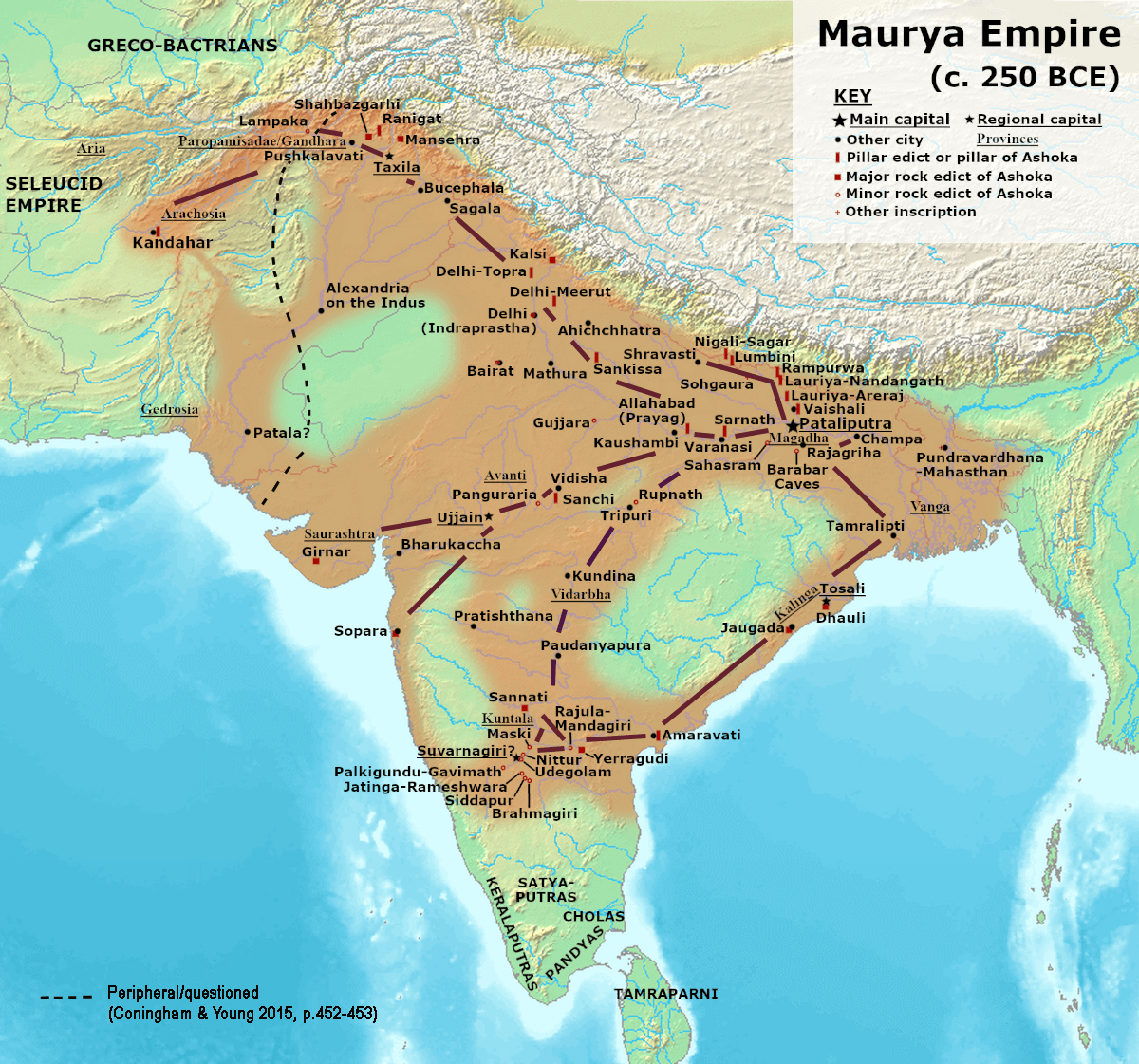
The rise of a vast, interconnected power across the South Asian subcontinent began around 322 BCE with the overthrow of the Nanda dynasty by Chandragupta Maurya.
In the early winter months, when the great rivers of the northern subcontinent fell shallow enough to be crossed on foot, a seasonal road came to life. Known as the Uttarapath, this northern highway stretched from the rugged, pine-scented highlands of eastern Afghanistan down into the humid, fertile basin of the Ganges. Along its path moved a civilization’s lifeblood: pack animals laden with high-value metals, caravans of merchants carrying river-borne and maritime goods, and the armies of a new kind of power. This road was the spine of the Maurya Empire, an expansive Iron Age state that, between 322 BCE and 185 BCE, bound together the disparate geographies of South Asia. Yet this vast domain, which eventually reached from the Hindu Kush to the northern Deccan, was not a modern, seamlessly integrated nation-state. It was a loose-knit network of fortified urban hubs and vital trade arteries, held together by military garrison commanders, a shared material culture marked by highly polished black pottery, and the sheer administrative will of a dynasty operating from the eastern metropolis of Pataliputra.
The genesis of this empire is obscured by a fog of conflicting legends, preserved in Sanskrit dramas, Buddhist chronicles, and the fragmented memoirs of Greek diplomats. To the Greek world, the story began with a young man named Sandrokottos—known in Indian sources as Chandragupta Maurya—who reportedly crossed paths with Alexander the Great during the Macedonian invasion of the Punjab. When Alexander’s exhausted army mutinied at the Beas River and retreated westward, they left behind a power vacuum of fractured Greek prefectures and local republics. Following Alexander’s death in Babylon in 323 BCE, Chandragupta capitalized on the ensuing chaos. Roman historian Justin recounts that Chandragupta rallied a force—described variously by later translators as mercenaries, hunters, or kingless "robbers" of the Punjab—and led a war of liberation that dismantled the remaining Greek garrisons. This military machine was then turned eastward against the Nanda Empire, a formidable and wealthy power ruling the Ganges basin from Pataliputra. Guided by his advisor Chanakya, Chandragupta overthrew the Nanda dynasty, claiming the imperial throne and establishing an administration that, as Justin dryly noted, transformed the people's liberation back into servitude under a highly centralized, militaristic regime.
The geography of this new empire was defined by its core enclaves and the vast, untamed spaces between them. Beyond the central powerhouse of Magadha, Mauryan authority was anchored in strategic regional capitals: the cosmopolitan frontier city of Taxila in the northwest; Ujjain on the Malwa Plateau; Kalinga along the coastal Bay of Bengal; and the gold-rich settlements of the lower Deccan Plateau. Controlling the territories between these hubs was a constant challenge of logistics and technology. The Maurya kings could not deeply penetrate the daily lives of the millions of people living in the forests and remote villages of the subcontinent; instead, their rule depended on the loyalty of military commanders who held the scattered, fortified cities. To bind these distant nodes, the state relied heavily on economic shifts already underway. The rise of Buddhism and Jainism played a crucial role in lubricating this imperial economy. By advocating nonviolence and denouncing the expensive, ostentatious animal sacrifices of the older Vedic traditions, these heterodox faiths significantly lowered the transaction costs of regional trade. The widespread adoption of coinage and the growing use of writing further streamlined complex business transactions, allowing Pataliputra to extract wealth and manage tribute from maritime networks and distant mines.
Connected to
- had as citizenAshoka304 BCE
- religionBuddhism
- founded by · had as citizenChandragupta Maurya340 BCE
- religionHinduism
- had as participantKalinga War262 BCE
+ 2 further connections to entries not yet ingested