Organization · Caribbean and Circum Caribbean
maroons
- Also known as
- A̱marun ba
- Beltz zimarroi
- boslandcreool
- bosneger
- bosnegers
- Cimarro
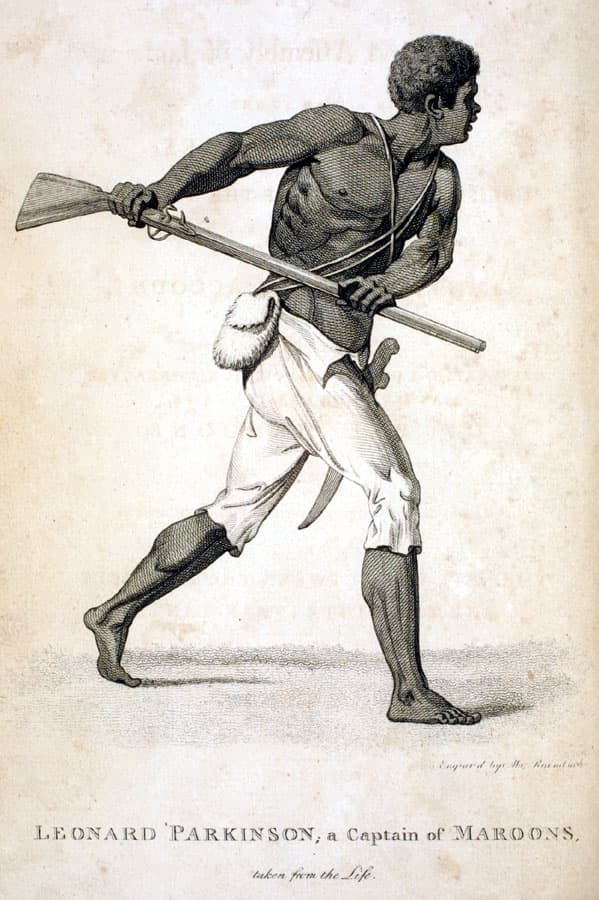
On December 26, 1522, a rebellion erupted on the sugar plantations of Admiral Diego Columbus in what is now the Dominican Republic, marking the emergence of the earliest Maroon communities in the Americas.
The word entered the English language in the 1590s as a corruption of the Spanish cimarrón, a term first used in Hispaniola to describe cattle that had gone feral in the high country, then applied to the indigenous Taíno who fled Spanish encomiendas, and finally to the African captives who did the same. To the Spanish, a cimarrón was something wild, unruly, and broken out of its proper enclosure. To the Taíno, the root word was likely simarabo: a fugitive. It was an identity born of flight, defined not by where a person was held, but by the jagged, inaccessible places where they chose to stand. From the swampy quagmires of the American South to the limestone sinkholes of Jamaica and the dense, suffocating jungles of the Guianas, these fugitives did not merely run; they founded independent societies in the blind spots of empire. They became the Maroons, a shadow network of free communities that haunted the edges of every great plantation economy in the Americas and the Indian Ocean.
The very first of these communities emerged almost as soon as the transatlantic slave trade began. On December 26, 1522, on the sugar estates of Admiral Diego Columbus—the son of Christopher Columbus—in what is now the Dominican Republic, captive Africans rose in rebellion. Those who survived the initial clash fled into the mountainous interior, joining remnants of the indigenous populations who had already sought refuge there. This synthesis of displaced peoples became the blueprint for marronage. A typical early Maroon settlement was a fragile, desperate alliance of three distinct groups: newly arrived Africans who had escaped almost immediately upon leaving the slave ships, refusing to submit to the system and often plotting impossible routes back to their homelands; seasoned plantation laborers who had endured years of enslavement before being pushed to flight by exceptional brutality or the sudden threat of being sold; and skilled, highly organized leaders who possessed a deep, ideological opposition to the slavocracy.
To survive, these communities had to turn the most inhospitable environments on earth into fortresses. The physical geography of their refuges was their greatest defense. In the dense jungles of Suriname and the steep, waterless canyons of Jamaica, Maroons engineered landscapes of illusion. They constructed false trails that ended in hidden booby traps, devised underwater paths through deep swamps that only the initiated could navigate, and planted crops in tiny, concealed clearings far from their actual villages. Loyalty within these settlements was maintained with absolute, military discipline. Because a single deserter or spy could bring about the destruction of an entire community, new members were brought to villages via deliberately disorienting, winding routes and subjected to long probationary periods, sometimes working as laborers within the community before earning full status. Crimes like desertion or adultery were met with the swiftest punishment: death.
From these hidden strongholds, Maroons waged an relentless style of irregular warfare that confounded European armies trained in the rigid, linear tactics of eighteenth-century battlefields. In Jamaica, the Windward Maroon leader Nanny became legendary for her mastery of guerrilla tactics—amassing forces in absolute silence, launching sudden, devastating ambushes, and retreating into the impenetrable bush before colonial militias could organize a counterattack. The Maroons did not fight to conquer territory; they fought to make the plantation system too expensive to maintain. They raided estates to burn cash crops, steal tools, seize livestock, and liberate more captives to swell their ranks. Yet, paradoxically, these sworn enemies of the colonial order were also economic actors within it. When they were not fighting, Maroons traded forest products, game, and hand-crafted goods with isolated white settlers and indigenous tribes, skillfully playing different colonial interest groups against one another.
This constant state of low-intensity warfare eventually forced European empires to do the unthinkable: treat escaped property as sovereign nations. In Jamaica, decades of conflict during the First Maroon War led the British governor, Edward Trelawny, to sign peace treaties in 1739 and 1740 with the Leeward leader Cudjoe and his eastern counterparts. The treaties granted the Maroons 2,500 acres of land and recognized their freedom nearly a century before the general abolition of slavery in the British Empire. But the freedom secured by these treaties carried a devastating compromise. In exchange for autonomy, the Maroons agreed to capture and return future runaway slaves, receiving a bounty of two dollars per person. This compromised peace fractured Maroon solidarity; during the Second Maroon War of 1795–1796, while the Trelawny Town Maroons rose against the British, other Maroon communities remained neutral or, in the case of Accompong, fought alongside colonial militias to suppress the rebellion.
While the Caribbean was the most famous theater of marronage, the phenomenon stretched across the globe to wherever the machinery of colonial slavery was erected. In the Indian Ocean, Dutch Mauritius became a site of early, violent resistance. In 1642, the Dutch East India Company brought over one hundred captives from Madagascar and Asia to the island; within weeks, nearly half of them escaped into the mountainous interior. In 1695, a multi-ethnic band of Indonesian, Chinese, and Bengali Maroons—including Aaron d'Amboine, Antoni (Bamboes), Paul de Batavia, Anna du Bengale, and Espérance—conspired to burn down the Dutch fort at Vieux Grand Port in an attempt to seize control of the island. Though they were captured and executed, another major Maroon revolt broke out in 1706. When the Dutch finally abandoned Mauritius in 1710, ruined by the economic strain of managing the colony, it was the Maroons who remained behind, master of the interior.
In their isolation, Maroon communities became crucible sites for entirely new cultures, preserving and blending African traditions with those of the European and indigenous peoples they encountered. Because the original runaways came from vastly different linguistic and ethnic groups across West and Central Africa, they had to invent new ways of communicating. This linguistic emergency birthed rich creole languages, such as Saramaccan in Suriname, which mixed African grammatical structures with European vocabularies. In other regions, Maroons intermarried so deeply with indigenous populations that they formed entirely new ethnic groups, such as the Garifuna and the Mascogos. In Jamaica, the Coromantee language was preserved for ceremonial and religious use, alongside herbal medical practices that mirrored West African spiritual traditions.
Today, the legacy of these fugitive states remains carved into the geography of the Americas. In Suriname, the Ndyuka Maroon treaty still dictates territorial rights in the gold-rich interior, serving as a modern legal shield against government encroachment. In Jamaica, the town of Accompong remains a highly autonomous enclave, where the descendants of the Leeward Maroons still govern their own affairs and gather every January 6 to commemorate the treaty that bought their freedom. But the modern world has brought challenges that centuries of colonial militiamen could not achieve. As the great rainforests and swamps of South America and the Caribbean are razed for timber and agriculture, the physical isolation that once protected these communities is vanishing, driving many younger Maroons into rapidly expanding urban centers. What remains is the memory of a profound historical paradox: that some of the most enduring, democratic, and culturally rich societies in the New World were built by those who had to hide in the dark to live in the light.
Connected to
3 links to entries not yet ingested in the Library.