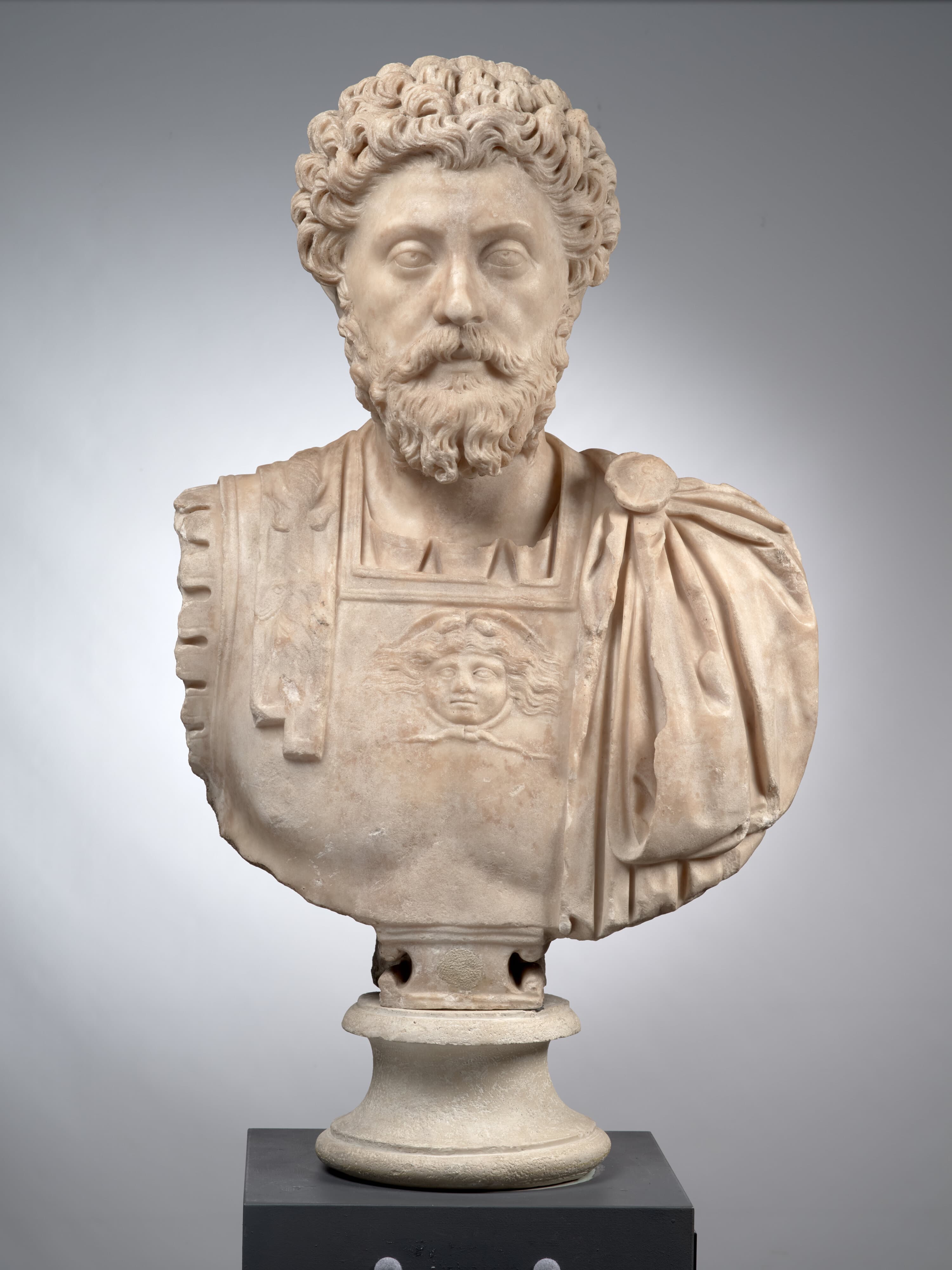
The closing chapter of the Pax Romana—a two-century epoch of relative stability for the Roman Empire—was shepherded by a man who divided his life between the violence of the imperial frontier and the quietude of Stoic philosophy.
In the early months of 138 CE, a sixteen-year-old Roman aristocrat named Marcus Annius Verus received news that would redirect the entire course of his life, and he met it not with ambition, but with a profound, quiet sadness. The Emperor Hadrian, dying and desperate to secure a stable succession, had adopted the middle-aged Antoninus Pius as his immediate heir on one strict condition: Antoninus must in turn adopt Marcus, along with the young Lucius Verus. When Marcus was told he must leave his family’s beloved villa on the Caelian Hill—a sunlit home surrounded by his mother’s brickworks and the gardens of his childhood—to move into the cold, marbled halls of the imperial palace, he wept. He was already a youth of unusual gravity, practicing a rigorous self-discipline that seemed entirely out of step with the decadence of Roman high society. To the young Marcus, the imperial adoption was not an elevation, but a sentence to a lifetime of public servitude.
The boy who would become the last of the "Five Good Emperors" had been raised in an atmosphere of intense moral seriousness. Born in Rome on April 26, 121 CE, Marcus lost his father, a praetor of Spanish descent, when he was only three. He was raised primarily by his maternal grandfather and his mother, Domitia Lucilla, a woman of vast wealth and cultured refinement. Rather than attending Rome's public schools, where aristocratic boys were often coddled or corrupted, Marcus was educated entirely at home by a handpicked collection of the era's finest minds. He studied Latin and Greek rhetoric under master tutors like Herodes Atticus and Marcus Cornelius Fronto, but his intellectual trajectory was permanently altered at the age of eleven when he encountered Diognetus, a painting master and philosopher. Diognetus introduced the boy to the austere world of Stoicism. Fascinated by the philosophy, the young Marcus immediately adopted its demanding physical regimen: he began wearing the rough Greek philosopher’s cloak, rejected luxury, and insisted on sleeping on the bare ground until his mother finally persuaded him to use a bed.
This tension between the internal world of the mind and the external demands of the state defined Marcus's entire existence. For over two decades, he served as the dutiful apprentice to his adoptive father, Antoninus Pius, who became emperor in 138 CE. Their partnership was one of unbroken harmony. Marcus immersed himself in the mechanics of governance, serving as consul multiple times, reforming legal codes, and learning the tedious, exhausting administration of a vast empire. He also married Antoninus’s daughter, Faustina, in an alliance that bound him inextricably to the ruling house. Yet, even as he spent his days drafting decrees and his nights studying law under the jurist Volusius Maecianus, Marcus remained a committed disciple of the Stoic path, learning from teachers like Sextus of Chaeronea and Junius Rusticus to work hard, ignore slander, avoid the waste of time, and remain grave without affectation.
12 links to entries not yet ingested in the Library.
When Antoninus Pius died in 161 CE, the Senate prepared to confirm Marcus, now forty, as the sole ruler of the Roman world. In an act of remarkable magnanimity that signaled the ethical character of his upcoming reign, Marcus refused the office unless the Senate also granted equal imperial powers to his adoptive brother, Lucius Verus. It was the first time in Roman history that the empire was ruled by two co-emperors. Though Verus was a weaker, more self-indulgent character, he respected Marcus deeply and deferred to his judgment. The dual reign was immediately tested. The long, golden autumn of the Pax Romana—nearly two centuries of relative internal stability—was drawing to a brutal close. The universe, it seemed, had saved its most catastrophic trials for the philosopher-king.
The misfortunes began almost immediately. In 162 CE, a disastrous inundation of the Tiber swept through Rome, drowning livestock, destroying crops, and triggering a severe famine. This was quickly followed by earthquakes, fires, and localized military rebellions. Most threatening of all, the Parthian Empire broke decades of peace by annihilating a Roman legion in Cappadocia and devastating Syria. While Marcus remained in Rome to manage the domestic crises, Lucius Verus was dispatched to the East to oversee the war. Supported by brilliant generals like Avidius Cassius, the Roman legions eventually crushed the Parthian forces, sacking their capital in 165 CE.
Yet the victory brought a ruinous curse. Returning soldiers carried with them a devastating pestilence, known to history as the Antonine Plague. From 165 CE onward, the disease swept through the empire like wildfire, killing between five and ten million people, decimiating the army, and bringing public life to a terrifying standstill. The great physician Galen documented the panic of the Roman elite as the social fabric began to unravel. Amidst this domestic horror, a massive confederation of Germanic tribes, led by the Marcomanni and the Quadi, shattered the northern borders, crossing the Danube and threatening Italy itself.
For the remainder of his life, Marcus Aurelius was forced to abandon the quiet libraries of Rome for the mud, cold, and blood of the northern frontier. With the treasury depleted by the plague, he went so far as to auction off imperial treasures—including his wife’s silk robes, gold vessels, and imperial jewels—to fund the military campaigns. He took the field himself, accompanied by Lucius Verus until the latter’s sudden death, possibly from the plague, in 169 CE. Left as the sole ruler of a fractured empire, Marcus spent nearly a decade in the military camps of Carnuntum and Sirmium, orchestrating the grueling Marcomannic Wars.
It was during these bleak northern winters, camped along the frozen Danube, that Marcus wrote the work that would guarantee his immortality. Written in Greek and never intended for publication, the journal he called simply To Himself—known today as the Meditations—was a private spiritual diary. It was a manual for survival, written by a man who was deeply tired, mourning the deaths of several of his children, suffering from chronic illness, and burdened with the survival of Western civilization. In its pages, Marcus does not write as an emperor commanding subjects, but as a soul arguing with itself. He reminds himself to rise early without complaining, to view his imperial purple robe as nothing more than sheep’s wool dyed in the blood of a shellfish, and to treat the difficult people he encountered daily as necessary, natural parts of a fractured world.
Even amidst the brutality of the northern campaigns, Marcus sought to govern with meticulous justice. He worked long hours, often from dawn until past midnight, reforming laws to protect minors, ease the path to manumission for slaves, and support the dwindling birth rate of legitimate citizens. When he attended the compulsory gladiatorial games, he refused to watch the slaughter, spending his time in the imperial box reading, writing letters, or listening to advisors. When a miraculous rainstorm saved his parched, surrounded army from thirst during a battle against the Quadi in 174 CE—an event pagan writers attributed to Egyptian magic and Christians ascribed to the prayers of their own—Marcus simply marched on, steady in his duty.
Marcus Aurelius died on March 17, 180 CE, at the age of fifty-eight, likely near the northern military frontier. He was succeeded by his biological son, Commodus, whose subsequent erratic and tyrannical reign would mark the definitive end of the golden age of Rome. Though Marcus's column and equestrian statue still stand in Rome, celebrating his triumphs over the Germanic tribes, his true monument remains the fragile text he scribbled by the light of a military candle. In a world of absolute power, he had remained remarkably uncorrupted, leaving behind a testament of a ruler who conquered his own mind before he attempted to conquer the world.