In 1250 CE, a military caste of freed slave soldiers seized control of Egypt, transforming their status from owned men to rulers of an empire.
In the spring of 1250, on the muddy banks of the Nile branch near al-Mansura, the French king Louis IX watched his Seventh Crusade dissolve into a disaster of hunger, disease, and relentless harassment. The force that finally shattered the European vanguard and captured the King of France was not the traditional levy of an Islamic empire, but a highly disciplined, insular brotherhood of elite slave-soldiers: the Bahriyya regiment of the Ayyubid Sultanate. Yet the sweet taste of victory quickly soured into a domestic crisis. The young, newly arrived Ayyubid sultan, al-Mu'azzam Turanshah, sought to break the power of these formidable soldiers by elevating his own Mesopotamian favorites. The response of the military elite was swift and merciless. On May 2, 1250, disgruntled officers assassinated Turanshah at Fariskur. In the chaotic aftermath, an electoral college of soldiers chose Shajar al-Durr—the widow of the previous sultan—to rule, establishing her authority through marriage alliances and lavish land grants to the military elite. It was a spectacular, bloody, and unprecedented usurpation. For the first time in Islamic history, a military caste of freed slaves, known as the Mamluks, had seized the throne of Egypt, initiating a regime that would dominate the Near East for nearly three centuries.
To understand how a society of slaves could inherit an empire, one must understand the unique institution of the mamluk itself. Unlike the ghulam, or common household slave, a mamluk was a highly trained specialist. Typically purchased as boys from the Kipchak Turkic steppes of Central Asia, these youths were brought to Cairo, converted to Sunni Islam, and taught Arabic. They underwent an agonizingly thorough education in equestrian arts, advanced weaponry, courtly etiquette, and Islamic theology. Upon graduation, they were formally manumitted and presented with their weapons and armor. Crucially, their freedom did not dissolve their ties; it cemented them. The freed mamluk owed lifelong, absolute loyalty to the master who had purchased and raised him, whom he often addressed as "father." Because they were ripped from their homelands as children, these men had no biological family ties or local tribal allegiances to divide their loyalties. Their only family was their regiment. The Ayyubid sultans had relied on this absolute devotion to garrison their frontiers, but by the mid-thirteenth century, the servants had grown more powerful than the masters, holding the ultimate leverage of physical force.
The early decades of this new "State of the Turks"—as contemporary Arabic chroniclers called the Bahri Mamluk period—were defined by a desperate struggle for survival against the most terrifying military machine of the medieval world. In 1258, the Mongol armies of Hulagu Khan sacked Baghdad, ending the Abbasid Caliphate and sending shockwaves through the Islamic world. As the Mongol horse archers swept through Syria, capturing Aleppo and Damascus, they appeared unstoppable. In Cairo, the Mamluk strongman Sayf al-Din Qutuz deposed the teenage sultan al-Mansur Ali to consolidate military command, executed the Mongol emissaries who demanded his submission, and reconciled with rival Mamluk factions, including the brilliant commander Baybars. In September 1260, at the Battle of Ain Jalut in the plains south of Nazareth, the unified Mamluk force confronted the Mongol army left behind under the general Kitbuqa. Through a disciplined feigned retreat orchestrated by Baybars, the Mamluks drew the Mongols into an ambush and shattered the myth of Mongol invincibility. It was a civilizational watershed; by halting the Mongol advance, the Mamluks saved Egypt and the western Islamic world from devastation, cementing their legitimacy as the self-appointed champions of Islam.
+ 6 further connections to entries not yet ingested
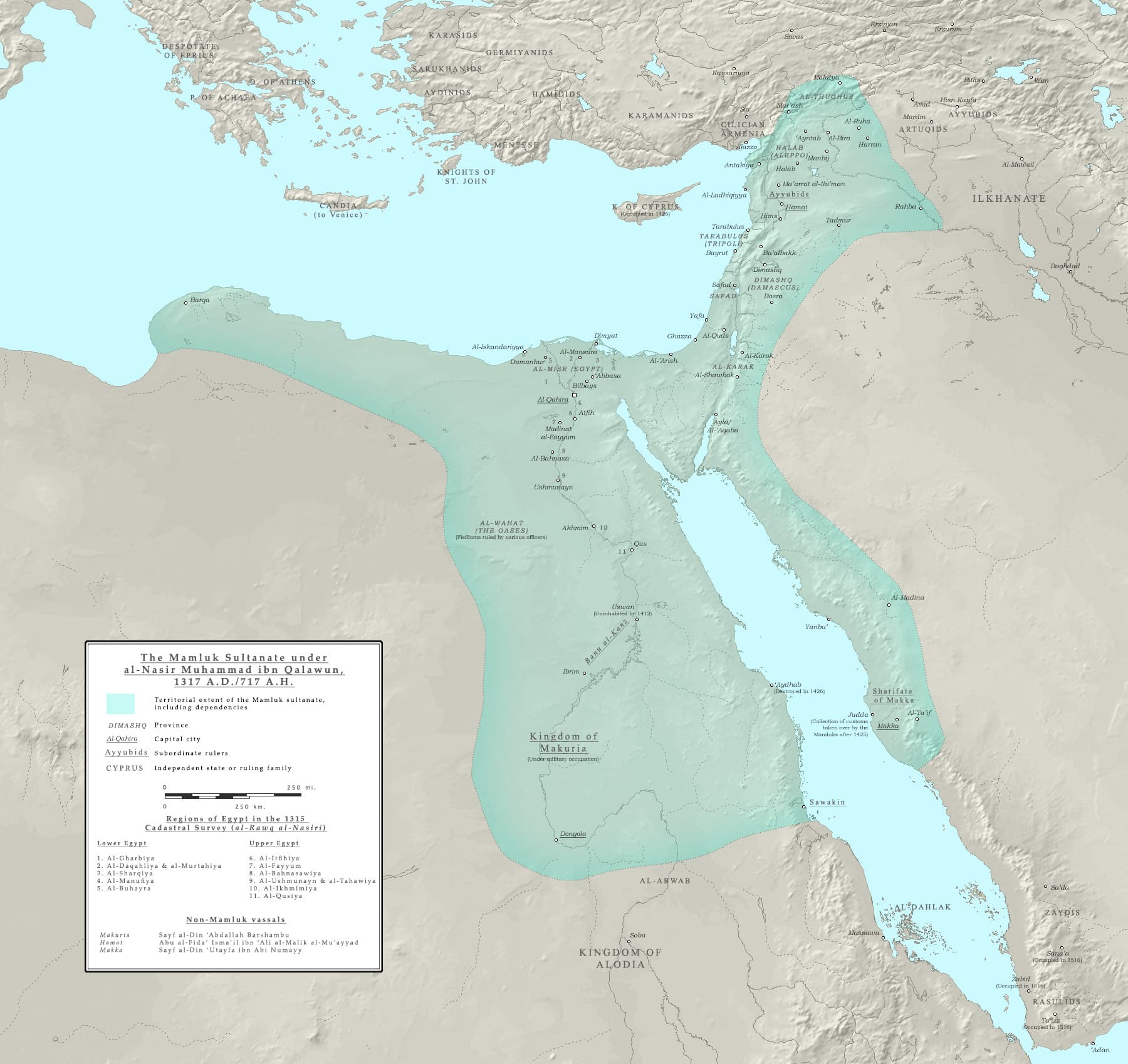
Shortly after the triumph at Ain Jalut, Baybars assassinated Qutuz and claimed the sultanate for himself, beginning a legendary reign that defined the golden age of the Bahri Mamluks. Baybars understood that raw military power required institutional and religious legitimacy. He invited a surviving member of the Abbasid dynasty to Cairo, reestablishing a shadow caliphate that, while politically toothless, gave Mamluk rule a veneer of undisputed Islamic orthodoxy. He then turned his veteran army against the remaining Crusader principalities along the Levantine coast and solidified Mamluk suzerainty over the Ayyubid principalities in Syria. This aggressive expansion was carried forward by his successors, Sultans Qalawun and al-Ashraf Khalil, who finally expelled the Crusaders from their last strongholds, including Acre, by 1291, and pushed Mamluk borders into Nubia, Cyrenaica, the Hejaz, and southern Anatolia. This vast realm was governed through the iqta system, a sophisticated mechanism of land allocation where the state distributed the tax revenues of agricultural estates to Mamluk officers in lieu of cash salaries, ensuring that the wealth of the countryside directly sustained the military apparatus.
At the center of this sprawling empire sat Cairo, which under Mamluk rule grew into one of the largest and wealthiest metropolises in the world. Situated at the crossroads of the Mediterranean, the Red Sea, and the Indian Ocean, Egypt became the indispensable middleman of global trade. The wealth of Europe, East Africa, and South Asia poured into the markets of the capital, funding an extraordinary renaissance of art and architecture. Mamluk sultans and their wealthy emirs sought to immortalize themselves by commissioning grand stone structures—mosques, madrasas, mausoleums, and hospitals—characterized by towering minarets, intricate stone carving, and monumental portals that still define the fabric of historic Cairo today. Their workshops produced world-renowned enameled glass lamps, inlaid metalwork, and exquisite illuminated Qur’ans. This cultural and economic vitality peaked during the long, stable third reign of al-Nasir Muhammad in the early fourteenth century. However, the system carried the seeds of its own instability. Because the sultanate was not strictly hereditary—succession was often determined by violent competition among the senior emirs of the dominant regiment—the death of a strong sultan invariably triggered a period of civil strife and economic disruption as rival factions fought for the throne.
This structural vulnerability deepened in 1382 when the emir Barquq usurped the throne, ending the Turkic Bahri dynasty and inaugurating the Burji, or Circassian, period. Named for the Circassian ethnicity of the new ruling elite, who were garrisoned in the towers (burj) of the Cairo Citadel, this era was marked by a steady erosion of central authority. The Mamluk state was battered by foreign invasions, rural tribal rebellions, and devastating natural disasters, plunging the treasury into chronic financial distress. To replenish the state's coffers, Sultan Barsbay in the early fifteenth century resorted to heavy-handed economic interventions, establishing state monopolies on lucrative trade goods with Europe and launching aggressive tax expeditions into the Egyptian countryside. He also projected Mamluk power abroad, successfully forcing the Kingdom of Cyprus to submit to Mamluk suzerainty in 1426. Though Sultan Qaitbay later managed to restore a degree of stability and architectural splendor during his long reign, the state was stagnating, unable to modernize its institutions or adapt to a changing geopolitical landscape.
The final act of the Mamluk drama unfolded in the early sixteenth century under the reign of Qansuh al-Ghuri. Confronted with a shrinking treasury and a new maritime threat from the Portuguese, who were disrupting the Indian Ocean trade routes, al-Ghuri squeezed the domestic economy with desperate, heavy-handed fiscal policies and attempted to modernize his traditional cavalry-based military. It was too late. To the north, the Ottoman Empire had embraced gunpowder, artillery, and disciplined infantry. In 1516, the Ottoman sultan Selim I marched south. The two empires clashed at the Battle of Marj Dabiq near Aleppo; betrayed by defecting emirs and devastated by Ottoman firearms, the Mamluk cavalry was annihilated, and al-Ghuri was killed on the field. By 1517, Ottoman forces entered Cairo, ending the independent Mamluk Sultanate and absorbing Egypt into their global empire. Yet the Mamluks did not vanish; their military caste was so deeply woven into the fabric of Egyptian society that the Ottomans retained them as local tax collectors and provincial administrators. For centuries to come, the descendants of these steppe-born slave-soldiers continued to govern the Nile, a persistent aristocracy of elite warriors who had once stood as the sole shield of the medieval Islamic world.