Event · 1235 CE – 1670 CE · West African Empires
Mali Empire
- Also known as
- Carstvo Mali
- Carstvo Mali
- Daular Mali
- Dola la Mali
- Empayar Mali
- Empire du Mali
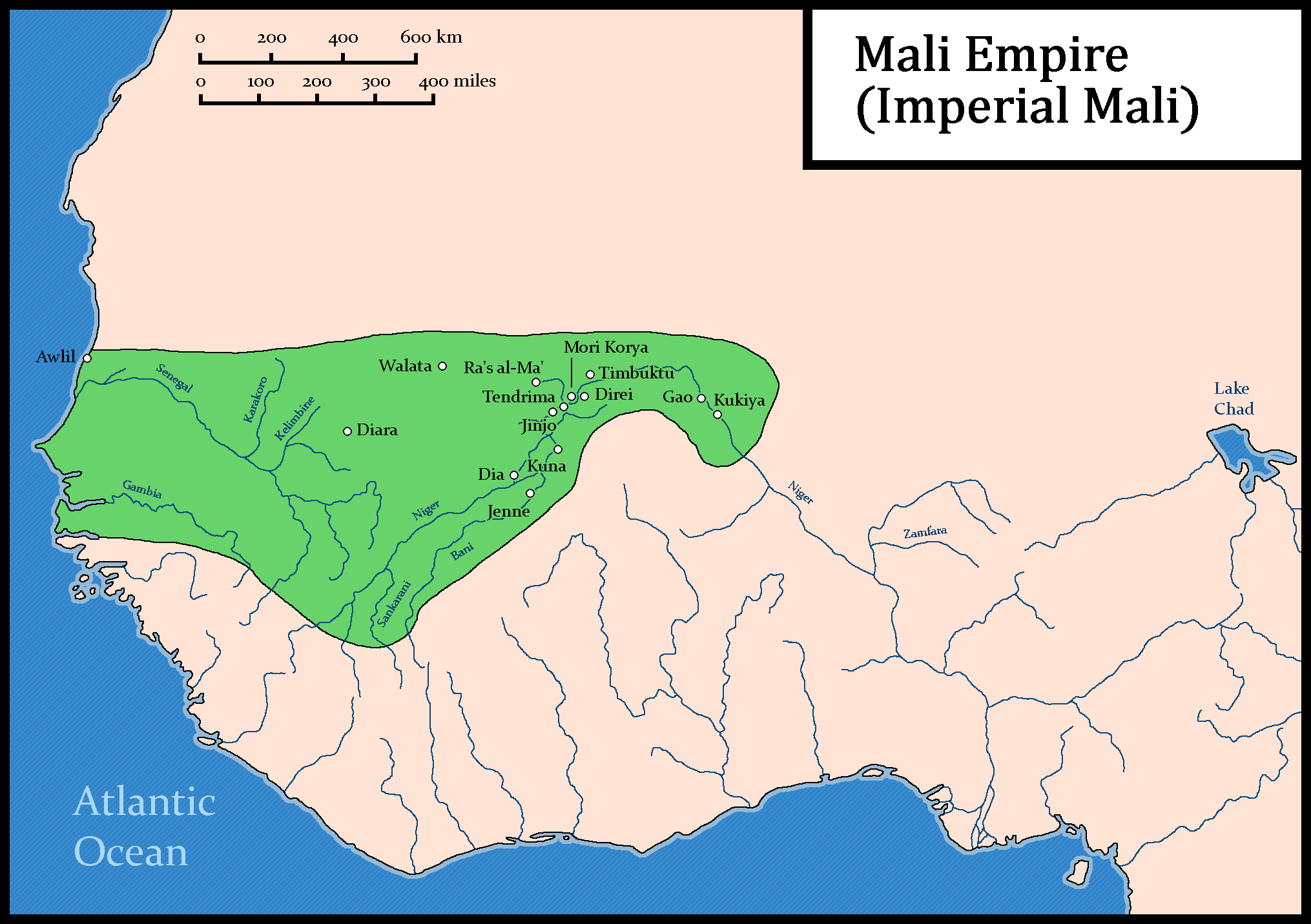
Before it was an empire, Mali was a modest Mandinka kingdom huddled along the upper reaches of the Niger River, waiting for history to shift.
In the early fourteenth century, a sovereign of the upper Niger River decided to test the limits of the world. According to Mamluk administrators in Cairo, who gathered the testimony of travelers decades later, Mansa Qu’s son Muhammad became obsessed with the great sea that lay at the western edge of his dominions. He commissioned two hundred boats filled with men, and another two hundred filled with gold, water, and provisions, instructing his captains not to return until they had reached the ocean’s end or exhausted their supplies. Only a single vessel returned. Its captain reported that the others had been swept away by a violent river-like current in the open ocean. Undaunted, the emperor abdicated his throne, assembled a fleet of two thousand ships, and sailed west into the Atlantic. He was never seen again.
The man Muhammad left behind to govern during his absence was his cousin, Kanku Musa. When the explorer-emperor failed to return, Musa assumed the title of mansa, inheriting an empire that was already transitioning from a regional confederation into the dominant geopolitical force of West Africa. This state, known to medieval Arab geographers as Mali, had its origins in the eleventh and twelfth centuries as the old Ghana Empire, or Wagadu, fractured and dissolved. As the trade epicenters of the Sahel shifted southward, a small Mandinka kingdom centered around the Manding region along the upper reaches of the Niger River began to expand. Out of this landscape emerged Sundiata Keita, a warrior-prince of the Keita dynasty. Forged in exile after the death of his father, the ruler of Niani, Sundiata returned to lead a coalition of Mandinka city-states and northern kingdoms against Soumaoro Kanté, the sorcerer-king of the Sosso Empire. Sundiata’s decisive victory at the Battle of Kirina in approximately 1235 consolidated the twelve kingdoms of the region under a single supreme ruler and established the Kouroukan Fouga, the oral constitution that laid the administrative and social foundations of the young empire.
Under Sundiata and his immediate successors, Mali’s borders pushed outward in every direction, eventually stretching from Kaabu in the west to the goldfields of the south, and north into the arid fringes of the Sahara. The empire’s heartland was the fertile Manden, but its wealth was anchored in its control of the trans-Saharan trade routes. It was this wealth that Mansa Musa chose to display to the wider Mediterranean world in 1324 during his famous pilgrimage to Mecca. Accompanied by a vast caravan that included a personal guard of five hundred men and immense quantities of gold, Musa’s journey became a legend of late-medieval global history. In Cairo, his lavish spending and generous alms-giving flooded the local economy, causing the value of the gold dinar to plummet against the silver dirham—an inflationary depression that lasted for twelve years. This spectacular entry onto the international stage permanently altered external perceptions of West Africa; by 1375, European cartographers would depict the "city of Melly" on the Catalan Atlas, represented by a monarch holding a massive gold coin.
Yet Musa’s pilgrimage was more than an exercise in vanity; it was an intellectual and cultural project. He returned to Mali accompanied by scholars, architects, and jurists, directing his resources toward the development of Timbuktu, which he had peaceably annexed in 1324. He transformed the informal madrasah of Sankore into a prestigious Islamic university, establishing Timbuktu as a premier center of scholarship, jurisprudence, and book production in the Islamic world. Musa built mosques and palaces across his territories, secured the northern salt mines of Taghazza, and consolidated administrative control over vital trade cities like Gao. His brother Sulayman, who took the throne in 1341 after the brief and troubled reign of Musa’s son, Maghan I, maintained this golden age. It was during Sulayman’s nineteen-year reign that the Moroccan traveler Ibn Battuta visited the empire, providing the first direct eyewitness account of Mali. Ibn Battuta observed a highly organized society characterized by strict justice, safety for travelers, and an elegant court protocol that balanced local Mandinka traditions with orthodox Islamic practice.
Even at its peak, however, the vast administrative weight of Mali—which at one point encompassed over one million square kilometers—carried the seeds of its own fragmentation. The death of Mansa Sulayman in 1360 initiated a period of political instability marked by short reigns, palace coups, and the rising influence of court ministers who ruled from behind the throne. In the western reaches of the empire, the Jolof Empire asserted its independence, gaining dominance over northern Senegambia. To the east, a devastating conflict in the 1370s between Malian imperial forces and Berber Tuareg forces from Takedda ravaged Gao, allowing the city and its surrounding territory to slip from the empire's grasp. Although Mali remained financially solvent and territorially formidable at the death of Mansa Musa II in 1387, the northern frontier was beginning to unravel.
The fifteenth century was defined by a steady retreat. The Mossi launched destructive raids into Macina, and by 1434, the empire lost control of Timbuktu and Oualata to the Tuareg. Simultaneously, the Songhai Empire was rising in the east under the aggressive military leadership of Sunni Ali Ber, who seized Mema and Timbuktu in the late 1460s. Desperate to counter these incursions, Mansa Mahmud Keita II sought external alliances, opening diplomatic relations with Portugal in 1487 and receiving European envoys in his capital. Yet Portuguese treaties could not halt the internal and regional pressures. By the sixteenth century, neighboring states like Diarra, Great Fulo, and Yatenga were systematically chipping away at Mali's borders. Though the empire survived a Songhai invasion of its capital in 1542, its territorial reach had shrunk dramatically from its fourteenth-century heights.
A brief, final attempt at imperial restoration occurred in the late sixteenth century. Following the collapse of the Songhai Empire after the Moroccan invasion of 1593, Mali attempted to reclaim its former northern territories. However, a catastrophic military defeat outside Djenne in 1599 shattered these hopes. The empire fractured rapidly into localized, competing chiefdoms, and the Keita dynasty finally retreated to their ancestral home of Kangaba, where they ruled not as emperors, but as provincial chiefs. By 1670, the political entity that had once unified the West African Sahel was gone. What remained was a profound cultural legacy: the Mandinka language, the legal frameworks established by the Kouroukan Fouga, and the enduring memory of an empire that had once bridged the deep interior of West Africa with the wider medieval world through its peerless wealth and intellectual ambition.
Connected to
4 links to entries not yet ingested in the Library.