Person · 1869 CE – 1948 CE · World Wars Era
Mahatma Gandhi
- Also known as
- Bapu
- Bapu
- Bapu
- Bapu
- Bapu
- Bapu
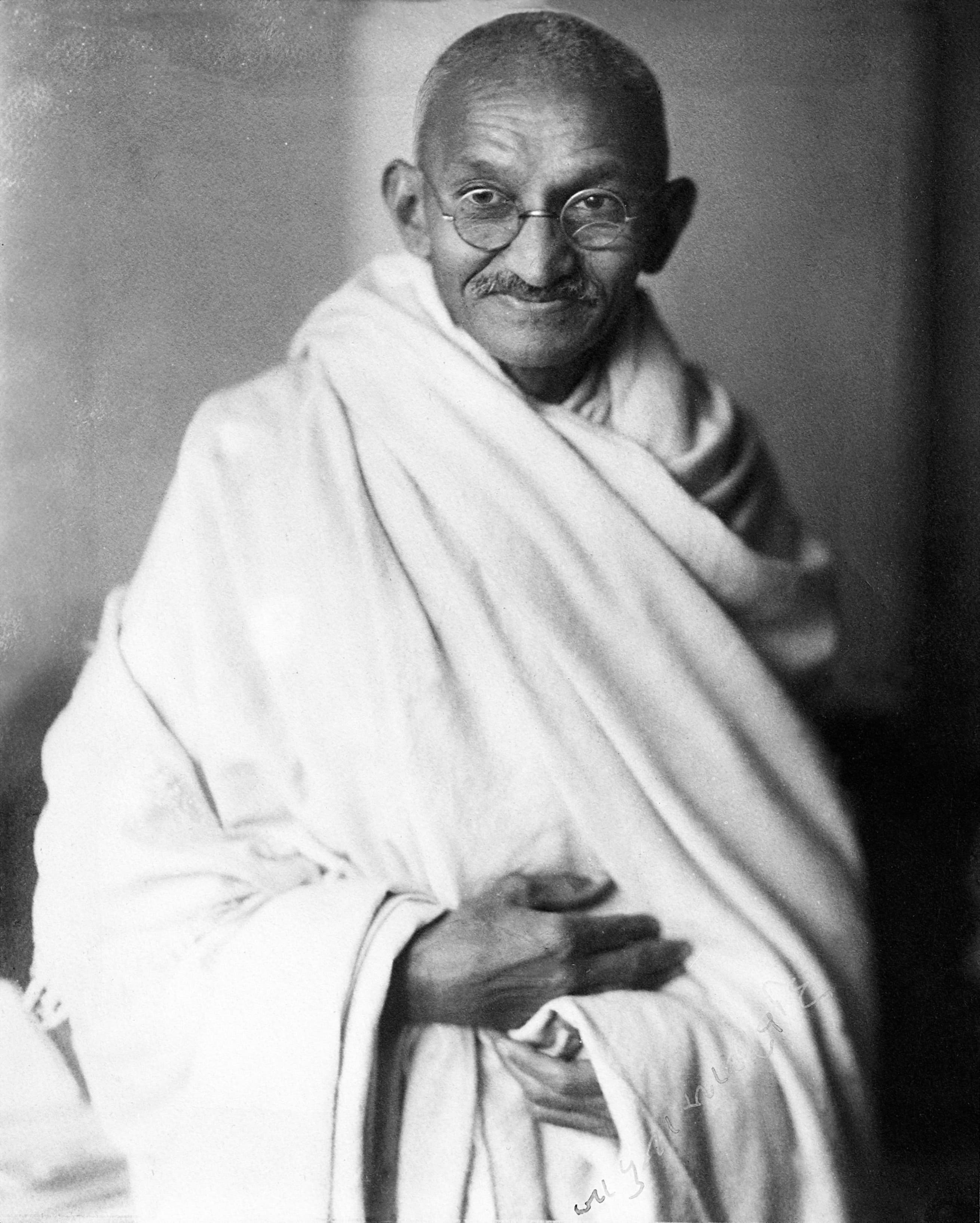
The transformation of Mohandas Karamchand Gandhi from an unsuccessful young lawyer into a global icon of resistance began not in his native India, but along the coast of South Africa.
In the late autumn of 1885, a sixteen-year-old boy left the bedside of his dying father in the town of Rajkot. Driven by what he would later torment himself by calling "animal passion," the teenager slipped away to be with his seventeen-year-old wife. During those few minutes of absence, his father, Karamchand Gandhi—the chief minister of the small princely state of Rajkot—breathed his last. The double anguish of that night deepened shortly thereafter when the young couple’s first child survived only a few days. The boy, Mohandas Karamchand Gandhi, was left with an indelible scar of guilt and a premature introduction to the heavy friction between human desire and moral duty. At the time, there was little to suggest that this shy, tongue-tied youth, who possessed "no interest in games" and whose sister described him as "restless as mercury," would eventually fashion his personal struggles with self-discipline into a political philosophy that would dismantle an empire.
Born in 1869 on the coastal edge of Gujarat in Porbandar, Mohandas grew up in a household defined by overlapping spiritual and political currents. His father was a capable administrator who navigated the delicate terrain of British regional political agencies and local princely courts. His mother, Putlibai, was an intensely pious woman from the medieval, Krishna bhakti-based Pranami tradition—a faith whose texts sought the essence of the Vedas alongside the Quran and the Christian Bible. Putlibai’s life was an exercise in rigorous devotion; she frequently undertook consecutive fasts without flinching and refused to eat without first completing her daily prayers. In this eclectic atmosphere, the young Gandhi absorbed the stories of the Indian classics, particularly the legendary king Harishchandra, whose absolute devotion to truth and love haunted the boy’s imagination. Yet, his early life was also bound by rigid societal expectations. At thirteen, he was married to Kasturbai Gokuldas Kapadia in an arranged joint wedding alongside his brother and cousin. It was an event the adolescent Gandhi initially understood merely as an occasion for "wearing new clothes, eating sweets and playing with relatives."
As Gandhi matured, the provincial confines of Gujarat began to chafe against his ambitions. After a brief, unsuccessful attempt at higher education in Bhavnagar, a family friend suggested that the young man study law in London. The proposal provoked immediate domestic and social crises. His mother feared the corrupting moral landscape of the West, prompting Gandhi to make a solemn vow before her to abstain from meat, alcohol, and women. More severe was the reaction of his caste elders in Bombay, who warned him that crossing the ocean would inevitably compromise his religion. When Gandhi refused to yield, the elders of the Modh Bania community excommunicated him. Unfazed, the eighteen-year-old sailed for England in September 1888, leaving behind his wife and their newborn son, Harilal.
London was a profound shock to the young Gujarati, but it was also where he began to find his voice. He enrolled at the Inner Temple to train as a barrister and attended English literature lectures at University College, London. To overcome his crippling childhood shyness, he joined a public speaking practice group. Yet his education extended far beyond the classroom and the courtroom. Gandhi found himself drawn to the struggles of London’s working class. During the bitter dock strike of 1889, when dockers, shipbuilders, and factory girls united to demand better wages, Gandhi and a friend personally sought out Cardinal Manning to thank him for his successful mediation of the dispute. It was a telling prelude to a life that would be spent navigating the grievances of the disenfranchised.
Upon returning to India in 1891, Gandhi found himself an educated barrister but a failed professional. Unable to establish a successful law practice during two lean, uncertain years, he accepted an offer in 1893 to travel to South Africa to represent an Indian merchant in a complex lawsuit. What was intended as a brief temporary assignment stretched into a twenty-one-year residency. It was in South Africa, amid the institutionalized racial hierarchies of the colony, that Gandhi transformed from a self-conscious lawyer into a formidable political organizer. There, he raised his growing family—which now included three more sons, Manilal, Ramdas, and Devdas—and first formulated and deployed satyagraha, his signature philosophy of nonviolent resistance.
When Gandhi returned to India in 1915 at the age of forty-five, he was no longer the hesitant young man who had left its shores. He was now hailed by some as "Mahatma"—the "great-souled"—an honorific first given to him in South Africa. He quickly immersed himself in the realities of rural India, organizing impoverished peasants, farmers, and urban laborers against punitive land taxes and systemic discrimination. By 1921, he had assumed the leadership of the Indian National Congress, refashioning a middle-class debating society into a mass nationalist movement.
Gandhi’s political genius lay in his ability to collapse the boundary between personal ethics and political action. To identify with the millions of rural poor, he abandoned Western attire in favor of a simple, hand-spun dhoti. He established self-sufficient residential communities, adopted a sparse diet, and used prolonged fasts as dual-purpose tools for personal introspection and political leverage. His campaigns targeted not only British rule but the internal fractures of Indian society itself, advocating for the expansion of women’s rights, religious amity, and the eradication of "untouchability." In 1930, he dramatized the injustice of colonial monopolies by leading a spectacular 400-kilometer march to the coastal village of Dandi to harvest salt from the sea, a simple act of defiance that captured the world's attention. This was followed over a decade later, in 1942, by the "Quit India" movement, which demanded immediate British withdrawal and resulted in his repeated imprisonment.
Yet, the final triumph of Gandhi's life was shadowed by a deep sense of tragedy. As independence neared in the 1940s, his dream of a unified, religiously pluralistic India was fractured by the rise of a competing Muslim nationalism demanding a separate state. When the British partitioned the subcontinent in August 1947 into India and Pakistan, the birth of the two nations was accompanied by an explosion of sectarian slaughter. Hundreds of thousands died, and millions of displaced Hindus, Muslims, and Sikhs fled across the newly carved borders.
Refusing to join the independence celebrations in the capital, the seventy-eight-year-old Gandhi traveled on foot through the bloodied villages of Bengal and Punjab, trying to quell the violence. In January 1948, he began his final hunger strike in Delhi, successfully demanding that the Indian government honor its financial agreements with Pakistan and protect its remaining Muslim citizens. To radical Hindu nationalists, this uncompromising insistence on interfaith justice was seen as a betrayal. On 30 January 1948, while walking to an evening prayer meeting in Delhi, Gandhi was approached by Nathuram Godse, a militant Hindu nationalist who fired three bullets into his chest.
The life of the man who had wrestled so publicly with his own weaknesses ended in sudden violence, but his method of resistance survived him. By translating ancient spiritual concepts of truth (satya) and non-harm (ahimsa) into a modern political strategy, Gandhi provided a blueprint for civil rights movements that would sweep across the globe in the decades to follow. In post-colonial India, he became enshrined as the "Father of the Nation," a moral compass whose image and ideals remained a permanent challenge to the realities of the state he helped to birth.
Connected to
- religionHinduism
+ 12 further connections to entries not yet ingested