Event · 12th c. BCE – 345 BCE · Vedic and Mauryan
Magadha
- Also known as
- Imperio Magadha
- Kekaisaran Magadha
- Kerajaan Magadha
- Ma Kiệt Đà
- Ma-kiệt-đà
- Magadh
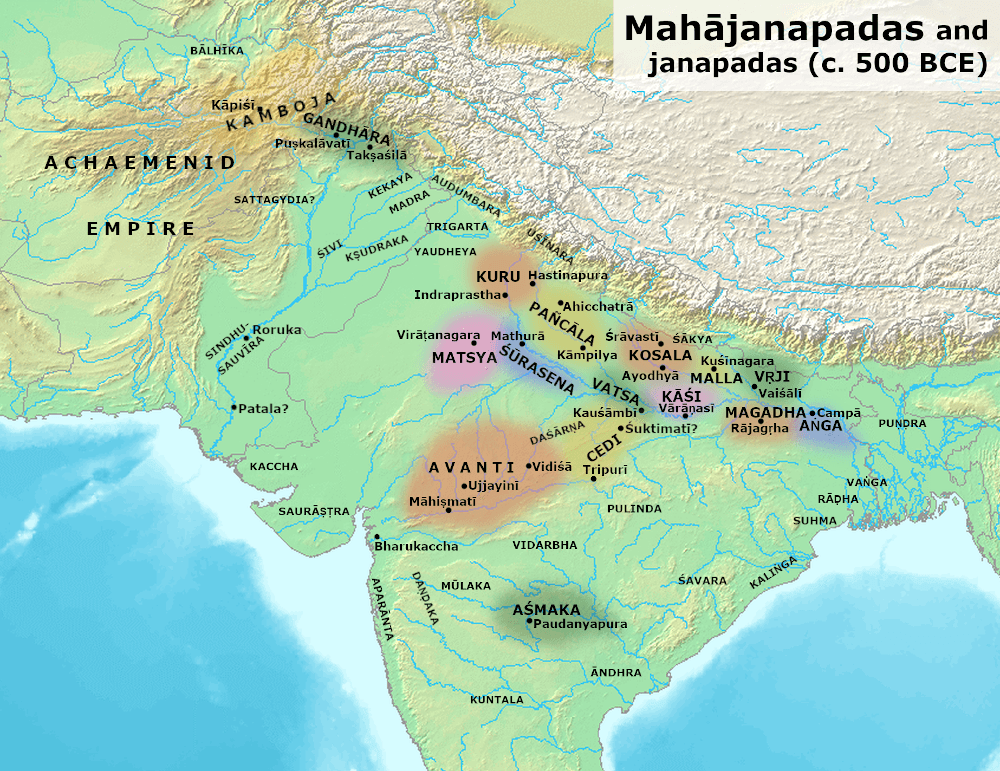
To the authors of the ancient Vedas, the eastern Ganges Plain was a wild, foreign frontier, and the people of Magadha were viewed as hostile, non-Vedic outsiders living well beyond the borders of orthodox Brahmanical culture.
In the late Bronze Age, somewhere around the turn of the first millennium BCE, the composers of the Atharvaveda looked eastward from their heartland in the fertile plains of the Kuru-Panchala and saw a land of spiritual and social exile. In their hymns, they listed the people of Magadha alongside other frontier tribes, casting them as outsiders living beyond the boundaries of proper Brahmanical life. To these orthodox Vedic commentators, Magadha was a wild, suspicious country, a place where people did not perform the sacred fire sacrifices, where the rigid hierarchies of the priesthood held no sway, and where the gods of the Rigveda were met with indifference. Yet, over the next eight centuries, this despised borderland on the eastern Ganges Plain would undergo a transformation so radical that it would rewrite the intellectual and political geography of South Asia. Magadha would not only conquer its neighbors to form the crucible of India’s first great empires, but it would also serve as the birthplace for two of the world's major religions, launching a philosophical revolution that challenged the spiritual foundations of the ancient world.
The physical stage for this rise was a naturally fortified pocket of the eastern Gangetic plains, corresponding roughly to the modern-day districts of Patna and Gaya in the Indian state of Bihar. Before its eventual expansion, the initial kingdom of Magadha was defined by clear, defensive river boundaries: the Ganges to the north, the Son to the west, and the Campā to the east, while the rugged, forested spurs of the Vindhya mountains formed its southern wall. Deep within this protected basin lay its first capital, Girivrijja, later known as Rajagriha. Tucked away among a ring of protective hills, Rajagriha was virtually impregnable to the cavalry and chariot raids of rival states. From this secure base, the early Magadhan state looked out upon a landscape undergoing a profound economic and social shift known to historians as the Second Urbanization. From about 500 BCE onward, iron technology cleared the dense forests of the wet eastern plains, surplus agriculture boomed, trade routes crystallized along the river highways, and bustling cities rose where wild jungle had recently stood.
This rapid urbanization occurred in a cultural environment that Indologist Johannes Bronkhorst and other scholars term "Greater Magadha"—a distinct region stretching roughly from Śrāvastī in the northwest to Rajagriha in the southeast. Unlike the western Vedic kingdoms, where Brahmins occupied the apex of the social hierarchy, Greater Magadha was dominated by a Kshatriya ruling class and a thriving culture of independent spiritual seekers. Here, orthodox rituals were rejected in favor of the movements: groups of wandering ascetics, philosophers, and mystics who abandoned household life to seek ultimate truth through meditation, extreme self-denial, and intellectual debate. In the crowded markets and quiet groves of Magadha, these heterodox philosophers debated everything from the existence of the soul and atomism to fatalism, free will, and strict non-violence (). It was a feverish intellectual ecosystem that produced some of history’s most influential thinkers. Vardhamana Mahavira, the twenty-fourth Tirthankara who revived and systematized Jainism, was born into a local royal family and found a receptive audience for his rigorous ascetic teachings here. Likewise, Gautama Buddha, the founder of Buddhism, spent much of his active life wandering the dusty roads of Magadha. He attained his ultimate enlightenment under a peepal tree in Bodh Gaya, walked its paths with his chief disciples—including local Brahmins like Sariputra, Maudgalyayana, and Mahakasyapa who abandoned their ancestral traditions to follow him—and left behind a legacy that would see the first Buddhist council gathered at Rajagriha shortly after his death.
Connected to
- religionHinduism
- is aMahajanapadas600 BCE
+ 5 further connections to entries not yet ingested