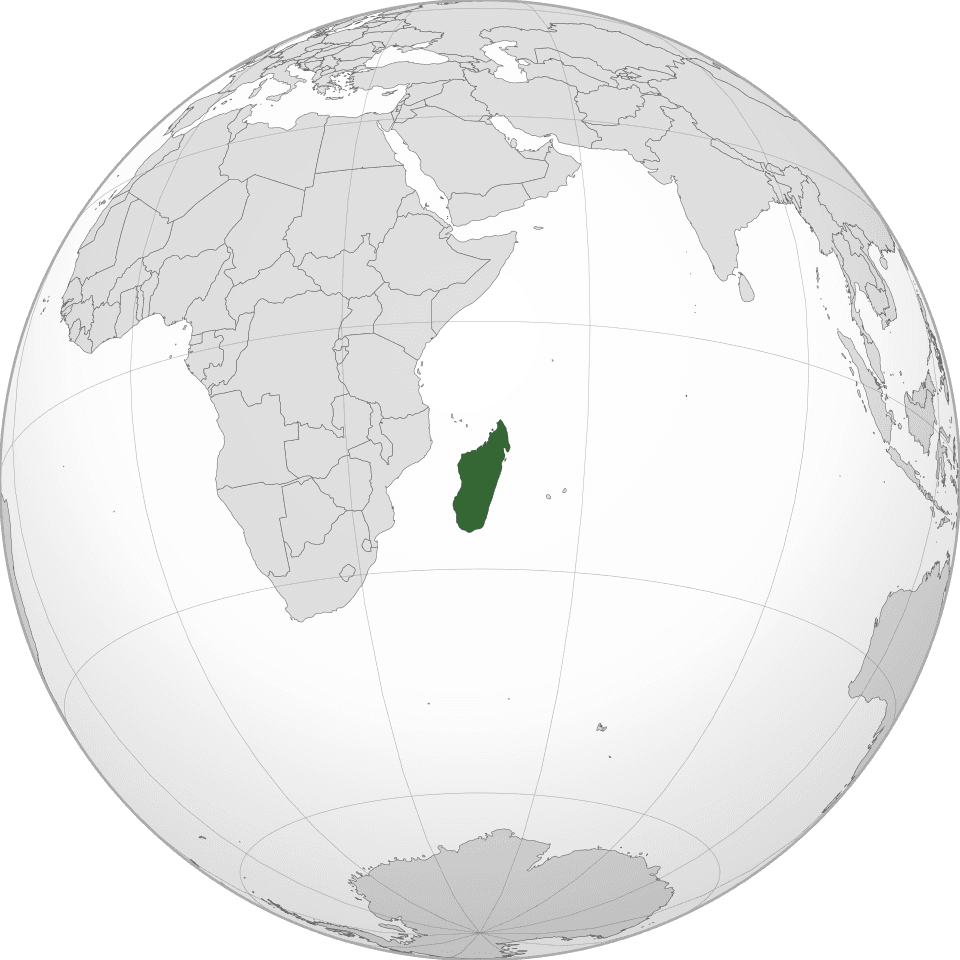
The deep geological isolation of Madagascar began 180 million years ago when it sheared away from Africa, followed by a second rupture from the Indian subcontinent 90 million years later.
To see Madagascar from above is to look upon a monumental teardrop of red clay, sheared from the flank of Africa by the slow violence of the earth’s crust. Some one hundred and eighty million years ago, the island parted from the supercontinent of Gondwana; ninety million years later, it severed its last ties with the Indian subcontinent. Left to drift in the warm isolation of the Indian Ocean, this vast landmass—nearly a thousand miles from its northern cape of Ambro to the southern cliffs of Cape St. Mary—became a sanctuary of evolutionary eccentricity. Here, the rules of biology were rewritten in seclusion. Nine-tenths of its flora and fauna exist nowhere else on Earth. It is a world of giant, flightless elephant birds that once laid eggs the size of boulders, of seventeen extinct species of massive lemurs, of the predatory, cat-like giant fossa, and of primeval forests that rise from the coastal plains to scale the sheer, misty ramparts of the central highlands.
Yet for all its deep geological antiquity, Madagascar is one of the most recently settled major landmasses on the planet, occupied by humans long after the colonization of distant continents and barely predating the arrival of people in Iceland or New Zealand. The island’s human genesis was not a simple crossing from the nearby African coast, which lies just two hundred and sixty miles across the turbulent Mozambique Channel. Instead, around the middle of the first millennium CE, the first permanent pioneers arrived from the east. Traveling in outrigger canoes across thousands of miles of open ocean, these voyagers came from present-day Indonesia. They brought with them the Austronesian language that still forms the bedrock of Malagasy speech, a sophisticated tradition of wet-rice cultivation, and a complex cosmology centered on the veneration of ancestral spirits.
These maritime migrants were not to remain alone. By the ninth century, Bantu-speaking peoples crossed the Mozambique Channel from East Africa, bringing with them zebu cattle, which would come to define the island’s wealth, prestige, and landscape. Over the centuries, these two primary ancestral streams—and the later arrivals of Arab traders, Indian merchants, and European mariners—intermingled in a slow, profound synthesis. The island’s geography, divided between the humid, forested east, the dry western plains, and the cool, high-altitude savanna of the central plateau, encouraged diversity. Out of this tapestry emerged at least eighteen distinct cultural groups. Among them were the Merina of the central highlands, destined to play a central role in the island's political destiny, alongside coastal groups and pastoralists who carved out lives in the shadow of the great western rivers like the Betsiboka and the Mangoky.
+ 9 further connections to entries not yet ingested
For centuries, Madagascar was a shifting mosaic of fragmented alliances and local chiefdoms, unified only by trade and a shared, evolving culture. The island’s interior was a rolling, moor-like country of vibrant red clay, broken by spectacular granite bosses that reared out of the earth like titanic castles, pyramids, and spires. To the north, the ancient extinct volcanic massif of Amber overlooked deep, land-locked harbors like Diego-Suarez, while in the center, the mist-shrouded peaks of Ankaratra dominated the horizon. Along the eastern coast, where short, violent rivers cut through mountain gorges to the sea, a three-hundred-mile chain of lagoons formed a natural barrier against the open ocean. Across this diverse landscape, early societies organized around hasina—a sacred life force and authority—competing for control over fertile valleys and strategic river estuaries.
By the sixteenth century, this mobile, decentralized world began to crystallize into powerful states. In the southwest, the Sakalava Empire arose under the Maroserana dynasty, exploiting early European contact to trade forest products and captives for firearms, eventually establishing the powerful kingdoms of Menabe and Boina. European contact, initiated by Portuguese navigators in 1500, introduced a disruptive new dynamic. The island’s deep bays and isolated beaches became notorious havens for Caribbean pirates in the late seventeenth century, while British and French merchants established fleeting outposts. Yet the Malagasy proved highly resilient; a British attempt to colonize St. Augustine’s Bay in 1645 was swiftly repelled by local communities.
It was in the central highlands, within the fertile, dried-up lake beds of Imerina, that the political landscape of Madagascar underwent its most dramatic consolidation. Beginning in the nineteenth century, a series of Merina monarchs unified the majority of the island under a single sovereign administration, creating the Kingdom of Madagascar. This centralized state constructed road networks, engaged in diplomacy with European powers, and adopted written codes of law. However, the kingdom's sovereignty was cut short at the close of the nineteenth century. In 1896, French colonial ambitions culminated in the outright annexation of the island, bringing an end to the Merina monarchy in 1897 and establishing a highly centralized, often brutal colonial administration that sought to exploit Madagascar’s agricultural and mineral wealth.
The colonial era reshaped Madagascar's infrastructure, introducing railways through the steep eastern forests and carving out canals to link the coastal lagoons. Yet, it also sowed deep social and economic divisions. The year 1960 marked the end of French formal rule and the birth of an independent Malagasy republic. This transition initiated a turbulent modern history characterized by four successive constitutional republics, each attempting to balance the legacy of French administrative systems, the deep-seated rivalries between the highland Merina and the coastal populations, and the challenges of economic development. Malagasy and French remained the twin official languages of the state, representing the dual heritage of its modern institutions.
Despite its vast natural wealth and its status as an international hotspot for ecotourism, modern Madagascar has struggled with the burdens of its colonial past and subsequent political instability. Classified by the United Nations as a least-developed country, its transition to a constitutional democracy in 1992 has been repeatedly interrupted by crises. A military coup in 2009 led to a protracted political impasse, and though constitutional governance was restored in 2014, stability remained elusive. In 2025, mass public protests culminated in another military intervention, resulting in the installation of Michael Randrianirina as president of an interim government.
For the majority of Madagascar's people, the daily reality is defined by a precarious relationship with the land. Nearly seventy percent of the population lives in multidimensional poverty, relying on subsistence agriculture and pastoralism in an environment increasingly threatened by deforestation and habitat loss. Yet the island’s cultural core remains remarkably intact. In the shadow of the highland mountains and along the humid coastal plains, the ancient belief in the power of the ancestors continues to co-exist with predominant Christian faiths. Madagascar remains a world apart—a place where the deep time of evolutionary isolation meets the complex, overlapping currents of human migration, leaving a society that is still navigating the delicate balance between its unique ecological inheritance and the demands of the modern world.