Person · 1845 CE – 1894 CE · Southern African Civilizations
Lobengula
- Also known as
- Chief Lobengula
- King Lobengula
- King Lobengula of Matabeleland
- Lobengoela Khoemalo
- Lobenguela
- Lobengula Khumalo
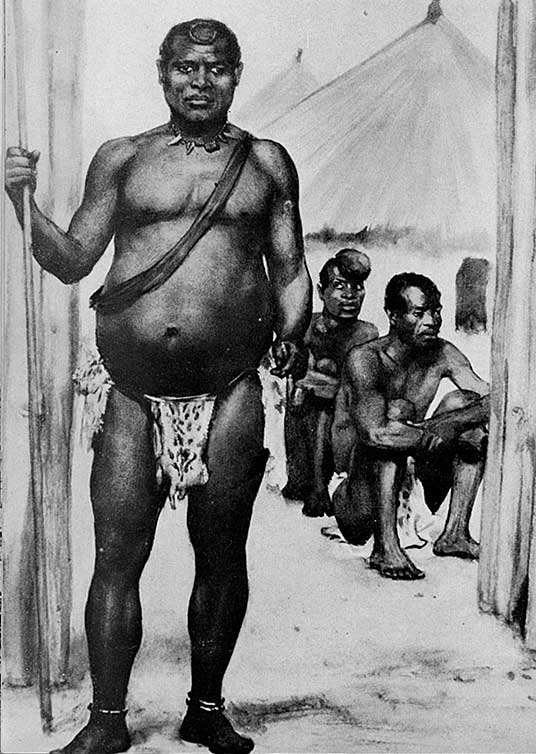
The throne of Mthwakazi was won not by birthright, but by the arbitration of the spear.
To stand before King Lobengula of Mthwakazi in the late nineteenth century was to encounter a man trapped between two irreconcilable worlds. Visitors to his royal kraal at Bulawayo often found him seated on a simple wooden stool, his immense, heavy frame glistening in the heat, administering justice with absolute authority over his subjects while simultaneously parrying the aggressive overtures of European concession-hunters. He was a monarch who ruled by the spear but was ultimately undone by the pen. As the second and last official king of the Ndebele state—known historically to the British as Matabeleland—Lobengula presided over a military society of formidable power, inherited from his father, Mzilikazi, who had carved a kingdom out of the southern African interior after fleeing the wrath of the Zulu king Shaka in the 1830s. Yet, for all the discipline of his fifteen thousand warriors, Lobengula’s reign would become a tragic masterclass in the asymmetric warfare of late Victorian imperialism, where treaties proved far more lethal than Maxim guns, though both would eventually claim his kingdom.
The kingdom Lobengula inherited in 1870 was forged in exile and sustained by iron discipline. Mzilikazi had led his followers, the "men of the long shields," away from the Zulu heartland, across the Transvaal, and finally north of the Limpopo River, absorbing Sotho youths and other local populations along the way. In this highly stratified society, privilege was reserved for the Ndebele elite, but it came at the price of absolute obedience; the slightest infraction of social or military duty was met with death, a rigor that allowed a relatively small nation to dominate its neighbors. When Mzilikazi died in 1868, the succession was not immediate. Lobengula, born around 1835 to an inferior wife, was offered the crown by the izinduna (chiefs), but his ascent was fiercely contested. Several regiments, led by Chief Mbiko Masuku, rose in rebellion. The dispute was settled by the ancient arbitration of the assegai—the short stabbing spear of the Nguni people—on the battlefield, where Lobengula’s conspicuous courage secured both victory and a unanimous claim to the throne.
His coronation at the military town of Mhlahlandlela was an exhibition of the state's martial splendor. Ten thousand warriors assembled in a colossal semicircle, their bodies adorned in black ostrich-feather capes and headdresses, leopard-skin kilts, and white cattle-tail ornaments around their arms and ankles. They danced and swore their lives to the new king while mountains of meat from slaughtered cattle were offered to Mlimo, the Ndebele spiritual leader, and to the spirit of the departed Mzilikazi, washed down with vast quantities of millet beer. To the white hunters, traders, and missionaries who began to trickle into the country, Lobengula appeared as a traditional despot, yet he was surprisingly tolerant of their presence, even punishing subjects who threatened them. He was a man of large appetites and domestic complexity, maintaining well over twenty wives—including Xwalile, daughter of the Gaza king Mzila, and the influential Lozikeyi—and fathering numerous sons, including Njube, Nguboyenja, Mpezeni, and Sidojiwe, whose lives would later be radically reshaped by the winds of colonization.
The existential threat to Lobengula’s sovereignty did not come from rival African polities, but from the discovery of gold. In 1870, the king had granted Sir John Swinburne’s London and Limpopo Mining Company the right to search for minerals in the Tati Concession along the southwestern border, but this was a localized arrangement. By the late 1880s, the pressure intensified. A British syndicate representing the interests of Cecil Rhodes—composed of Francis Thompson, Charles Rudd, and Rochfort Maguire—arrived at Bulawayo in 1888, determined to secure exclusive mineral rights over the entirety of Lobengula's domain. The king was deeply wary. He was illiterate, operating in a world where agreements were sealed by verbal promises and shared understanding, while his suitors operated in the predatory framework of European contract law.
Lobengula’s defenses were breached not by an enemy, but by a friend. Leander Starr Jameson, a medical doctor who had successfully treated the king's agonizing gout, used his intimacy with the monarch to advocate for the British. Jameson assured Lobengula that in exchange for the mineral rights, the Ndebele would receive a steady supply of British weapons and money, and crucially, that any white miners who entered the territory would remain subject to the king's laws. Jameson also insisted on a clause to exclude the Boers and the Portuguese from settling or gaining concessions in the region, playing on Ndebele anxieties about Boer expansion. Trusting Jameson, Lobengula put his mark to the Rudd Concession on October 30, 1888. It was a twenty-five-year agreement that effectively signed away the sovereignty of his nation.
The betrayal did not take long to surface. As his own subjects began to protest and the true, expansive nature of the document became clear, Lobengula realized he had been deceived. He turned to friendly English missionaries to translate and verify the terms, only to have his worst fears confirmed: the concession gave the British South Africa Company virtually unchecked authority to exploit his lands. In a desperate bid to undo the damage, the king sent two emissaries to London to appeal directly to Queen Victoria. The mission was sabotaged from the start; associates of the financier Alfred Beit deliberately delayed the diplomats at the port to ensure Rhodes’s plans remained unimpeded. On April 23, 1889, Lobengula dispatched a formal protest to the British Queen, declaring that he and his izinduna would not recognize the contract because he had been tricked. The response from the Queen’s advisors was cold and final: it was "impossible" for the British crown to exclude white men from the territory.
The inevitability of war now loomed over Bulawayo. The British South Africa Company, armed with its royal charter and backed by an influx of armed settlers known as the Pioneer Column, began moving into Mashonaland, establishing settlements and treating Lobengula's nominal vassals as British subjects. By October 1893, the friction erupted into the First Matabele War. The Ndebele warriors, fighting with immense bravery and carrying their traditional ox-hide shields, were utterly outmatched by the industrial technology of the British forces. At the Battle of the Shangani, the devastating firepower of the Maxim gun cut down the charging impis in waves, rendering centuries of Zulu military tactics obsolete in a single afternoon.
As his capital at Bulawayo fell to the advancing colonial forces, Lobengula fled into the rugged north, his kingdom collapsing behind him. He would not survive the winter of his defeat. By December 1893, rumors reached the British that the king was grievously ill, likely suffering from smallpox or diabetic complications aggravated by the physical toll of his flight. Sometime in early 1894, Lobengula died in hiding. His death was kept a closely guarded secret by his surviving followers for months, a final act of defiance to deny the British the satisfaction of a captured king. By October 1897, the conquest was complete; the white colonists had firmly established themselves across the territory, renaming the land Rhodesia in honor of the man who had orchestrated its seizure.
In the aftermath of the kingdom's fall, the colonial authorities sought to erase the Ndebele royal line's political potential while weaponizing its prestige. Lobengula's young sons—Njube, Nguboyenja, and Mpezeni—were sent south to the Cape Colony to receive a Western education, away from the influence of their father's former subjects. Though the royal line was fractured, and the sons died without leaving direct male heirs to the throne, the legacy of the Ndebele kingdom persisted in unexpected ways. Decades later, Njube’s sons, Albert and Rhodes, would return to Bulawayo and co-found the Highlanders Football Club, an institution that remains a powerful symbol of cultural identity in modern Zimbabwe. Lobengula's tragedy was that of a ruler who attempted to navigate the shifting sands of global diplomacy with the tools of an isolated regional power, discovering too late that in the scramble for Africa, the white man's ink was far more indelible than the blood spilled on his battlefields.
Connected to
7 links to entries not yet ingested in the Library.