Person · 1452 CE – 1519 CE · Early Modern Europe
Leonardo da Vinci
- Also known as
- da Vinci
- da Vinci
- Da Vinci Leonardo
- de Vinci
- de Vinci
- jan Lejonato pi ma Winsi
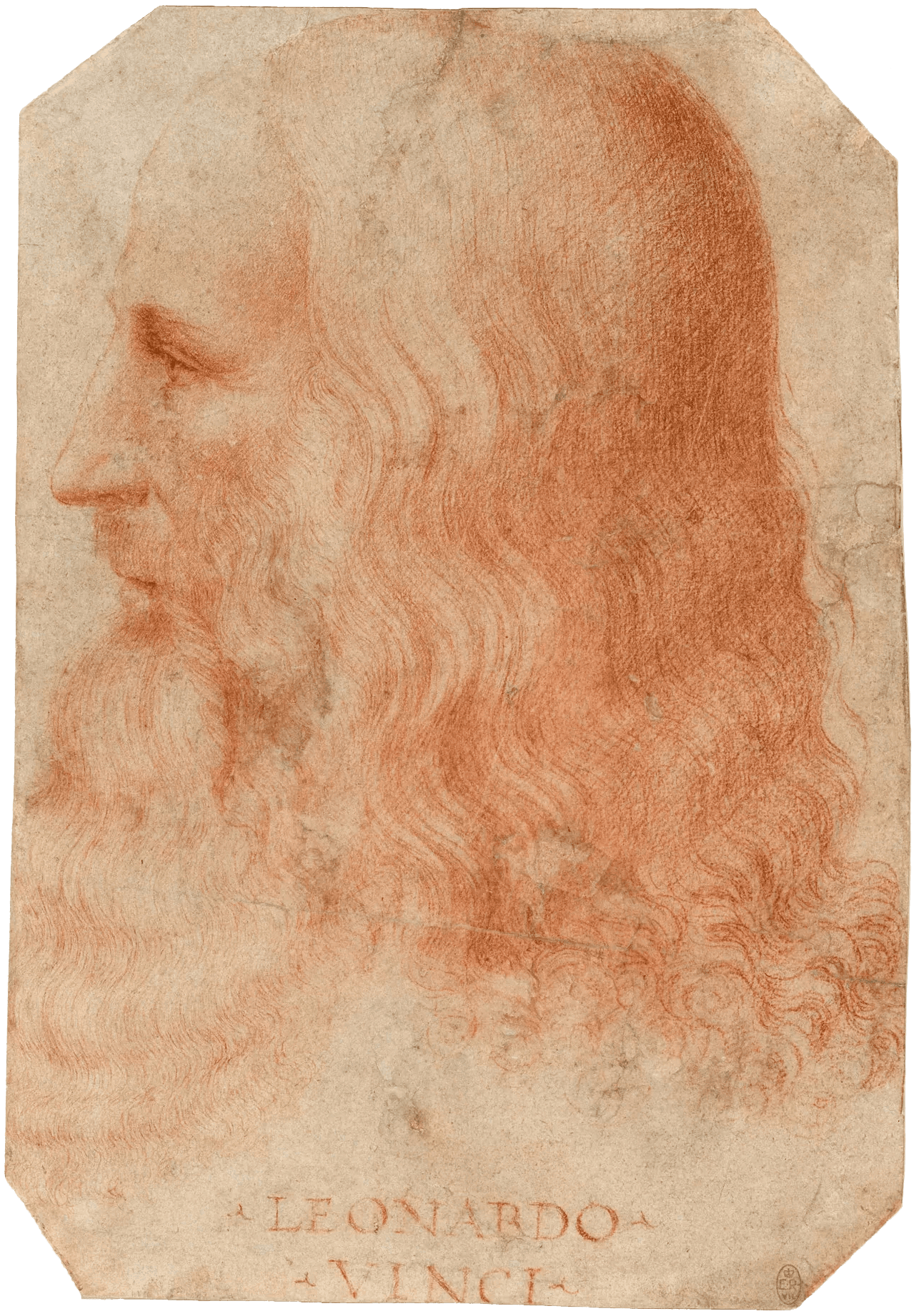
Great geniuses are rarely born with a clear path laid before them, and Leonardo di ser Piero da Vinci, born out of wedlock to a Tuscan notary and a lower-class woman, was no exception.
In the mid-1460s, a teenager arrived in Florence from the Tuscan hill country, bringing with him a mind that refused to distinguish between the curve of a human muscle and the swirl of a mountain stream. Leonardo, born out of wedlock in 1452 to a successful notary named Piero da Vinci and a lower-class woman named Caterina, had spent his earliest years in or near the fortified hamlet of Vinci. Raised primarily in his father’s household, he received only a basic, informal education in reading, writing, and vernacular mathematics. Yet he carried an insatiable curiosity that would soon destabilize the boundaries of Renaissance art. His earliest recorded memory, preserved in the sprawling pages of his later notebooks, was not of a human face but of a bird: a kite, he recalled, had descended to his cradle, forcing its tail feathers between his infant lips. Whether a true recollection or a childhood fantasy, the image was telling. To Leonardo, the physical world was a theater of forces waiting to be dissected, measured, and understood.
The Florentine world he entered was the intellectual engine of the fifteenth century, a city vibrating with Christian Humanist philosophy, classical revivals, and artistic competition. Around the age of fourteen, Leonardo was placed as a garzone, or studio boy, in the workshop of Andrea del Verrocchio, the leading sculptor and painter of Florence. Verrocchio’s studio was less a quiet sanctuary for contemplation and more a bustling laboratory of the material arts. Here, alongside fellow apprentices and associates like Sandro Botticelli, Pietro Perugino, and Domenico Ghirlandaio, the young Leonardo was exposed to draftsmanship, chemistry, metallurgy, plaster casting, leatherwork, mechanics, and carpentry. It was a hands-on education in how the world was constructed. When Verrocchio set about painting The Baptism of Christ in the early 1470s, Leonardo was permitted to paint the young angel holding Jesus’s robe. The result was a revelation. Using the relatively new medium of oil paint rather than traditional tempera, Leonardo rendered the angel's face, the delicate folds of the drapery, and a misty, winding river landscape with a soft realism that made the rest of the canvas appear flat. Legend—later popularized by the biographer Giorgio Vasari—claimed that Verrocchio was so humbled by his pupil’s superiority that he resolved never to touch a brush again. While the story of the master's retirement is almost certainly apocryphal, the painted angel itself remains undeniable evidence of a young genius outgrowing his training.
By 1472, at the age of twenty, Leonardo had qualified as a master in the Guild of Saint Luke, the prestigious Florentine association of artists and doctors of medicine. Though his father set him up with his own workshop, his attachment to Verrocchio was such that he continued to live and collaborate with his old master for several years. During this first Florentine period, Leonardo began to formulate a philosophy of art that was radically empirical. While contemporaries sought to revive classical antiquity by copying ancient sculptures, Leonardo turned his eyes exclusively to nature. He argued that an artist who merely reproduced the external surfaces of things, without searching into the hidden laws of their creation, was only half-equipped for the calling. Every aesthetic challenge became a scientific inquiry. To paint a mountain, he studied geology; to paint a human body, he investigated anatomy and the mechanics of muscular movement; to paint the fall of light on a face, he probed the physics of optics and the physiology of the eye. He became fascinated by the world’s fugitive and unusual appearances: the strange contours of jagged rocks, rare plants, the grotesque expressions of eccentric characters, and the subtle, questionable smiles of women.
Connected to
12 links to entries not yet ingested in the Library.