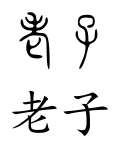
Somewhere in the sixth century BCE, in the southern state of Chu, an archivist of the royal Zhou court named Li Er is said to have grown weary of the declining dynasty and departed for the western wilderness.
At the westernmost gate of the Chinese world, where the dust of the Central Plains dissolves into the rugged, unsettled wilderness of the frontier, a lone archivist is said to have made his exit from history. The kingdom of Zhou was in its long, agonizing decline, its moral authority splintering into the chaotic warfare of the Spring and Autumn period. Sickened by the decay of the court, the old scholar turned his back on the civil division of his homeland, intending to vanish into the western wastes. But at the border, a keen-eyed sentry named Yinxi recognized the traveler. Knowing that such wisdom, once lost to the desert, could never be recovered, the guard refused to let the sage pass until he committed his teachings to writing. The traveler complied. He sat down and produced a brief, enigmatic text of some five thousand characters before resuming his journey into the sunset, never to be seen again.
This story, recorded by the grand historian Sima Qian in the first century BCE, is the foundational myth of Laozi—the "Old Master" or "Venerable Teacher." Yet, like the philosophy attributed to him, the man himself remains entirely elusive, existing at the precise intersection of history, theology, and literary invention. To search for the historical Laozi is to chase a shadow that grows larger and more diffuse the closer one approaches. Traditional accounts identify him as Li Er, born in the southern state of Chu during the sixth century BCE, a contemporary of Confucius who served as the keeper of the royal archives for the Zhou court. This position would have granted him access to the classic texts of the Yellow Emperor and the ancient world, establishing him as a scholar of immense depth. Other accounts in Sima Qian’s records complicate this neat biography, suggesting he may have been Lao Laizi, a contemporary of Confucius famous for his filial piety, or a fourth-century BCE court astrologer named Lao Dan who predicted the rise of the Qin state.
By the mid-twentieth century, a modern scholarly consensus emerged that treats these biographical fragments with deep skepticism. Rather than the work of a single historical author, the text traditionally known as the Laozi—now universally called the Dao De Jing (the "Classic of the Way and Virtue")—is understood to be an accretionary document. It is a compilation of oral traditions, aphorisms, and philosophical poetry assembled by multiple hands over generations. While other ancient Chinese texts are anchored by a central "Master" figure who debates disciples and navigates specific historical events, the Dao De Jing is conspicuously empty of such human detail. It features no historical figures, no local anecdotes, and no specific dates. It is a voice speaking from nowhere, addressed to anyone. The oldest surviving fragments of this text, discovered in the late fourth-century BCE bamboo slips at Guodian, represent only about a third of the received text, interspersed with passages that were later abandoned, confirming that the book was still a fluid, evolving entity long after the traditional sixth-century BCE lifespan of its alleged author.
+ 11 further connections to entries not yet ingested
At the heart of the text is the Dao—the Way—an entity defined primarily by what it is not. It is unseen, silent, and empty, yet it serves as the fertile, inexhaustible source of all existence. It is not a distant, transcendent creator god, but rather the immanent, quiet rhythm of the natural world. Humans, possessing free will and complex desires, frequently act "unnaturally," disrupting this cosmic equilibrium with their ambitions, technologies, and intellectual distinctions. The Dao De Jing functions as a manual for reversal, urging a return to an original state of simplicity and harmony, often compared to an uncarved block of wood or a newborn infant. To achieve this, the text employs a unique literary style rich in paradox, symmetry, and rhythmic repetition, deliberately subverting the conventional language and ethical systems of the era. Where Confucius advocated for rigorous moral cultivation, elaborate rituals, and social hierarchies, the author of the Dao De Jing viewed such structures as artificial impositions that only accelerate moral decay.
The primary mechanism for aligning oneself with this cosmic rhythm is wu wei, a multifaceted concept frequently translated as "non-action" or "effortless action." Far from advocating mere laziness or passivity, wu wei represents a sophisticated mode of behavior: acting without forcing, responding spontaneously to the demands of the moment, and flowing around obstacles rather than striking them. It is the strength of water, which is soft and yielding, yet wears down the hardest stone. On a political level, this philosophy translated into a radical approach to statecraft. The Dao De Jing advises rulers to govern with a light hand, to avoid heavy taxation, aggressive wars, and complex legal codes that only create more criminals. It even suggests that a ruler should keep the populace in a state of simple-minded ignorance—not necessarily out of tyrannical malice, but to protect them from the competitive, unnatural desires stimulated by sophisticated culture and technological progress. By remaining quiet and desireless, the ruler allows the state to govern itself.
This vision of quietude and restraint resonated deeply across the centuries, particularly among those who found themselves on the margins of imperial power or exhausted by the demands of public life. Throughout Chinese history, when the rigid moral expectations of Confucianism became too burdensome, scholars and potential officials invoked the authority of Laozi and his spiritual successor, Zhuangzi, to justify withdrawing from public service. It offered an intellectual sanctuary, allowing the literati to reject the summons of corrupt emperors while maintaining their moral integrity. In times of political upheaval, antiauthoritarian movements and rebel groups frequently adopted the text’s defense of the weak and its promise that the soft would eventually overcome the hard.
But Laozi’s legacy was not confined to quietist philosophy. During the Han dynasty, the "Old Master" underwent a profound transformation. As Taoism evolved from a school of thought into an organized religion, Laozi was elevated from a mortal sage into a divinity: Taishang Laojun, one of the Three Pure Ones of the Taoist pantheon. He was no longer merely a dead archivist; he was the personification of the Dao itself, an eternal being who had undergone multiple incarnations across history to reveal the sacred mysteries to humanity. The first organized Taoist religious sect, the Way of the Celestial Masters, was founded on the belief in these divine revelations. In some later, more polemical traditions, the story of Laozi’s journey to the west was expanded to claim that he had traveled all the way to India, where he became the teacher of Siddhartha Gautama, or had even incarnated as the Buddha himself.
Thus, the figure who began as a quiet archivist escaping the noise of a crumbling empire became an immortal god, an ancestor claimed by the imperial Li family of the Tang dynasty, and the patron saint of Chinese mysticism. Whether Laozi was a single man who lived in the sixth century BCE or a composite persona dreamed into existence by ancient editors, the "Old Master" achieved precisely what the Dao De Jing advocated. By stepping into the shadows of the western pass and leaving his name behind, he became permanent. His voice, preserved on bamboo and silk, continues to offer a quiet, paradoxical alternative to the noisy ambitions of human civilization, reminding those who listen that the highest virtue, like water, seeks the lowest places, and in doing so, sustains the world.