Place · East African Civilizations
Lalibela
- Also known as
- Eaglaisí Lalibela
- Giáo đường nham thạch Lalibela
- Laalibalaa
- Lalibala
- Lalibela, Ethiopia
- Lalibella
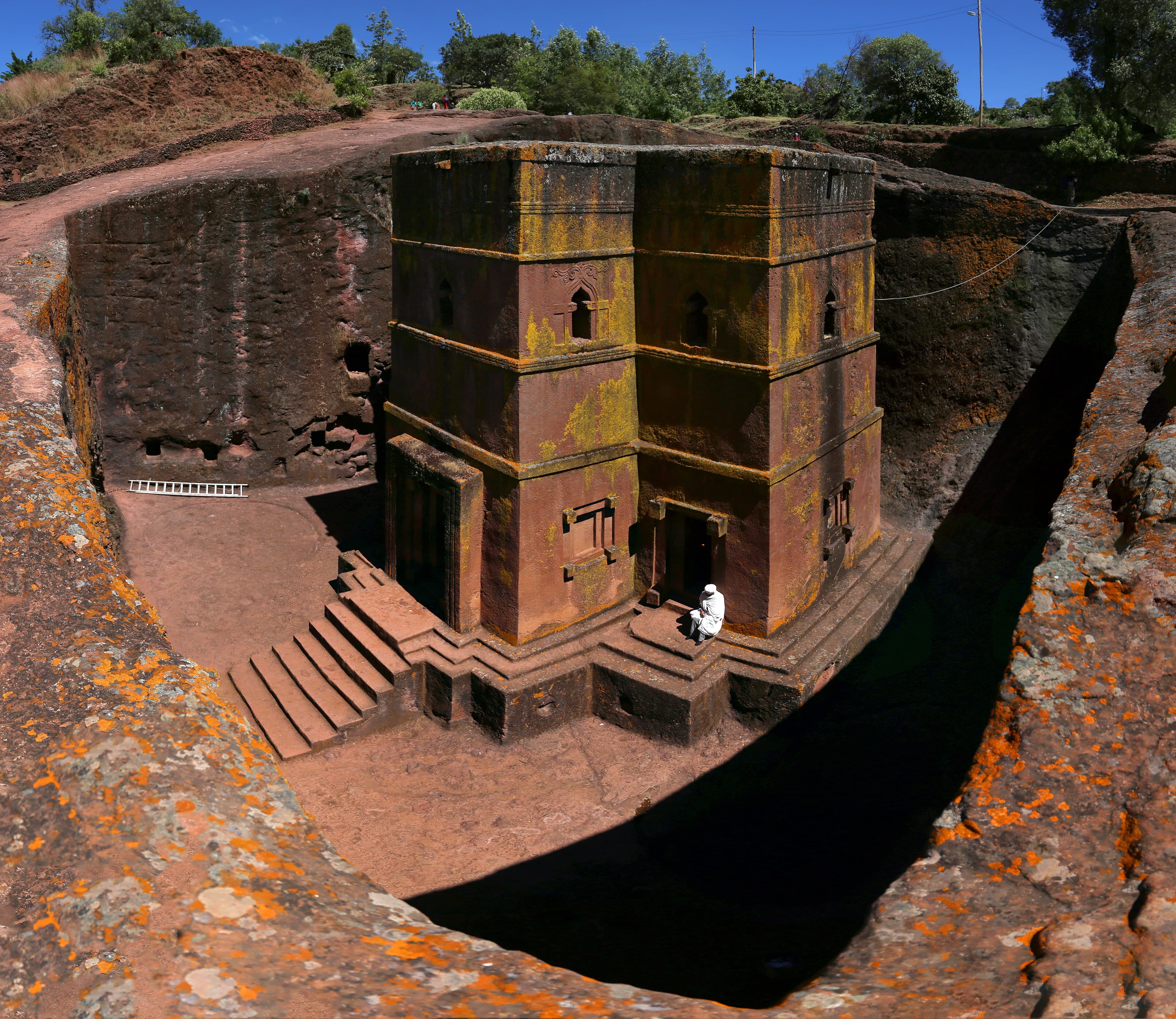
High in the mountainous Lasta district of Ethiopia, some 2,500 meters above sea level, lies a landscape carved not by the slow erosion of nature, but by the deliberate devotion of medieval hands.
High on the wind-swept plateau of Lasta, where the thin air of the Ethiopian highlands sits some twenty-five hundred meters above the level of the sea, the earth does not merely support architecture; it contains it. To stand in Lalibela is to look down upon roofs that lie flush with the surrounding soil, gazing into deep, red-basalt trenches where monumental structures have been coaxed out of the living mountain. These are not buildings assembled from quarried blocks, held together by mortar and human recalculation. They are monolithic sculptures of immense scale, hollowed out with chisels and crowbars to leave behind columns, vaults, architraves, and windows—all born from a single, unbroken mass of volcanic tuff. For centuries, those who encountered this place struggled to categorize it within the known boundaries of human engineering. When the Portuguese priest Francisco Álvares journeyed here in the 1520s, he found himself so overwhelmed by the sheer improbability of the site that he cut his descriptions short, swearing an oath before God that he was telling the truth, lest future readers accuse him of writing outright falsehoods.
The origin of these subterranean monuments is bound up in a grand, medieval act of translation. In the late twelfth century, the capture of Jerusalem by the Muslim general Saladin in 1187 severed the traditional pilgrimage routes for East African Christians. According to local historical tradition, King Gebre Meskel Lalibela of the Zagwe dynasty—who ruled from approximately 1181 to 1221—was granted a divine vision of Jerusalem and commanded to construct its likeness on the African continent, a "New Jerusalem" in the rugged territory then known as Roha. The physical geography of the town was painstakingly rechristened to map onto the topography of the Holy Land. A seasonal stream slicing through the red rock was named the River Jordan; a nearby hill became the Mount of Olives; and the names of the churches themselves mirrored the sacred geography of the Levant. The ultimate expression of this architectural translation is Biete Giyorgis (the Church of Saint George), a free-standing, three-tiered monolith carved in the shape of a perfect Greek cross, isolated within a deep, sheer-walled pit and accessible only through a dark, hand-cut stone tunnel.
Yet beneath the seamless poetry of the foundation myth lies a far more complex, layered history of human occupation and construction. While tradition credits King Lalibela with raising—or rather, lowering—the entire complex during his four-decade reign, modern archaeological and historical scholarship suggests a much longer, multi-phased evolution. Excavations at the site have yielded pottery and animal remains dating from 900 to 1100 CE, revealing that the area was a bustling secular settlement before it ever became a holy city. David Phillipson, a specialist in African archaeology, has argued that several of the structures, including the churches of Merkorios, Gabriel-Rufael, and Danagel, were originally carved out of the stone as early as the seventh or eighth century, during the twilight of the Kingdom of Aksum. In this view, they served first as secular fortifications or palace complexes for regional elites before being painstakingly remodeled, expanded, and consecrated as Christian temples centuries later. Other structures may have been completed long after King Lalibela’s death; local historian Getachew Mekonnen notes that Queen Meskel Kibra, Lalibela’s widow, is credited with constructing the church of Biete Abba Libanos as a posthumous memorial to her husband, while other architectural details suggest active carving continued well into the fourteenth century.
Architecturally, the churches of Lalibela represent a profound monument to cultural continuity, acting as a stone archive of the Axumite civilization that had adopted Christianity in the early fourth century. Throughout the complex, one finds stone imitations of timber-frame construction. The exterior of Biete Amanuel, for instance, features alternating recessed and projecting horizontal bands that mimic the classic Axumite "monkey-head" style of building, where wooden beams were layered with stone and plaster. Windows and doorways are framed with stone moldings that copy the distinctive shapes of ancient Axumite stelae. This deep, indigenous architectural vocabulary is overlaid with threads of international connection. The pitched roof and linear carvings of Biete Maryam suggest Eastern Christian, particularly Syrian, design elements, while Coptic decorative flourishes point to the historical ties between the Ethiopian Church and Alexandria. While early European travelers, unable to fathom such sophistication in sub-Saharan Africa, frequently attributed the construction to foreign hands—a sixteenth-century Portuguese narrative claimed they were built by angels, and a flawed nineteenth-century French translation of an Ethiopian manuscript conjured a mythical force of five hundred European builders—modern scholars emphasize that foreign artisans, if present at all, merely contributed surface ornamentation. The structural concepts, engineering, and execution remain thoroughly and unmistakably rooted in local, centuries-old Axumite traditions.
This stone sanctuary, carved to withstand the rise and fall of empires, has survived centuries of acute geopolitical turbulence. In the sixteenth century, during the destructive wars between the Christian empire and the Adal Sultanate led by Ahmad ibn Ibrahim al-Ghazi, the churches faced existential peril. The chronicle Futuh al-Habasha records that the Adalites attempted to destroy the monolithic structures, and narrates a dramatic confrontation where a Christian nun threw herself onto a fire lit within one of the temples. However, the sheer mass of the solid rock proved nearly indestructible; as the soldier Miguel de Castanhoso recorded in 1544, the invaders tried to dismantle the churches with crowbars and gunpowder, but the living rock absorbed the blasts, leaving the structures largely undamaged. In the modern era, the site has remained a potent symbol of Ethiopian sovereignty and identity. During the Second Italo-Ethiopian War, Emperor Haile Selassie made a perilous pilgrimage to Lalibela in April 1936, seeking spiritual solace shortly before the capital fell to Italian forces. Decades later, during the Ethiopian Civil War of the 1980s, the town was repeatedly captured by anti-government rebels, which devastated the foreign tourism that had begun to flourish after UNESCO designated the churches a World Heritage Site in 1978. Most recently, during the Tigray War in late 2021 and subsequent regional conflicts in 2023, control of the town fluctuated amid fierce firefights, once again thrusting this medieval sanctuary into the crucible of modern warfare.
Despite the scars of history and the relentless pressures of weathering, Lalibela remains far more than an archaeological curiosity or a static open-air museum. It is a living, breathing landscape of faith. Every January, during the festivals of Genna (the Ethiopian Christmas) and Timkat (Epiphany), the red stone trenches of the town fill with tens of thousands of white-shrouded pilgrims who travel on foot from across the highlands. The air fills with the scent of frankincense, the deep resonance of prayer drums, and the rhythmic chanting of Orthodox priests standing at the precipices of the pits. In these moments, the distinction between the past and the present dissolves. The vernacular "tukuls"—the traditional, double-story round stone dwellings that cluster around the historic core—and the simpler earthen "chika" houses continue to shelter a community whose daily life is synchronized with the liturgical calendar of the churches. By carving their faith directly into the crust of the earth, the medieval builders of Roha ensured that their second Jerusalem would not merely endure as a monument of stone, but as an active, sacred pulse at the heart of the Ethiopian world.
Connected to
3 links to entries not yet ingested in the Library.