Place · Andean Civilizations
Kuelap
- Also known as
- Cuelap
- Cuélap
- Kuelapas
- Kuélap
- Kuélap
- Kuélap
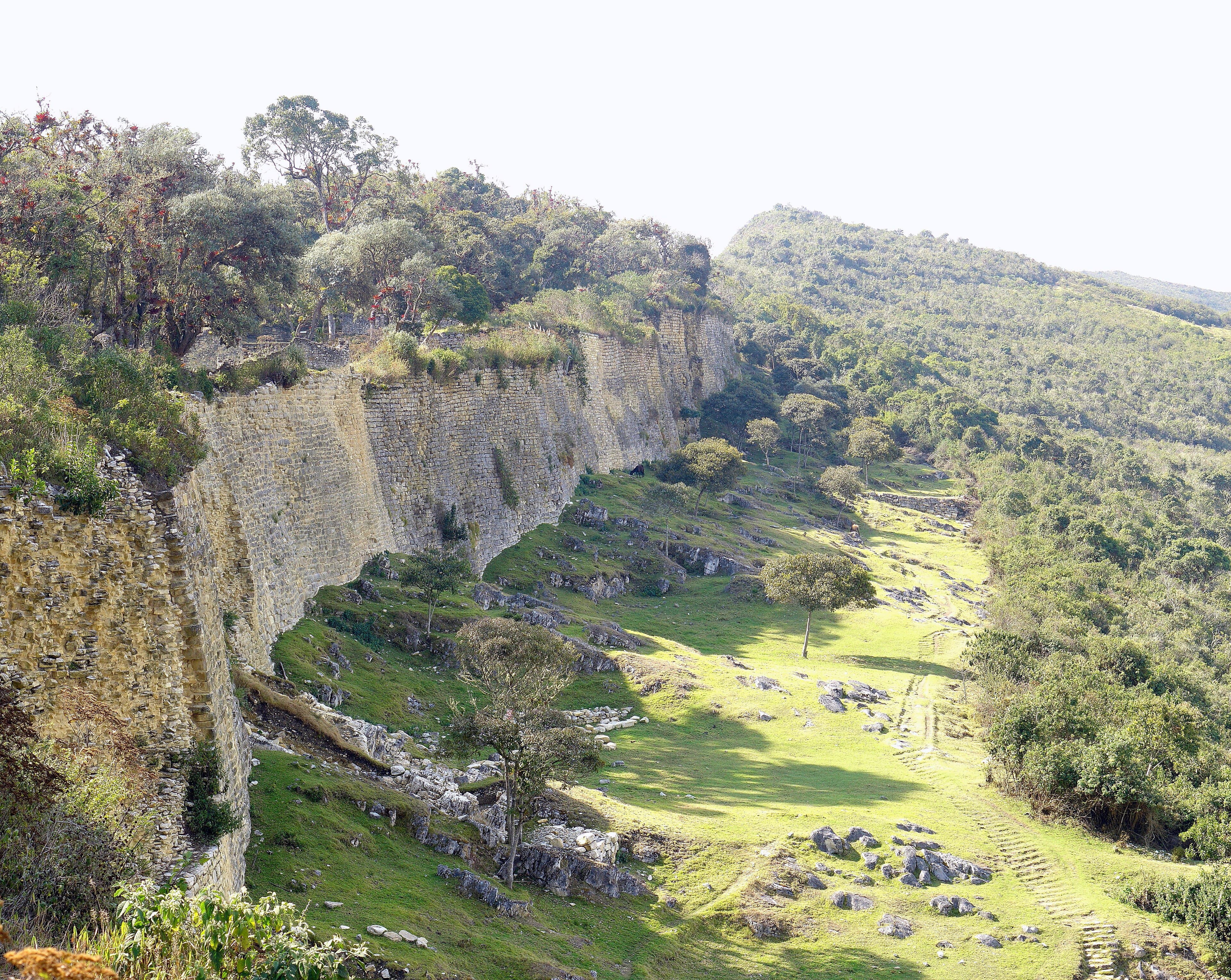
High in the cloud forests of northern Peru, where orchids and epiphytes drape the trees, a massive limestone fortress sits on a ridge three thousand meters above the Utcubamba Valley.
High in the Peruvian Andes, where the cold mountain air collides with the warm, rising breath of the Amazon basin, a limestone ridge juts three thousand meters above the Utcubamba River. For centuries, this ridge was swallowed by the cloud forest, a vertical world of thick moss, orchids, and epiphytes that thrived in the perpetual moisture. Buried beneath this dense canopy lay Kuélap, a colossal walled settlement built not by the Inca, but by the Chachapoyas—the "People of the Clouds." Seen from the valley below, the site appears less like a city and more like an extension of the cliff itself, a monumental limestone crown spanning six hectares. Its outer walls, soaring up to twenty meters high and stretching nearly six hundred meters from north to south, are built from finely worked limestone blocks, some weighing as much as three tons. It is a monument of staggering scale, designed to dominate the landscape and isolate its inhabitants from the world below. Yet, for all its defensive appearance, Kuélap was not merely a fortress; it was a crowded, vertical metropolis of the dead and the living, where domestic life, cosmic observation, and ancestor worship were bound together in stone.
The story of Kuélap is one of immense longevity and sudden, catastrophic silence. While human occupation on the ridge began as early as the fifth century CE, the vast majority of the city’s structures were raised during a golden age of construction between 900 and 1100 CE. During this era, the settlement housed a population of approximately three thousand people. Unlike the rigid, imperial geometry of later Inca architecture, Kuélap was a city of curves. Of its 421 recorded structures, all but five are circular. These round houses, built from thick limestone walls and capped with conical thatched roofs, were packed densely together along narrow, winding alleys. Today, only the stone foundations remain, some rising to two meters high, decorated with elegant geometric friezes of zigzags and rhomboids protected by projecting stone cornices. To walk through Kuélap was to walk among the ancestors. The Chachapoyas did not banish their dead to distant cemeteries; instead, they buried them directly within the walls of their homes and inside the monumental perimeter defenses. The living ate, slept, and raised children literal inches from the bones of their predecessors, keeping the lineage of the household physically anchored to the earth.
The architectural layout of Kuélap reflects a highly organized, stratified society with sophisticated engineering capabilities. Water was channeled into the settlement from a mountain spring via a complex network of stone canals, ensuring a reliable supply high above the river. The city itself was divided into distinct sectors, the most exclusive of which was Pueblo Alto, or the "High Town." Guarded by an eleven-and-a-half-meter wall, Pueblo Alto could only be accessed through two narrow entrances. At its northernmost tip stood the Torreón, a seven-meter-high tower that served as a defensive stronghold, a claim supported by the discovery of stone weapons cached within its ruins. At the opposite end of the city, in the southwest, lies El Tintero, or the "Inkwell," a enigmatic, five-and-a-half-meter-tall temple shaped like an inverted cone. Excavations inside this structure have unearthed ceremonial remains, leading researchers to hypothesize that it functioned as a solar observatory, tracking the movements of the sun to regulate the agricultural cycles of the valleys below.
To enter this sky-high redoubt, an outsider had to navigate a psychological gauntlet. Kuélap has only three entrances—two on the east and one on the west. The main entrance is a masterpiece of defensive architecture: a grand, trapezoidal gateway that may have once supported a corbel arch. As one walks inward, the passage narrows dramatically, squeezing the space until it allows the passage of only a single person at a time. Any hostile force attempting to breach the city would be forced to advance in a vulnerable, single-file line, entirely at the mercy of defenders waiting on the high walls above. For centuries, this design rendered Kuélap virtually impregnable. But its formidable defenses could not protect it from the radical geopolitical shifts of the sixteenth century. Following the Spanish Conquest, the social fabric of the region was utterly shattered. In 1570, the city was permanently abandoned, its inhabitants scattered or decimated by warfare and imported diseases. The cloud forest, which had been held at bay for a millennium by constant human labor, quickly reclaimed the ridge. Roots snaked through the mortar of the roundhouses, and vines draped over the high limestone walls, erasing the city from memory.
For nearly three centuries, Kuélap existed only in local whispers until 1843, when Juan Crisóstomo Nieto, a judge from the nearby city of Chachapoyas, accidentally stumbled upon the ruins. His discovery ignited a wave of nineteenth- and twentieth-century exploration. The Italian-born geographer Antonio Raimondi surveyed the site in 1870, followed by the French explorer Charles Wiener in 1881. Over the next century, a procession of international and Peruvian scholars—including Ernst Middendorf, Adolf Bandelier, Louis Langlois, and Henry and Paule Reichlen—braved the difficult mountain terrain to map, excavate, and attempt to understand the ruins. For most of this modern era, reaching Kuélap required a grueling journey: a long trek up a winding horse trail from the village of El Tingo, or a slow journey along a thirty-seven-kilometer dirt road. In recent years, however, the construction of a modern cable car system has bridged the valley, whisking visitors across the chasm to within two kilometers of the fortress walls.
This sudden accessibility has brought new eyes to Kuélap, but it has also highlighted the fragility of a monument built to withstand armies but not the ravages of time and shifting climates. Since 2013, the site has suffered from severe structural instability. The delicate balance of moisture, stone, and soil that kept the walls standing for fifteen hundred years has begun to fail, culminating in the dramatic collapse of a major section of the perimeter wall in April 2022. This disaster prompted an emergency intervention by the Peruvian Ministry of Culture, alongside international experts, to stabilize the limestone blocks and identify the underlying causes of the decay. Today, Kuélap stands at a delicate crossroads. It remains a testament to a civilization that carved an empire out of the clouds, balancing on the edge of a precipice, fighting its final battle not against invading armies, but against the slow, dissolving forces of nature itself.
Connected to
6 links to entries not yet ingested in the Library.