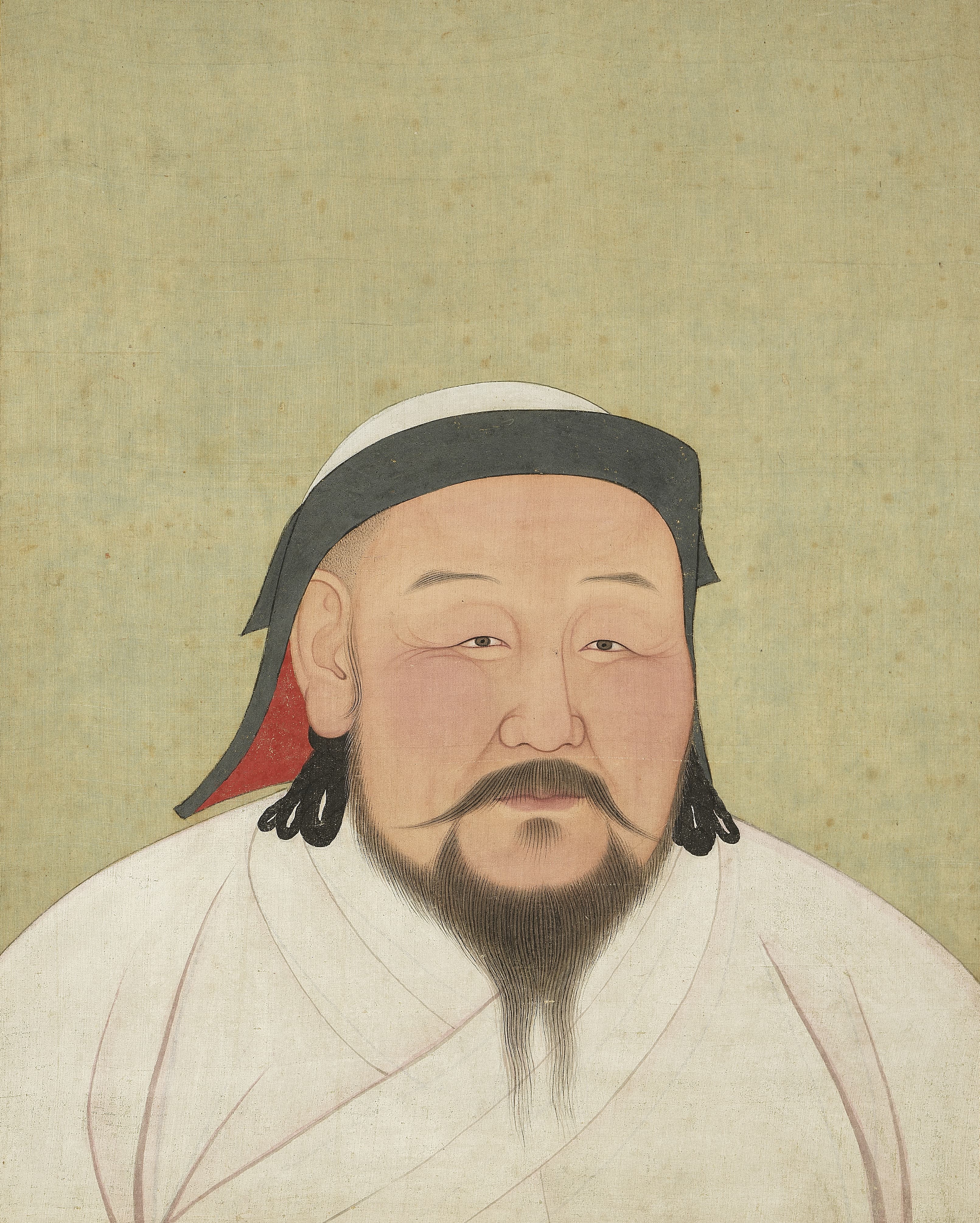
When Genghis Khan smeared the fat of a rabbit and an antelope onto the middle finger of his nine-year-old grandson, he reportedly warned his followers to heed the boy’s wisdom.
In the late autumn of 1224, near the banks of the Ili River in central Asia, a nine-year-old boy named Kublai stood before his grandfather, Genghis Khan. The boy had just returned from his first hunt, carrying a rabbit and an antelope he had killed alongside his elder brother Möngke. Following a strict Mongol tradition, the aging conqueror smeared the fat of the slain animals onto Kublai’s middle finger. Looking at the child, Genghis Khan turned to his assembly and remarked, "The words of this boy Kublai are full of wisdom, heed them well—heed them all of you." Three years later, the founder of the largest contiguous empire in human history was dead, and the boy with the fat-smeared finger was left to navigate a world that was rapidly outgrowing the nomadic Steppe that had birthed it. Kublai would spend the rest of his seventy-eight years attempting a colossal, paradoxical synthesis: remaining a true Mongol Khagan, the supreme lord of the horse-archers, while transforming himself into a classical Son of Heaven, the legitimate, sedentary emperor of China.
This duality defined Kublai’s early career as a prince of the blood. Born in 1215 to Tolui, Genghis’s youngest son, and his politically astute chief wife Sorghaghtani Beki, Kublai was reared in an atmosphere where survival demanded both martial prowess and administrative cunning. In 1236, after the Mongol conquest of the Jin dynasty in northern China, the new Khagan, Ogedei, granted the Toluid family a massive appanage in Hebei. Kublai, young and inexperienced, initially left the governance of his ten thousand households to local officials. The result was a disaster of classic proportions: rapacious tax collectors and corrupt administrators squeezed the peasantry until ethnic Han farmers fled their fields in droves, causing tax revenues to plummet. Realizing his error, and guided by his mother, Kublai intervened directly. He revised the tax laws, curbed the excesses of his officials, and successfully lured the displaced population back to their land. It was a formative lesson. While his cousins looked westward toward the rich plunder of Europe and the Middle East, Kublai turned his gaze southward, recognizing that the true wealth of the world lay in the disciplined, tax-paying peasantry of the Chinese agricultural heartland.
This intellectual gravitation toward Chinese statecraft was not accidental. Kublai deliberately surrounded himself with a brain trust of Chinese scholars, monks, and administrators. In 1242, he invited Haiyun, the leading Buddhist monk in northern China, to his nomadic court at Karakorum to discuss philosophy. Through Haiyun, Kublai met Liu Bingzhong—a brilliant polymath who was simultaneously a Buddhist monk, a Taoist philosopher, a poet, a painter, and a mathematician. Liu became Kublai’s chief advisor, introducing him to Zhao Bi and a host of other Confucian-trained scholars. Under their influence, Kublai came to understand that while an empire could be conquered on horseback, it could not be governed from it. When his elder brother Möngke ascended the imperial throne as Khagan in 1251, Kublai was appointed viceroy of northern China. He immediately put these theories into practice, boosting agricultural production in Henan and increasing social welfare spending in Xi'an. These actions earned him the deep loyalty of local Han warlords, but they also aroused intense jealousy in Karakorum. Accused by rival court factions of building a rival state within the empire, Kublai was subjected to a humiliating audit by Möngke’s tax inspectors. Rather than rebel, Kublai chose submission; he traveled to his brother’s court with his wives and made a personal, emotional appeal. Möngke publicly forgave him, restoring the fragile unity of the Toluid house.
+ 12 further connections to entries not yet ingested
The limits of this unity were shattered by Möngke’s sudden death in 1259 during a campaign in Sichuan. At the time, Kublai was besieging the Song dynasty stronghold of Wuchang along the Yangtze River. Learning of his brother's demise, and warned by his wife Chabi that his younger brother Ariq Böke was already mobilizing troops in the north, Kublai hastily concluded a secret truce with the Song minister Jia Sidao and raced back to his power base in Inner Mongolia. In the spring of 1260, Kublai summoned his own kurultai—the Mongol great council—and was proclaimed Great Khan. It was a highly irregular election, boycotted by many of the senior Borjigin princes. Simultaneously, Ariq Böke was elected Khagan at the traditional capital of Karakorum, backed by the late Möngke’s family and the western branches of the empire. The resulting Toluid Civil War lasted four brutal years, laying waste to Karakorum and fracturing the Mongol Empire forever. Though Kublai ultimately triumphed in 1264 when a starving Ariq Böke surrendered to him at Xanadu, the victory was hollow. The golden chain of Genghis Khan's lineage had snapped; though Kublai retained nominal suzerainty over the Ilkhanate in Persia and the Golden Horde on the Volga, his actual authority was now permanently restricted to the East.
In the wake of this civil war, Kublai set about anchoring his legitimacy in the soil of his grandest conquest. He abandoned Karakorum and, in 1264, founded a new capital on a vast rectangular plot northeast of the old city of Yenking. Officially named T’ai-tu ("Great Court"), but known to the West as Cambaluc or Kaan-baligh ("City of the Khan"), this grand metropolis was completed in 1267. Today, its ancient outline forms the northern heart of modern Beijing. Having built a Chinese-style capital, Kublai formally claimed the Mandate of Heaven. In 1271, he proclaimed the establishment of the Yuan Dynasty, positioning himself as the rightful successor to the Tang and Song.
Yet the Song dynasty still ruled the wealthy, highly developed regions south of the Yangtze from their magnificent capital at Hangzhou. The war to subdue them was a grueling, fifty-year endeavor that had languished under previous Khagans, but Kublai pursued it with relentless focus. The critical obstacle was the twin besieged cities of Xiangyang and Fancheng, which guarded the approaches to the Yangtze basin. For nearly five years, the cities held out, until Kublai’s forces used massive counterweight trebuchets designed by Muslim engineers from Persia. Once the barrier fell, Kublai’s brilliant general, Bayan, swept south. Hangzhou surrendered in 1276, and the young Song emperor was taken captive to T’ai-tu. Diehard Song loyalists fled further south, carrying two young princes with them to continue the resistance. The struggle finally ended in 1279, when, cornered at the naval Battle of Yamen off the coast of Guangdong, a faithful minister clasped the last young Song prince in his arms and leaped into the sea.
For the first time in history, a non-Han ruler controlled the entirety of China proper. At its height, Kublai’s empire was a dizzying, cosmopolitan tapestry. His court was a magnet for global adventurers: merchants from Venice like Marco Polo, physicians from Byzantium, astronomers from Persia, and administrators from Central Asia. He introduced an extraordinary paper currency, maintained an extensive postal relay system, and patronized the sciences, ordering the construction of magnificent astronomical instruments that stood in Peking for centuries. To govern this sprawling realm, Kublai balanced competing interests with cold pragmatism. Though he admired Chinese culture, a rebellion by the Han governor Li Tan early in his reign had left him deeply suspicious of the ethnic Han elite. He banned Han warlords from holding hereditary titles and barred Chinese officials from the highest echelons of the central administration, preferring to employ Semu—"colored-eye" foreigners from Central Asia and Europe—who owed their status entirely to him.
This pragmatism extended to religion. While his cousins in the west converted to Islam, Kublai looked to Tibetan Buddhism as a unifying force for his empire. He patronized the Sakya school of Tibet, appointing the young, brilliant monk Drogön Chögyal Phagpa as the head of the imperial Buddhist church. Phagpa even devised a new Nagari-based alphabet for the Mongol language, intended to unify the tongues of his diverse subjects, though it never achieved widespread use. Yet Kublai’s patronage of Buddhism was also political; in 1258, he had presided over a massive debate between Buddhist and Taoist scholars, ultimately ruling in favor of the Buddhists and ordering the forced conversion of hundreds of Taoist temples.
The final decades of Kublai’s reign were darkened by the classic hubris of the aging conqueror. Obsessed with expanding his borders to demand the submission of foreign states, he launched a series of disastrous overseas campaigns. His invasions of Japan in 1274 and 1281 were shattered by defensive walls and fortuitous storms—the legendary kamikaze—which destroyed his massive armada and cost tens of thousands of lives. Expeditions into the dense jungles of Vietnam and Java yielded little but high casualties and crippling financial costs. To fund these fruitless enterprises and his own love of imperial splendor, Kublai turned to ruthless financial ministers like Ahmed of Fenaket, whose oppressive taxation sparked deep domestic resentment and eventual rebellion.
When Kublai Khan died in 1294 at the age of seventy-eight, he left behind an empire of unprecedented scale but profound internal tension. He had successfully bridged the gulf between the steppe and the sown, but the bridge was fragile. He was the last of the Mongol rulers to possess the raw, terrifying vitality of the Eurasian grasslands, yet he had wrapped that vitality in the heavy silk robes of Confucian majesty. In the centuries that followed, his successors would lose both the nomadic martial spirit of their ancestors and the political goodwill of their Chinese subjects, leading to the collapse of the Yuan dynasty less than a century after his death. Kublai’s legacy remained etched not in the longevity of his house, but in the physical and conceptual map of China itself, which he had unified, expanded, and anchored at the great northern capital he built from the dust.