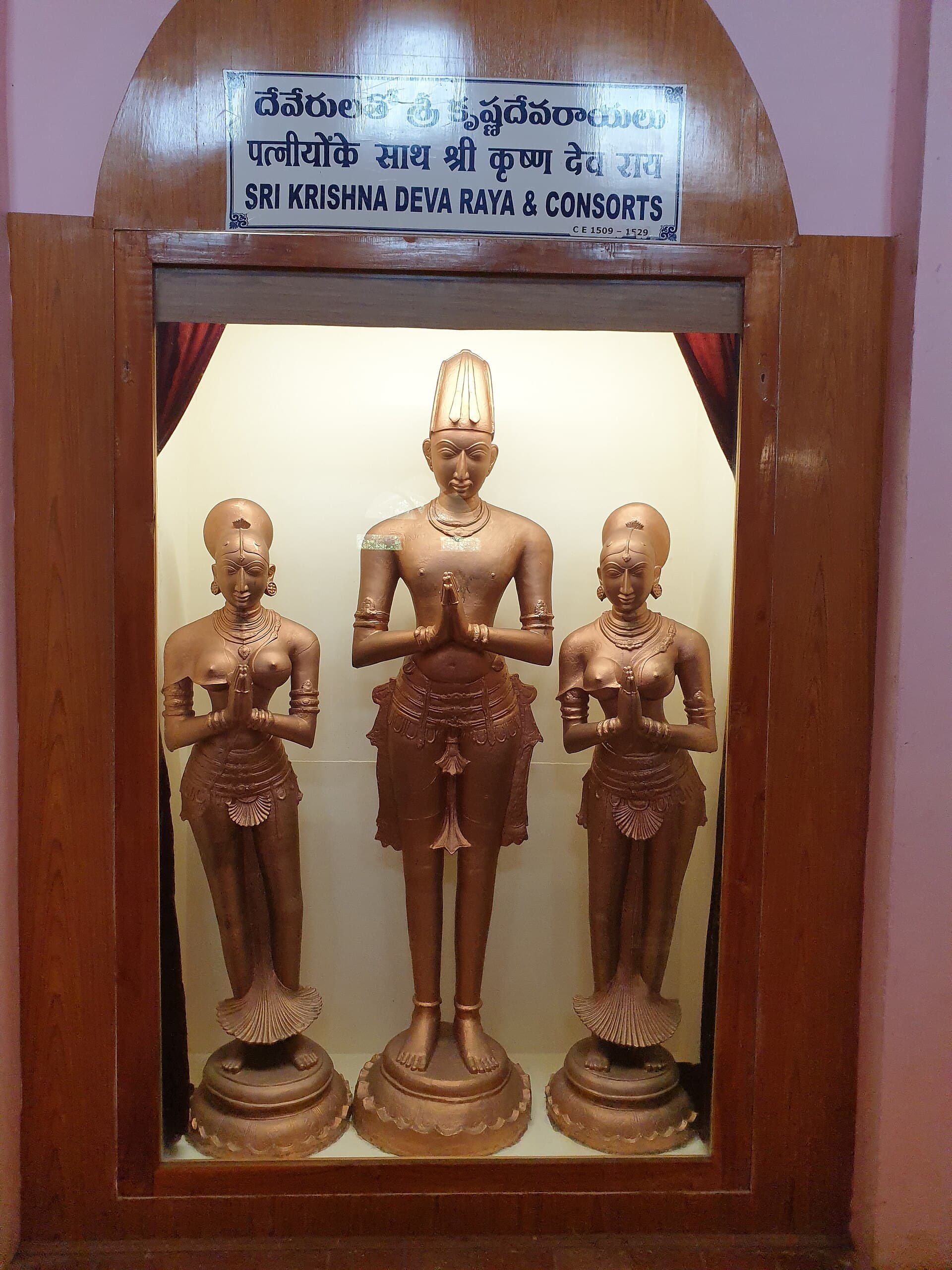
When the Mughal emperor Babur surveyed the shifting political landscape of sixteenth-century India, he identified one man as the most powerful ruler on the subcontinent: Krishnadevaraya, the sovereign of the Vijayanagara Empire.
In the early sixteenth century, the Portuguese traveler Domingo Paes rode into the city of Vijayanagara and found himself in the presence of a monarch who seemed to embody the sheer, kinetic energy of his age. The king was of medium height, fair-complexioned, and of a very good figure, rather fat than thin, with the marks of smallpox on his face. He was a man who began his days not with the quiet contemplations of statecraft, but by drinking a cup of sesame oil, sweeping a heavy weight across his palace courtyard, and wrestling with one of his captains until the sweat ran, before throwing himself into a river to bathe. This was Krishnadevaraya, the third ruler of the Tuluva dynasty, who ascended the "Jewelled Throne of Karnataka" in 1509. Following the decline of the Delhi Sultanate, he presided over the largest and most powerful empire in India during his time. To those who watched him govern, he was a paradox of the era: a brutal, brilliant military commander who personally led his campaigns and tended to his wounded soldiers, and a polyglot poet-king who ruled with a constant, self-conscious eye toward the preservation of cosmic and social order.
His rise to power was a triumph of survival. Krishnadevaraya was the son of Tuluva Narasa Nayaka—an army commander who had seized control of the state to prevent its disintegration—and his queen Nagamamba. He inherited a realm hemmed in by persistent, existential threats: the Bahmani Sultanate, the aggressively fracturing Deccan Sultanates, the Gajapatis of Odisha to the northeast, and the newly arrived Portuguese, a maritime force that had established control over the essential sea trades of the western coast. To secure the throne after the death of his half-brother Viranarasimha, Krishnadevaraya relied heavily on the counsel of his prime minister, Timmarusu, a brilliant elder statesman whom the king credited as the architect of his ascension. Together, they transformed Vijayanagara from a defensive state into an expansionist empire, systematically breaking the power of the neighboring Muslim sultanates that had long plundered the southern plains. Under his command, the raid and plunder of Vijayanagara towns and villages by the Deccan sultans came to an end.
The military campaigns of Krishnadevaraya were defined by a mixture of massive, crushing scale and sudden, tactical improvisations. In 1509, his armies clashed with the Deccan sultans, severely injuring Sultan Mahmud and killing Yusuf Adil Shah. In a calculated move of realpolitik, the king annexed the valuable Raichur Doab, reunited the regions of Bidar, Gulbarga, and Bijapur, and then released the captive Sultan Mahmud, establishing him as a de facto ruler and earning himself the ironic title "establisher of the Yavana [foreign] kingdom." His campaigns, however, were not without reversals. In 1513, when he personally engaged the forces of Sultan Quli Qutb Shah of Golconda at Pangal, the Vijayanagar army suffered defeat, forcing the king to retreat and surrender the Pangal fort. Yet, more often than not, the king was known to abruptly change battle plans in the heat of conflict, turning seemingly lost battles into decisive victories.
+ 8 further connections to entries not yet ingested
The war with the Gajapati Kingdom of Odisha, which ruled a vast swath of land spanning Bengal, Andhra, and Odisha, became a masterclass in siege warfare and espionage. Seeking to reclaim coastal Andhra, Krishnadevaraya laid a grueling, year-long siege to the Udayagiri fort in 1512, eventually starving the garrison into submission. He followed this with a march to the fort of Kondaveedu. When the Vijayanagara army began to retreat after months of heavy casualties, it was the prime minister, Timmarusu, who discovered a secret entrance to the unguarded eastern gate. A daring night attack delivered the fort into the empire’s hands and resulted in the capture of Prince Virabhadra, the son of the Gajapati king Prataparudra Deva. When the king planned his final invasion of Kalinga, Prataparudra attempted to set a trap at Kalinganagar. Timmarusu, however, discovered the plan by bribing a Telugu deserter. Driven back to his capital at Cuttack, the Gajapati king was forced to surrender, offering his daughter, Princess Jaganmohini, in marriage to the emperor. In a gesture of diplomatic magnanimity that stabilized his northeastern frontier, Krishnadevaraya returned all captured lands north of the Krishna River, establishing the river as their permanent boundary.
The climax of Krishnadevaraya’s military career occurred on May 19, 1520, at the Battle of Raichur. To wrest the strategic Raichur Fort from Ismail Adil Shah of Bijapur, the king mobilized an army of staggering proportions, reportedly field-testing 700,000 foot soldiers, 32,600 cavalry, and 550 elephants. He was aided by a Portuguese contingent led by Cristovão de Figueiredo, whose use of firearms helped breach the fortress walls. The victory was total but costly, claiming the lives of 16,000 Vijayanagara soldiers. In the aftermath, the king’s demeanor hardened. He treated the defeated Bahmani generals with immense brutality, stripping them of their lands. When neighboring Muslim monarchs sent envoys seeking terms, they received a haughty reply: the emperor declared that if the Adil Shah would come to him, do obeisance, and kiss his foot, his lands would be restored. The submission never came. In response, Krishnadevaraya marched north, occupied Bijapur, and eventually razed Gulbarga, the historic, early capital of the Bahmani Sultanate, to the ground.
Yet, this destroyer of cities was also a meticulous builder of domestic prosperity. He was of the opinion that a king should always rule with an eye toward Dharma, and his domestic policies reflected a deep concern for the economic welfare of his subjects. He abolished obnoxious taxes, such as the marriage fee, and traveled extensively on annual tours of his empire to personally hear grievances and punish corrupt officials. Recognizing that the strength of his state lay in agricultural yields, he ordered the deforestation of wild areas to bring new land under cultivation and undertook massive irrigation projects around the capital. To achieve this, he utilized Portuguese engineering expertise to construct sophisticated water supply systems, while securing a steady supply of Arabian horses and firearms from Portuguese merchants in Goa. In his political-poetic treatise, the Amuktamalyada, he articulated his economic philosophy clearly: "The extent of the kingdom is the means for the acquisition of wealth. Therefore even if the land is limited in extent, excavate tanks and canals and increase the prosperity of the poor... so that you may obtain wealth as well as religious merit."
This administrative vision was matched by an extraordinary cultural flowering. Though the official language of the Vijayanagara court was Kannada, Krishnadevaraya was linguistically neutral, ruling a highly multilingual empire by patronizing literature and issuing royal inscriptions in Kannada, Sanskrit, Telugu, and Tamil. He was himself a polyglot of exceptional talent, composing works in Sanskrit, such as the Jambavati Kalyana and Madalasa Charita, and writing the Amuktamalyada in Telugu. Under his reign, Telugu literature entered its golden "Prabandha Period." His court, known as the Bhuvana Vijayam ("Conquest of the World"), was famously anchored by the Ashtadiggajas—eight legendary Telugu poets who were conceptualized as the eight pillars holding up the literary world. Among them were Allasani Peddana and Mukku Timmana, the latter of whom famously lauded the king in verse as a "Man-Lion" who destroyed his northern enemies through the mere power of his name. In this vibrant intellectual atmosphere, the king was advised not only by the grave Timmarusu but also by the legendary, witty poet-advisor Tenali Ramakrishna.
The final years of the great emperor, however, were darkened by tragedy and suspicion. In 1524, hoping to secure his legacy, Krishnadevaraya appointed his young son, Tirumala Raya, as Yuvaraja (crown prince). The boy did not survive long, dying of poison shortly after his elevation. Overcome with grief and paranoia, the king suspected his loyal, lifelong minister Timmarusu of the crime and ordered him blinded. Even as his domestic court fractured, the aging king began preparations for a military strike on Belgaum, then held by the Adil Shah. But the campaign was never realized. Krishnadevaraya fell ill and died on October 17, 1529, leaving the empire to his brother, Achyuta Deva Raya.
When the Mughal emperor Babur, sitting in the north, surveyed the political landscape of India in his memoirs, he recorded Krishnadevaraya as the most powerful sovereign in the subcontinent, ruling its most extensive empire. Beyond the conquests, the treaties, and the ruins of the sultanates he leveled, Krishnadevaraya left behind a blueprint for how a medieval Indian state could integrate diverse languages, global trade, and artistic achievement under a single, cohesive political vision. His legacy survived not merely in the stone monuments of Vijayanagara, but in the literary traditions of southern India, where his reign is still remembered as a moment when power and poetry were briefly, brilliantly aligned.