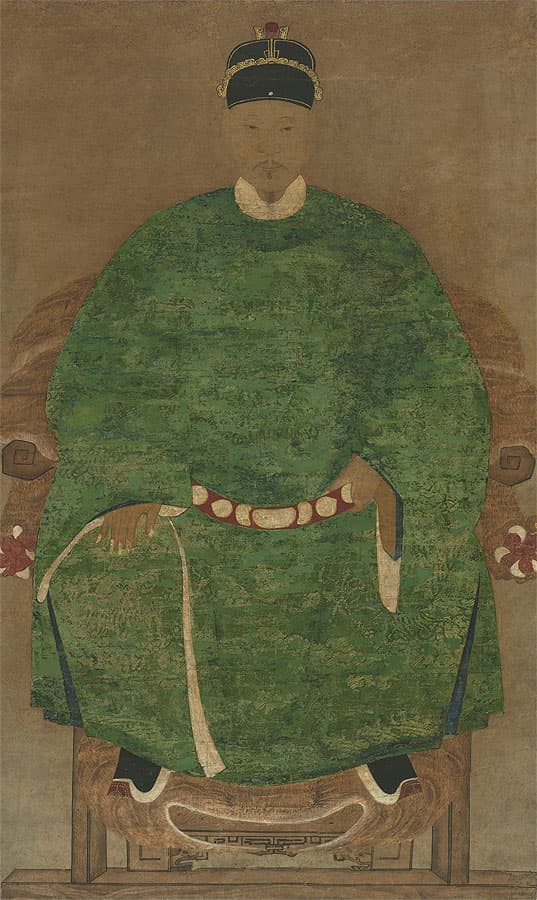
Born on the coast of Japan to a Chinese merchant father and a Japanese mother, the boy first named Fukumatsu would spend his short, tempestuous life navigating the violent collapse of one empire and the birth of a maritime kingdom.
In the late summer of 1659, a fleet of thousands of Chinese warships choked the waters of the Yangtze River, their masts bristling like a floating forest against the ancient walls of Nanjing. At the helm of this armada was a man who went by the name of Zhu Chenggong, though the Dutch called him Koxinga—a European corruption of Guoxingye, meaning "Lord of the Imperial Surname." He was thirty-five years old, a scholar-turned-pirate-king who carried the fading hopes of the Ming dynasty on the decks of his war-junks. For three weeks, his iron-clad troops lay siege to the southern capital, terrorizing the newly established Qing dynasty to such a degree that officials in distant Beijing burned letters, packed their archives, and contemplated retreating back to the remote forests of Manchuria. The invaders, rumored to be invincible, had brought the Manchu empire to the precipice of ruin. Yet, in a display of classical hubris, Koxinga had announced the date of his final assault well in advance, desiring a singular, grand, decisive showdown in the manner of his father’s historic naval victories. It was a fatal delay. The Qing garrison fortified their positions, launched devastating cavalry counterattacks, and broke the siege, sending Koxinga’s forces retreating back to their ships. This failure on the banks of the Yangtze did not merely save the Qing; it redirected the course of maritime East Asia, forcing the desperate warlord to turn his gaze away from the mainland toward a rugged, forested island across the strait: Taiwan.
To understand the contradictions of the man who nearly broke the Qing, one must look to the shores of Hirado, Japan, where he was born in 1624 as Fukumatsu. His father, Zheng Zhilong, was a legendary Han Chinese merchant, privateer, and maritime lord who commanded the shipping lanes of the Taiwan Strait; his mother was Tagawa, a Japanese woman of samurai-era lineage. Raised in Japan until the age of seven, the boy was eventually brought to his father’s ancestral home in Fujian province, where he was groomed for the life of a traditional Chinese gentleman. He excelled in the imperial examinations, became a scholar at the prestigious Guozijian in Nanjing, and studied under Qian Qianyi, one of the great literary minds of the era. But the quiet world of libraries and inkstones collapsed in 1644 when Beijing fell to rebel forces and the Manchu armies swept south of the Great Wall to establish the Qing dynasty.
In the chaotic aftermath, the fugitive Ming court reconstituted itself in the south. The Longwu Emperor, seeking the protection of the wealthy and powerful Zheng family, established his court in Fuzhou in 1645. There, the emperor took a deep liking to the young scholar-soldier, granting him the imperial surname of the ruling house of Zhu and renaming him Chenggong, or "Success." From that moment on, Koxinga discarded his original family name, proudly styling himself a member of the imperial house for the rest of his life. Yet his family’s loyalty was far from absolute. When the Qing armies approached the mountain passes of Fujian in 1646, Koxinga’s father, Zheng Zhilong, chose self-preservation over dynastic loyalty. He ordered his generals to retreat, leaving the Longwu Emperor defenseless. The emperor was captured and executed, and Zhilong surrendered to the Qing in Fuzhou, lured by promises of governorship. Koxinga pleaded with his father against this betrayal, but to no avail. Stripped of his father's backing, Koxinga retreated to the coastal stronghold of Xiamen, declaring his undying allegiance to the last surviving Ming claimant, the Yongli Emperor. The tragedy deepened the following year when Qing forces sacked the Zheng family estate at Anping. Koxinga's mother, Lady Tagawa, who had journeyed from Japan to join her family, refused to surrender to the Manchu soldiers and committed suicide, a loss that hardened Koxinga's resolve into an unyielding, decades-long crusade.
+ 12 further connections to entries not yet ingested
For the next decade, Koxinga operated as a sovereign maritime prince, financing his vast armies through the lucrative merchant networks his father had built. From his island bases of Xiamen and Kinmen, he launched relentless amphibious raids against the Manchu-occupied coast of Fujian. He was a master of naval warfare; when the Qing general Prince Jidu launched a massive fleet to crush him in 1656, Koxinga’s sailors, aided by a timely maritime storm, annihilated the Manchu ships. Yet, despite his naval supremacy, Koxinga lacked the terrestrial strength to hold mainland territories permanently. The disastrous defeat at Nanjing in 1659 made it painfully clear that he could not reclaim the empire from the coast alone. Moreover, his maritime supply lines were under constant threat from the Dutch East India Company, which operated a powerful colonial trading state on the island of Taiwan, then known as Formosa. To survive, Koxinga needed a secure, defensible kingdom of his own.
In the spring of 1661, Koxinga made his historic gamble. Leading an armada of hundreds of ships and thousands of battle-hardened troops, he crossed the strait and landed at Lakjemuyse, catching the Dutch colonists completely off guard. "Hitherto this island had always belonged to China," Koxinga informed the Dutch authorities, "and the Dutch had doubtless been permitted to live there, seeing that the Chinese did not require it for themselves; but requiring it now, it was only fair that Dutch strangers, who came from far regions, should give way to the masters of the island." The siege of Fort Zeelandia, the formidable Dutch stronghold, lasted for nine grueling months. It was a conflict defined not just by European artillery and Chinese numbers, but by the shifting loyalties of the indigenous Taiwanese Aboriginal tribes. Having previously allied with the Dutch to suppress a Chinese peasant rebellion a decade earlier, the Aboriginal groups now turned on their European rulers. Offered amnesty by Koxinga, the Sincan Aboriginals defected to the Chinese, hunting down Dutch soldiers. Mountain and plains clans surrendered their Dutch Protestant schoolbooks and celebrated their liberation from foreign rule and compulsory education by hunting down colonial administrators.
On February 1, 1662, the Dutch Governor of Formosa, Frederick Coyett, signed the capitulation of Fort Zeelandia, ending thirty-eight years of Dutch colonial rule on the island. In the peace treaty, Koxinga signed his name with the grand title of Great Ming Commander in Chief of the Punitive Expedition. Coyett would later write in his memoirs that Koxinga’s life was saved during the final transition of power by a Dutch defector named Hans Jurgen Radis, who warned him not to inspect the fort’s ramparts because the retreating Dutch had rigged them to explode—though Chinese imperial records remain entirely silent on the existence of any such defector.
With Taiwan secured, Koxinga immediately set about transforming the island into the Kingdom of Tungning, a militarized state dedicated to the restoration of the Ming dynasty. He began distributing oxen and iron farming tools to the indigenous populations, teaching them Chinese agricultural techniques, gifting them tobacco, and presenting their chiefs with formal Ming gowns and caps to bind them to his new state. Yet his grand ambitions were cut short by the sheer exhaustion of his lifelong war. In late 1662, furious over the Fourth Sangley Massacre—the mass killing of Chinese settlers by Spanish colonists in the Philippines—Koxinga dispatched an Italian friar named Vittorio Riccio to Manila to demand tribute and threaten the Spanish colonial government with invasion. The Spanish garrison braced for war, but the invasion never came. On June 23, 1662, before his fleet could set sail for Luzon, Koxinga died suddenly at the age of thirty-seven, his body worn out by the burdens of a collapsing empire.
Koxinga’s legacy would outlive his short, tempestuous life, becoming a mirror in which subsequent generations of East Asians saw their own aspirations. To the Qing dynasty, which finally conquered Taiwan in 1683, he was eventually rehabilitated as a model of loyalty and Confucian devotion. In Japan, he was celebrated in popular culture as a hero of mixed heritage, bridging the Japanese and Chinese worlds. In the twentieth century, both Chinese nationalists and modern states would claim him as a founding father—either as a patriotic defender of the Chinese motherland against Western imperialism, or as the pioneer who established Taiwan as an autonomous, self-governing entity separate from the mainland. By wresting Taiwan from the Dutch East India Company, Koxinga did more than carve out a personal fiefdom; he permanently anchored the island of Taiwan within the cultural and political orbit of the Chinese world, transforming it from a neglected frontier into one of the most geopolitically significant islands on earth.