Organization · Bantu Expansion
Kongo people
- Also known as
- Bacongo
- Bacongo
- Bacongos
- Bakongai
- Bakongo
- Bakongo
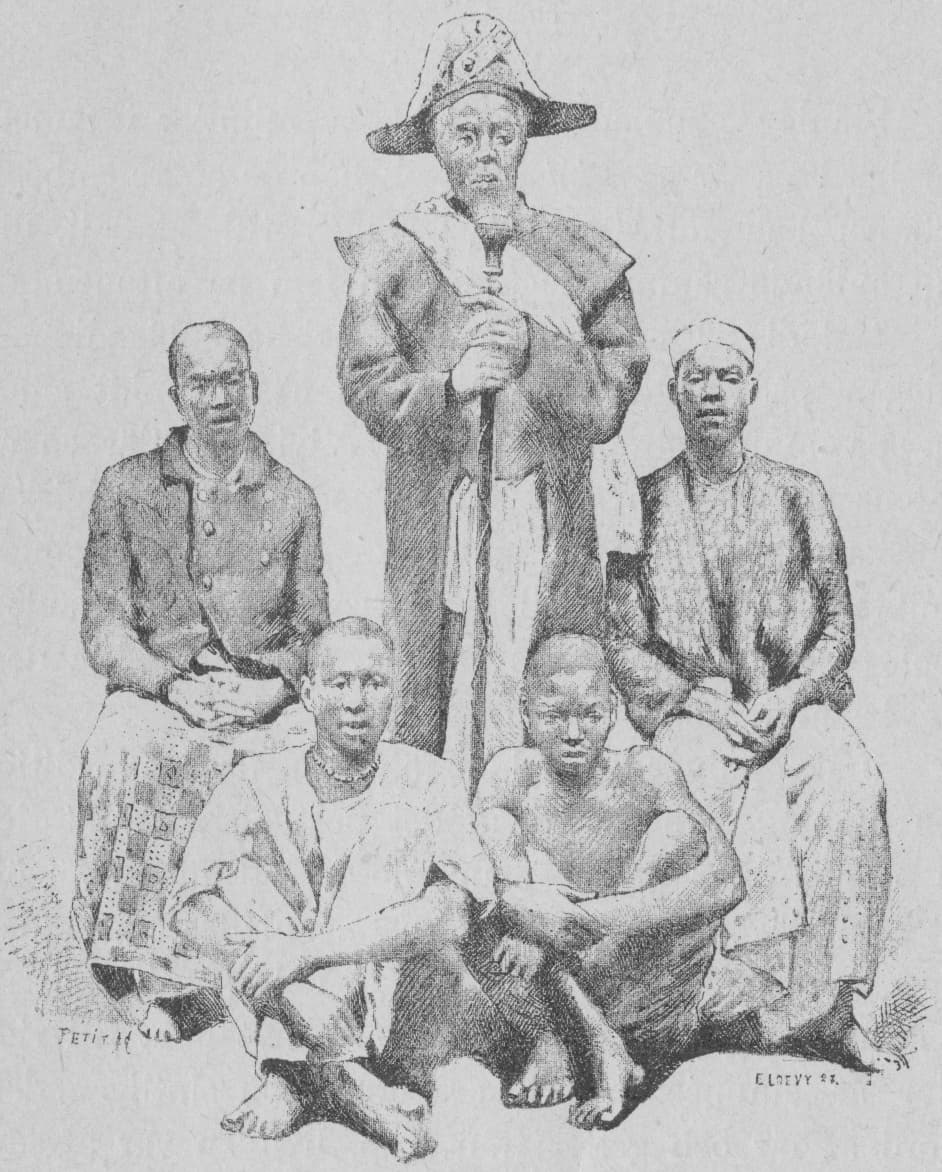
Long before European sails appeared on the Atlantic horizon, the Kongo people moved through a succession of political worlds, from the early medieval Kingdom of Vungu to a network of coastal realms including Loango, Kakongo, and the great Kingdom of Kongo.
In the early decades of the sixteenth century, a series of urgent letters traveled across the Atlantic from the highland capital of Mbanza Kongo to the royal court in Lisbon. They were written in elegant Portuguese by Nzinga Mbemba—known to history by his baptismal name, King Afonso I—and addressed to his "brother," King Manuel I. Afonso’s kingdom, a highly organized Central African state of Kikongo-speaking peoples, had recently embraced Catholicism and European trade with a rare, idealistic enthusiasm. But the partnership had rapidly soured. Portuguese merchants, initially content with ivory and copper, had discovered a far more lucrative commodity to fuel their sugarcane plantations on the nearby island of São Tomé: human beings. They were no longer merely buying captives from the kingdom’s margins; they were kidnapping members of the Kongo nobility, inciting border wars, and depopulating entire districts. Afonso’s letters were a desperate appeal to Christian brotherhood, warning that the insatiable demand for labor was tearing his realm apart. His pleas went unheeded. The tragic irony of the Kongo people’s history was already set in motion: they were among the first Africans to welcome Europe as equals, only to become the first major victims—and eventually, reluctant instruments—of the transatlantic slave trade.
To understand the tragedy of the Kongo is to understand a society that was remarkably sophisticated long before European sails appeared on the Atlantic horizon. Settled in the fertile valleys and coastal plains of Central Africa well before the fifth century CE, the ancestors of the Kongo developed advanced agricultural techniques and complex social structures. Glottochronological evidence suggests that the Kikongo language had split from neighboring Gabon-Congo dialects around 950 BCE, establishing a distinct linguistic identity that would eventually bind together diverse subgroups like the Yombe, Vili, Beembe, and Lari. By the thirteenth century, small principalities began coalescing along the Congo River, eventually merging into a powerful federation. When Portuguese explorer Diogo Cão first anchored south of the river’s mouth in 1483, he did not find a fragmented tribal frontier, but a centralized state. The Kingdom of Kongo possessed a professional bureaucracy, a standardized currency of seashells called nzimbu, a vast network of inland trade routes, and a cosmopolitan capital, Mbanza Kongo, situated two hundred kilometers inland.
The initial encounter between the two worlds was defined by an astonishingly rapid cultural exchange. Unlike the conquest of the Americas, the early relationship between Portugal and Kongo was one of diplomatic parity. The Kongo nobility, open to new ideas and technological imports, embraced Christianity not under the threat of the sword, but as a strategic and spiritual alignment. In 1491, King Nzinga a Nkuwu was baptized as João I. His successor, Afonso I, established schools, sent young Kongolese aristocrats to study in Lisbon, and envisioned a modern, literate Christian state. Yet this conversion also fulfilled a dark prophecy. Decades earlier, around the 1450s, a local prophet named Ne Buela Muanda had foretold the arrival of white strangers who would bring about both the spiritual and physical enslavement of the Bakongo. To warn future generations of this encroaching doom, the people composed songs of warning. Among them was Malele—meaning "Tragedy"—a haunting lament that would survive for centuries, preserved in the oral traditions of the diaspora as far away as Guadeloupe.
The prophetic tragedy manifested as the demand for labor in the Americas spiked. By the 1560s, Portuguese traders were exporting upwards of seven thousand enslaved people a year from the region. To feed this engine, the Portuguese bypassed the Kongo crown, establishing clandestine trading posts at Malebo Pool and offering luxury European goods directly to provincial elites and rival traders. This shattered the delicate internal balance of the kingdom. Power in Kongo was not based on hereditary succession but on election by a council of nobles—a system that required the king to constantly build consensus and distribute wealth. As local chiefs acquired European firearms and prestige goods through illicit slave trading, the central authority of the king withered.
The social fabric tore completely in 1568 when the Jaga—a fierce warrior group from the east—invaded the kingdom, sacking Mbanza Kongo and burning its stone churches. To survive, the Kongo king was forced to beg for Portuguese military intervention. The Portuguese restored the monarch, but the price of their protection was absolute. The kingdom was forced to cede the strategic coastal port of Luanda in 1575, which rapidly became a major hub for the slave trade. In the economic devastation that followed the war, impoverished Kongolese families began selling their own kin to settle debts, mirroring the ancient debt-slavery of Rome. The Kongo people were trapped in a vicious, self-perpetuating cycle: to defend themselves from slave-raiding neighbors, they had to acquire European firearms, which could only be purchased with more captives. Over the next three centuries, they were forced into the dual roles of victims and victimizers, participating in the very trade that was systematically draining their homeland of its youth and vitality.
This centuries-long hemorrhage did not merely devastate the African interior; it permanently reshaped the cultural landscape of the Americas. Millions of Kikongo-speaking captives were carried across the Atlantic, their shared language and spiritual practices becoming a bedrock of African-diasporic cultures in Brazil, Cuba, and the Caribbean. In these new lands, European colonizers often used the term Bafiote or simply "Congo" to refer to any enslaved person from West-Central Africa. Back in Africa, the remnants of the old kingdom were finally dismantled during the nineteenth-century Scramble for Africa, which carved the ancient Kongo lands into three separate European colonies: Portuguese Angola, the Belgian Congo, and the French Congo. Yet the shared identity of the Bakongo people, anchored in their resilient language, survived the artificial borders drawn in Berlin. In the mid-twentieth century, they became one of the most politically active ethnic groups on the continent, leading the intellectual and military struggles that eventually liberated Angola, the Republic of the Congo, and the Democratic Republic of the Congo from colonial rule. The kingdom of Afonso I had long since vanished, but the endurance of the Kongo people remained—a testament to a civilization that survived both the crucible of the transatlantic slave trade and the partition of their world.
Connected to
- is a kind ofBantu people
+ 11 further connections to entries not yet ingested